Key takeaways
- Adaptive AI voice agents decide their next move mid-call, working from what they just heard.
- Response speed is what gives automation away first. Callers read a long gap as a dead line and start talking over the agent to check that someone is there.
- Guardrails keep the conversation inside your business policies while the agent still decides how to move through it.
- Improvement across calls is not automatic. Phonely stores every call so someone on your team can read the failures and adjust the agent's instructions or knowledge base.
- An agent answers policy questions from what your team has written down, so gaps in your own documentation surface on live calls.
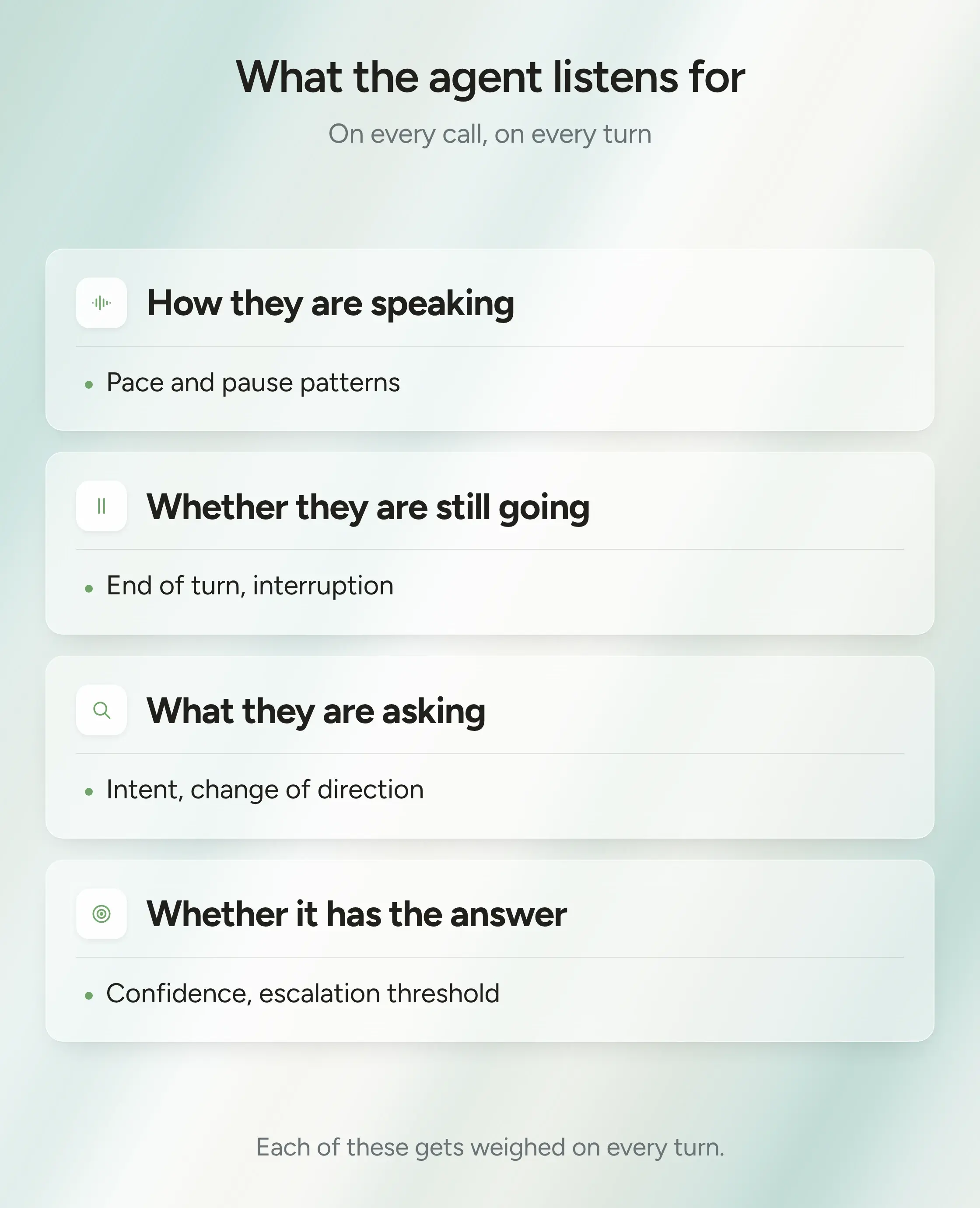
An adaptive AI voice agent answers phone calls and changes how it handles the conversation while the call is live. Its timing, its wording, and its choice of what to ask next all follow from what the caller says and how they say it.
The Bureau of Labor Statistics projects employment of customer service representatives will decline 5 percent from 2024 to 2034, with less demand expected as those tasks continue to be automated. What absorbs that work has to handle calls that do not follow a script.
Some phone automation carries the same label while running a fixed decision tree behind a more natural voice. Because the tree is set before the call, a caller who interrupts, switches topic halfway through, or raises something the tree has no branch for will stall the call. Older touch-tone menus ask your callers to translate what they want into a numbered option, which adds transfers and hold time whenever the need does not match the list.
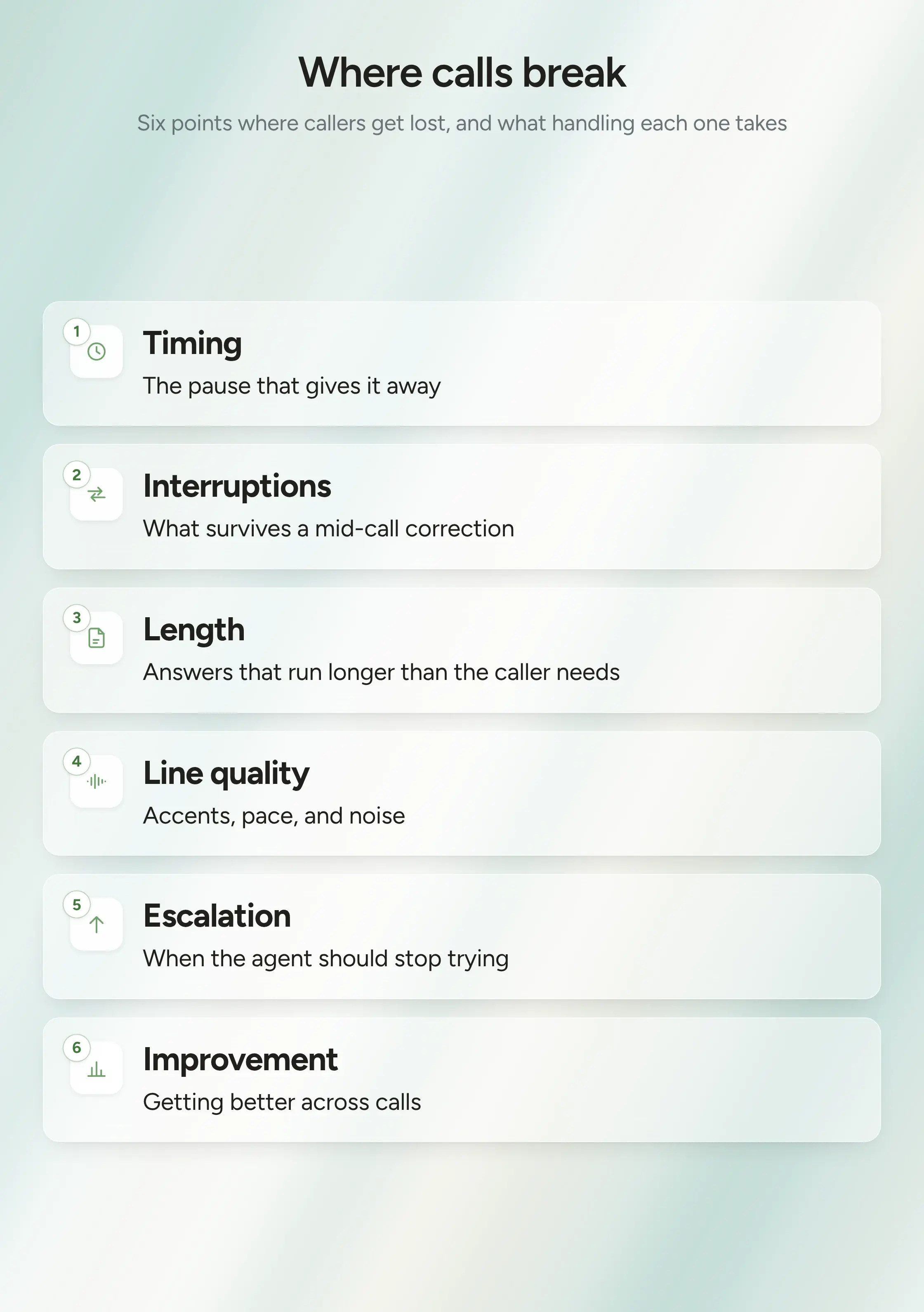
Where calls break and what adapting looks like
Phone calls break in predictable places. Each point below covers where callers get lost and what handling it well requires.
- Timing, turn-taking, and the pause that gives it away
Once a pause stretches past what a person would normally leave, the line begins to feel dropped, and the caller starts filling the silence to see if anyone is still on the other end.
Pauses inside a caller's speech do not always mark the end of a turn. Someone reading a member number off a card stops between digits. Because silence alone is a weak signal, the agent reads the partial transcript as it arrives and weighs whether the words so far add up to a complete request. Reading a number out with pauses between the digit groups is a quick way to check this on a demo line.
A gap can also open while the agent looks something up. Asked whether a Thursday appointment is still booked, the agent says "let me check that now" and confirms the time once the calendar comes back, so the caller knows the request landed while the query runs.
Callers cut off repeatedly tend to hang up, and an abandoned inbound call at a home services business becomes a job for whoever answers next.
- Interruptions, corrections, and context that survives them
Halfway through giving a street address, a caller can decide to move the appointment instead, and the address stops mattering.
Barge-in detection stops the agent the moment the caller speaks. Reading what the interruption meant is the harder problem. "Mm-hmm" while the agent confirms a booking means the caller is following along. A cough carries no meaning. Read every sound as a correction, and the agent stops and restarts constantly. When it misses one, your caller ends up confirming a booking that carries the wrong date, which becomes a second call.
The agent also decides which of the details it already collected still apply. The caller's name and matched account carry into the new request. The half-finished address gets dropped, because the agent keeps what serves the caller's current goal.
- Answers that run longer than the caller needs
Spoken answers cannot be skimmed or reread, so a reply that adds context the caller did not ask for buries the part they wanted. An agent answering a question about opening hours does not need to add holiday hours and parking. The agent makes that length decision on every turn.
Phonely's plans include a set allowance of call minutes, starting with 100 free minutes of phone answering each month, so an agent that pads simple answers raises your average handle time and pushes you through that allowance faster. How Much Should You Pay for a Voice AI Agent breaks down where the rest of the cost sits.
- Accented speech and noisy phone lines
Phone audio is harder to work with than the sound a laptop or smart speaker picks up. Telephony carries a narrower frequency range, so detail is lost before recognition begins. Add a caller on a job site or driving with the windows down, and the signal degrades further.
Accent coverage comes from the breadth of speech the recognition model was trained on, which makes it a question for your evaluation of the platform, since the agent does not adjust it mid-call.
A phone number captured wrong means the callback never lands, and the lead disappears without anyone knowing why. Calling a demo line from a car is a reasonable way to hear what recognition does with a degraded line before you commit.
- Escalation when confidence drops
An adaptive agent assesses whether it is resolving the request. Repeated rephrasing from the caller signals that it is not, and so does a question the agent has no data to answer.
The threshold shifts with what is at stake. A billing dispute is more costly to get wrong than a request for directions, so the agent allows itself fewer attempts before passing the call to a person.
Phonely can route calls to the right department or live agents, with the account and call context attached, so the person picking up starts with what the caller already told the agent. Etech Global Services reports lifting first-call resolution by 34% after adopting Phonely.
- Getting better from real call outcomes
The points above all play out on individual calls. Improving the agent across calls runs on a separate loop.
Phonely gives your team every conversation in one place, so a call that went wrong can be pulled up and traced to whatever caused it. A prompt gets rewritten, a routing rule changes, or a policy document gets updated, and the calls that follow show whether the fix worked.
Phonely runs a version of that loop on its own models. Four model iterations moved accuracy from 81.5% to 99.2%, past the 94.7% scored by the closed-source model it replaced.
Neither loop runs on its own. Any platform describing its agents as self-improving should be able to show you where the judgment happens.
What makes that possible on a live call
Real-time model switching and sub-second response
A single model handling every part of a call is a compromise. Interpreting a caller's intent and formatting a booking correctly are separate tasks, and specialized models handle each more accurately. Switching between them fast enough for live conversation is the constraint.
Groq built multi-LoRA support on its inference infrastructure with Maitai, letting a single instance hold dozens of fine-tuned models and hot-swap between them at inference with no added latency. On that architecture, Phonely reports cutting time to first token by 73.4% at the ninetieth percentile, with throughput holding from 10 to 30,000 requests per minute without a perceptible change in speed.
Pulling from your own data so answers stay specific
An agent working only from general knowledge will send your caller to the website for anything specific.
Phonely connects to the systems holding your records, including your calendar and CRM, so an appointment gets booked and the account updated while the caller is on the line.
A knowledge base carries whatever your team last put into it. An agent quoting a price that has since changed will be confidently wrong, so keeping that material current is an ongoing job.
When an adaptive agent is the wrong call
Some call types benefit from reaching a person first, which is a routing decision you make in advance. A caller reporting a serious incident often needs someone with the authority to act, and building that into your routing rules is faster than relying on the agent to catch it.
Uniform call volume is another reason to wait. If every caller asks one question with one answer, there is little for an agent to adjust to, and you are paying for flexibility you will not use.
Documentation is the constraint most teams underestimate. The agent draws its policy answers from the material you've given it, so any place your written rules disagree with each other becomes something a caller hears. If two people in your business would answer the same question differently, settle it internally before an agent settles it live on a call.
What to check before you buy
Most of this is testable on a demo call:
Compliance claims deserve the same treatment. Ask any vendor which of their certifications are third-party audited and which are self-attested, then ask to see the report.
Running an adaptive agent on Phonely
Keeping the agent inside your rules
An agent choosing its own next move raises an obvious concern about what stops it agreeing to something nobody authorized.
Phonely applies AI guardrails that keep every interaction on topic and aligned with your business policies, so the agent varies how it moves through a call within the boundaries of what you allow it to offer. Your data is used only for your own agent and never to train models, and the infrastructure goes through regular third-party penetration testing.
Quality at scale attracts the same doubt. TSA Group, which runs a contact center with 4,500 human agents, says it did not believe AI could match that standard and now has agents resolving calls better than its best people.
What setup actually involves
Standing up an agent does not need engineering time. Phonely's builder needs no code, and its public templates give you a working agent to start from.
The real work is what the agent draws on, meaning your hours, services, booking rules, and escalation criteria. How to Implement Voice AI Software: 5-Step Guide walks through that sequence.
Frequently asked questions
- How do you measure the return on a voice agent?
The calculation compares what your current call handling costs against what the platform costs, then credits the calls the agent resolves on its own and the calls you were previously missing. Cost per call and share of calls resolved without a handoff are the two numbers most worth watching in the first month.
- Can one agent handle several calls at once?
A team answering phones has a hard ceiling on simultaneous calls, and callers past that ceiling wait. Concurrent calls to a voice agent do not queue behind each other. Phonely says its voice AI handles thousands of simultaneous calls without queuing, so answer times hold steady when incoming volume spikes.
- Do you have to tell callers they are speaking with AI?
Requirements depend on where you operate and whether the call is inbound or outbound. In February 2024, the FCC confirmed that the TCPA's restrictions on artificial or prerecorded voice reach AI technologies generating human voices, which means outbound calls using them require the called party's prior express consent. Several states have since added their own AI disclosure rules, and a few now reach voice specifically. Confirm what applies to your business with counsel.