Key takeaways
- AI reduces wait times in customer service by answering every call instantly, handling unlimited concurrent conversations, resolving routine requests in real time, routing complex ones with full context, and providing 24/7 multilingual coverage. The result is removing hold queues, not just shortening them.
- The biggest wait-time reductions land in five workflows: inbound phone support, appointment scheduling, lead qualification, after-hours overflow, and omnichannel follow-up across SMS and chat.
- Five criteria separate production-grade voice AI: sub-second latency, unlimited concurrency, native CRM integrations, support for 100+ languages, and SOC 2/CCPA/HIPAA/PCI compliance.
- Deployment runs minutes for self-serve and days for enterprise. Wait time drops on call one, with Phonely customers reporting 72%+ cost reductions and zero hold time across 100,000+ daily calls.
Deloitte Digital's 2024 Global Contact Center Survey found that 3 in 4 contact center leaders say agents are overwhelmed by systems and information, leading to unnecessarily long call times. That overload is where wait time lives.
Gartner research shows 91% of customer service leaders are now under executive pressure to implement AI, and predicts agentic AI will autonomously resolve 80% of common customer service issues by 2029, cutting operational costs by 30%.
AI is the only response designed to scale with inbound volume. Here's how voice AI removes wait time from customer service, where the biggest gains land, and what it looks like for teams already running it.
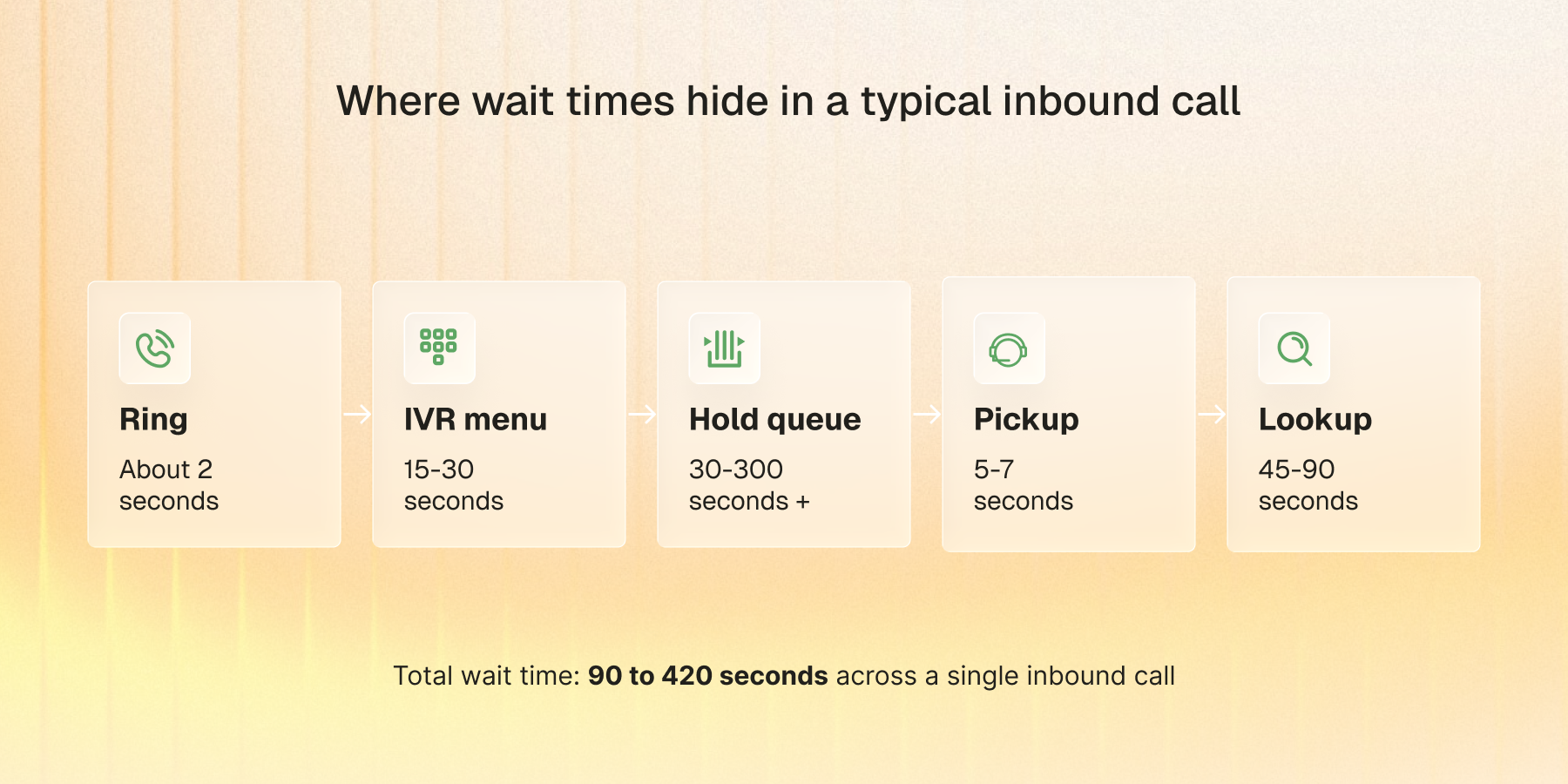
How AI reduces wait times in customer service
Voice AI hits wait time on multiple fronts at once. Hold queues don't get shorter. They go away.
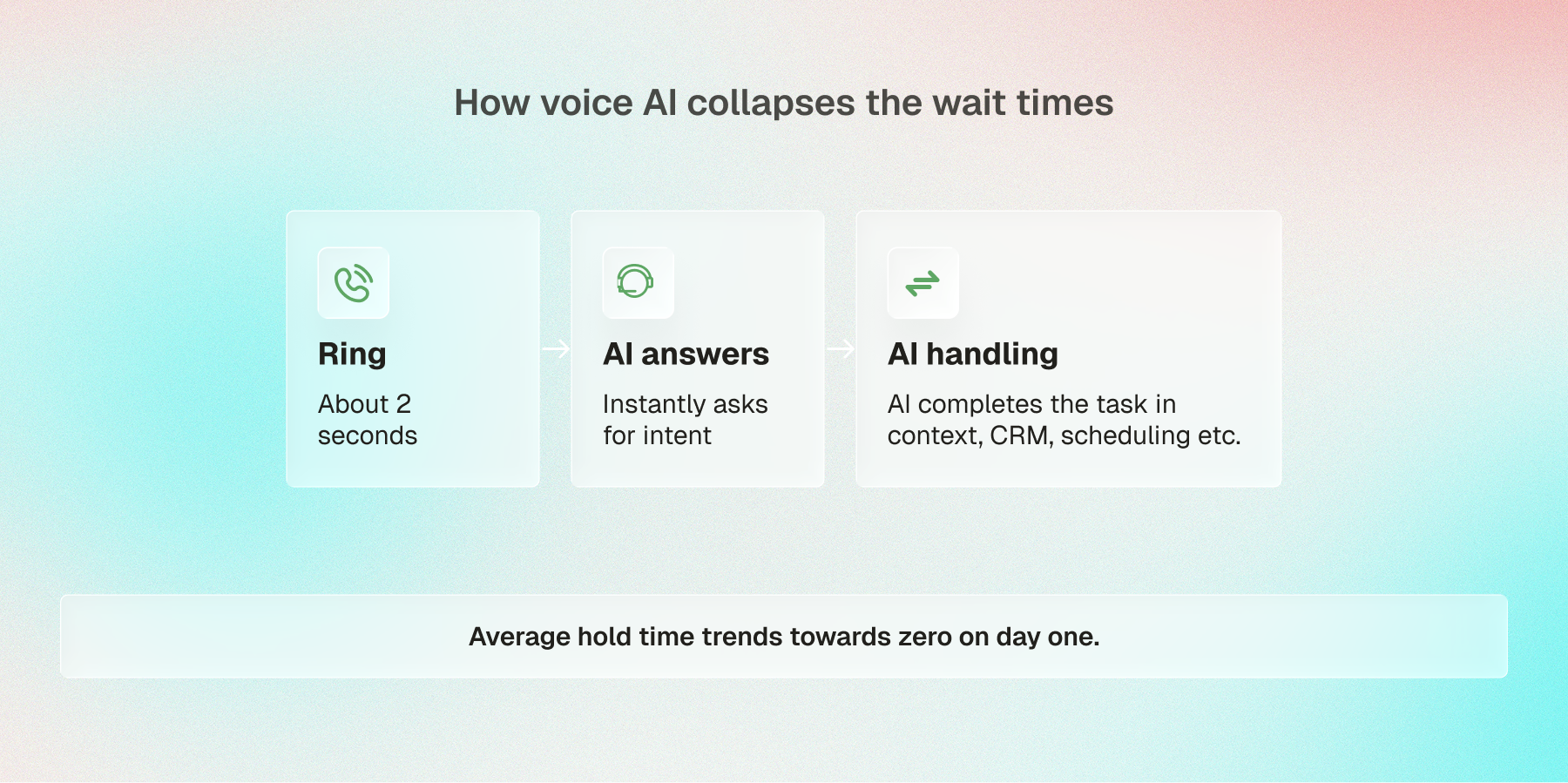
McKinsey's research on gen AI in service operations found that a gen AI deployment at a European bank eliminated wait times for about 20% of contact center requests within seven weeks of going live.
Instant pickup on every inbound call
Most wait time begins in the gap between the call connecting and a human picking up. Voice AI removes that gap. Instead of running a caller through an IVR menu and dropping them into a queue, AI agents answer in under a second and start the conversation in natural language.
This shift makes traditional first-reply-time metrics less meaningful. The relevant question stops being how fast the agent answered and becomes whether the customer's request was resolved before they had to wait at all. Phonely's voice AI answers 100% of inbound calls with zero hold time.
Unlimited concurrent conversations
A human agent can hold exactly one conversation at a time. A team of fifty can hold fifty. The moment inbound volume exceeds headcount, every additional caller waits.
AI removes that ceiling. Voice AI handles thousands of simultaneous calls without queuing, so spikes from product launches, seasonal surges, or after-hours overflow stop translating into hold time. TSA Group, with 4,500 human agents on staff, runs Phonely alongside its team to absorb daily inbound load without growing the queue.
Real-time resolution through CRM and tool integrations
A large share of perceived wait time happens after the call is answered. The customer is on the line, but the agent is searching for their account, pulling up order history, or checking a policy. McKinsey research on AI in contact centers found that one energy company shaved up to 60 seconds off customer authentication time alone by integrating an AI voice assistant into its back-end call workflow.
Voice AI cuts that overhead end-to-end. It queries the CRM, scheduling tool, and knowledge base in real time and closes the request inside the same conversation, with no "let me put you on a brief hold."
Intelligent routing without IVR mazes
Phone trees force callers to listen through menus, guess which option fits, and frequently end up misrouted. Each transfer adds wait time and forces customers to repeat their story to whoever picks up next.
Voice AI replaces the menu with natural-language intent detection. The agent works out what the caller needs in the first few seconds and either resolves it or hands it off to a specialist with a full transcript and customer record already attached. The handoff carries context, not a blank slate.
24/7 multilingual coverage
Wait time is not only a daytime problem. Calls placed at 2 a.m. or in a language a team doesn't speak typically hit voicemail or an overflow service, and the caller waits until business hours.
Voice AI removes those gaps. A single deployment answers calls at any hour, in any of 100+ languages, with consistent quality across every shift. Phonely ships with 1,000+ natural voices and tailors for regional accents and localized phrasing. The same agent that handles a 9 a.m. call in English handles the 3 a.m. one in Spanish.
Where AI cuts the most wait time across customer service
Not all customer service workflows contribute equally to wait time. A handful account for most of the hold queue in a typical contact center, and that's exactly where voice AI cuts the most.
Inbound phone support
Inbound phone support is where wait time piles up fastest. Calls arrive in unpredictable spikes, queues form at peak hours, and even fully staffed teams cap out when volume exceeds available agents.
Voice AI absorbs that load instantly. Every inbound call is answered in natural language, with no menu and no queue. The wait time inside the call drops too: instead of putting the caller on hold to pull up records or transfer, the AI resolves the request inside the same conversation.
Etech Global Services moved its full inbound queue onto Phonely's voice AI. Cost dropped, first-call resolution climbed, and the queue stopped growing with volume.
Appointment scheduling and rescheduling
Scheduling calls has its own wait time pattern. Customers want to confirm availability, find a time that works, and often verify insurance, address, or service details. Each step normally requires the agent to navigate multiple systems while the caller waits.
Voice AI handles the entire flow in one conversation. It checks the live calendar, books or reschedules the appointment, and confirms verification details in real time.
Lifelike Health books appointments through Phonely under full HIPAA compliance, with hold time taken out of the patient's day.
Lead qualification and intake
Inbound lead calls are time-sensitive in a way that ordinary support calls are not. A prospect who can't get through within minutes will call a competitor. Even short hold times translate directly into lost revenue, not just lower satisfaction.
Voice AI captures every lead the moment they call. It qualifies in real time using the same questions a human SDR would ask, books the next step, and pushes the lead into the CRM without delay.
Signpost runs Phonely on inbound for the small businesses it serves, so every lead lands in the CRM the moment they call, not whenever an agent gets free.
After-hours and overflow calls
After-hours calls and peak-time overflow are where most missed calls happen. Calls placed at 9 p.m. or during a midday surge typically hit voicemail or get dropped, and each missed call is potential revenue walking to a competitor.
Voice AI eliminates the gap. It picks up every call instantly and handles overflow during volume spikes without queuing.
Engage CX uses Phonely's AI agents to outperform their human call center at a fraction of the cost, with continuous coverage that no shift-based team could replicate.
Omnichannel follow-up across SMS and chat
Wait time doesn't only happen on phone calls. A customer who sends an SMS and waits hours for a reply, or starts a chat and gets passed between agents who don't see the history, is also waiting. The cumulative effect across channels often exceeds any single phone hold time.
Voice AI extends across channels with the same context and quality. It can text a confirmation the moment a call wraps, respond to a live chat with full call history already loaded, and follow up by SMS or email without the customer having to re-initiate contact. Customers don't repeat themselves at any handoff, and follow-up happens in whichever channel the customer chooses, in real time.
How to measure the wait time AI removes
Wait time isn't one number. It's spread across four metrics most contact centers already track, and voice AI moves each one differently. Baseline them before you deploy, then re-measure after the first week of live calls.
Baseline before you switch anything on
Pull 30 to 90 days of ASA, AHT, abandonment, and service level from your existing telephony reporting, split by hour of day. The hourly split is the part teams skip and the part that matters: wait time concentrates into a few peak windows, and an all-day average hides exactly the hours your customers are waiting.
Watch abandonment, not just ASA
ASA only counts calls that were eventually answered. A center reporting a 25-second ASA alongside 12% abandonment is performing worse than the ASA suggests, because its longest waits ended in hang-ups that never entered the average. Abandonment is the more honest measure of wait time, and it's the metric that moves first when calls stop queuing.
Separate queue wait from in-call wait
Hold time before pickup and hold time during the call are both wait time to the customer, but they land in different metrics: the first in ASA, the second buried inside AHT. Voice AI cuts both, so a team tracking only ASA will understate the improvement. Reviewing your call center performance metrics together, rather than one at a time, is what makes the second reduction visible.
Re-measure at week one and week four
The queue effect is immediate. ASA and abandonment change on day one, because the first call is answered without a queue. Resolution-side metrics behave differently: FCR, containment, and intent accuracy keep climbing over the first few weeks as the agent calibrates against real call patterns. Phonely's call analytics dashboard reports these per call, so the week-one and week-four comparison comes out of the same system handling the calls.
Real results from teams using AI to cut wait times
Phonely is deployed across 10,000+ customers handling more than 100,000 calls per day, with customers reporting operational cost reductions of 72% and up.
The four named outcomes below show what that translates to in production:
What to look for in AI built to reduce wait times
Voice AI platforms aren't all built the same. The five criteria below separate platforms that actually reduce wait time at scale from those that look capable but don't deliver in production.
Sub-second response latency
Latency is what separates voice AI that feels natural from voice AI that feels robotic. A 2-second pause before each response, repeated across a 4-minute call, adds real wait time inside the conversation. The caller perceives it. The CSAT score reflects it.
Look for end-to-end response latency under one second. That's the threshold where conversations sound human.
Unlimited call concurrency
Concurrency caps hide in vendor pricing and platform architecture. A voice AI that handles 100 simultaneous calls smoothly may queue or drop calls at 500. During peak hours, those caps translate directly into hold time, which is the problem you bought the platform to solve.
Look for true unlimited concurrency, not just a high cap.
Native CRM and scheduling integrations
A voice AI that just answers the call doesn't reduce wait time on its own. Wait time disappears when the AI can actually complete the task: look up the customer's record, book the appointment, update the case, push the follow-up. That requires the AI to be wired into your CRM, scheduling tool, ticketing system, and other operational platforms.
Look for native integrations rather than custom API work for every connection.
Support for 100+ languages and accents
Most voice AI platforms launched English-first. Coverage for other languages is often shallow, and accent handling within English is shallower still. A platform that handles American English smoothly may struggle with Scottish, Indian English, or non-native speakers, and customers feel the friction.
Look for genuine multilingual coverage with accent handling and regional phrasing built in.
SOC 2, CCPA, HIPAA, and PCI compliance
Compliance is a deployment gate, not a checkbox. Different industries demand different certifications: enterprise procurement teams ask for SOC 2, healthcare requires HIPAA, payment processing needs PCI, and California-based operations require CCPA-compliant data handling.
Look for compliance with all four as a procurement baseline.
Phonely is built to clear all five criteria at production scale, which is what lets customers like Etech and TSA Group run their full call volume through the platform.
How fast can AI start reducing your wait times?
Wait time starts dropping the moment AI answers its first call. There's no ramp-up before the first second of hold time disappears. The variable isn't when impact starts. It's how long deployment takes.
For most teams on Phonely, deployment is measured in minutes. 70% of Phonely customers get started in under 5 minutes through the self-serve dashboard: point your inbound line at a Phonely number, upload your FAQs and workflows, and the AI is answering calls.
Larger operations with CRM integrations, multi-channel routing, and compliance requirements take longer. Phonely's enterprise team handles those deployments in days, not months, with dedicated implementation support for telephony, integrations, and ongoing optimization.
Once live, the wait time benefit is immediate. Every inbound call is answered without queuing, regardless of volume. Operational metrics like containment and intent accuracy tune up within the first weeks as the AI calibrates against real call patterns, but the headline outcome starts on day one: calls answered instantly, no hold queue.
Answer every call instantly with Phonely
Wait time isn't a customer service problem to manage. It's one to eliminate. Phonely is built to answer 100% of your inbound calls instantly, scale without concurrency caps, and complete the task on the call instead of routing the customer through queues.
Start free with your first 100 minutes, or talk to sales about enterprise deployment.