Key takeaways
- Most phone answering platforms cost $50 to $1,000 a month, and most small and mid-sized businesses pay $100 to $500. By type: IVR runs $25 to $100, AI voice agents $50 to $300, hybrid $250 to $1,000, and live human services $150 to $2,000 or more.
- The billing model matters more than the rate. Per-minute and per-call plans put the volume risk on you, costing more as you grow, while flat-rate and usage-based AI do the opposite, letting the cost per minute fall as volume rises.
- Against a live service, the gap is not a fixed discount, it widens as you grow. Live costs climb with volume, while AI does not, and AI answers unlimited calls at once and gets cheaper the more you use it.
- What you should pay depends on your industry. Volume determines which pricing model fits, and the value of a missed call is what makes coverage worth paying for, so healthcare buys HIPAA, home services buy a flat rate for seasonal spikes, and legal, insurance, and real estate buy never being second to answer.
- An AI platform is far cheaper than hiring. A full-time receptionist runs about $46,500 to $52,000 a year fully loaded and covers one desk during business hours, while a platform costs a fraction of that, runs around the clock, and scales without a new headcount.
Two businesses can sign up for the same phone answering platform, agree to the same per-minute rate, and still open completely different invoices at the end of the month.
One pays a few hundred dollars. The other pays four figures. Same rate card.
That gap is what a real cost breakdown of phone answering platforms has to explain. The rate on the quote tells you what a minute costs. It says nothing about what the service costs you once your call volume, your busy season, and the calls nobody picked up are added in.
Below is what you actually pay across every pricing model, where the number inflates after you sign, and how to read a quote before you commit.
How much does a phone answering platform cost?
A phone answering platform runs anywhere from $50 to $1,000 a month, and the typical small or mid-sized business lands in the $100 to $500 range. That is a fraction of what a full-time receptionist costs, and a single hire still only covers one person during business hours. A platform is priced to cover the same phones, often more of them, for less.
Where you land in that range comes down to which of four platform types you choose, listed roughly from least to most expensive.
All monthly figures above reflect publicly listed provider pricing as of mid-2026 and represent typical ranges, not quotes. Actual cost varies with call volume, coverage hours, and features.
The headline number is the easy part. What you actually pay depends less on the rate than on the billing model underneath it, because the same call volume can cost wildly different amounts depending on how it's metered.
That's where the breakdown starts.
The 5 pricing models, and what each really costs you
Five models dominate the market, and they differ on one thing that matters more than the rate: when your call volume climbs, who absorbs the cost, you or the provider.
Here is how each one behaves, and where it quietly turns against you:
- Per-minute pricing
You pay for talk time, typically $0.75 to $1.50 a minute for live agents and a fraction of that for AI. For low volume with short calls, it can be the cheapest option on paper.
The trap is the billing increment. Providers round each call up to a set increment, which can run as long as 30 or 60 seconds, so under 60-second rounding, a call that ends at 2 minutes 10 seconds bills as 3 full minutes, nearly 40 percent more than the talk time.
Stack that across a month of short calls, and the rate card stops describing your bill. One question settles it before you sign: do you round in 6-second or 60-second increments?
- Per-call pricing
You pay a flat fee per answered call, regardless of length, from a few dollars for an AI call to $5 to $12 for a live agent. Long, involved calls become a bargain. Short ones become a tax, because a 20-second wrong number costs the same as a 6-minute booking, and many providers still count hang-ups, spam, and misdials as billable calls.
This model rewards genuine, lengthy conversations and punishes high-volume, short, or junk-heavy call patterns.
- Monthly and tiered plans
You prepay for a block of minutes or calls, often 100 to 500 minutes for somewhere between $95 and $1,200, and move up tiers as you grow. Budgeting is simple until you cross the line you paid for.
Overage typically costs more per minute than the plan itself, so a single busy month can wipe out the discount the tier was supposed to give you. Coverage hours sit here too: daytime is the cheapest band, while nights, weekends, and 24/7 either bump you up a tier or carry a surcharge of their own.
- Flat-rate (unlimited)
One price, no matter how many calls arrive. Volume stops mattering, and so do overage cliffs, rounding, and seasonal spikes.
This model is almost always AI, because no human team can answer unlimited calls at a fixed cost. It fits any business whose volume is hard to predict or actively growing, and it is the only model where your busiest month and your quietest month cost exactly the same.
- Hybrid (AI plus live)
AI takes every call and handles the routine ones, passing anything that needs a person to a live agent. You typically pay a base fee plus the human time you use. It lands in the middle, cheaper than all-human and stronger on difficult calls than all-AI.
What you end up paying depends mostly on your escalation rate, the share of calls that reach a human, which is the figure to pin down before committing.
Rates shown are typical market figures as of mid-2026, not quotes.
The pattern is hard to miss once you see it. The models that look cheapest in a quiet month, per-minute and per-call, are the ones that hand you the volume risk, so they cost more exactly as your business grows. Only AI economics can break that link by letting the rate fall as volume rises instead of climbing with it.
That sets up the real comparison: how an AI platform comes out against a live answering service on cost.
Live agents vs AI vs hybrid: the real cost gap
The gap between a live answering service and an AI platform is not a fixed discount. It is a curve that bends in your favor the more calls you take. Both bill by the minute, so on paper they look alike, but AI inverts the two things that make per-minute pricing painful, which is why the same call volume can leave the two thousand dollars apart once it climbs.
The first is what your rate does as volume grows. A live agent costs $0.75 to $1.50 a minute, and that rate does not fall when you get busier, so triple the calls means roughly triple the bill. AI moves the other way. On Phonely, pricing is usage-based, and the per-minute cost drops as volume rises, reaching as low as $0.05 a minute at scale. Live pricing makes growth more expensive. AI pricing makes it cheaper.
The second is concurrency, the cost of no rate card prints. A live team can only answer as many calls as it has people on shift, so when the phones light up after an ad airs or a storm hits, callers wait or hang up, and the only fix is paying for more agents. Phonely answers an unlimited number of calls at once, so a midday rush or a 2 a.m. spike adds no capacity cost at all. For any business with uneven call patterns, that single difference often matters more than the rate.
Hybrid sits in between. AI absorbs the routine volume at AI economics, and you pay live rates only on the calls that escalate to a person, which softens the live curve without flattening it.
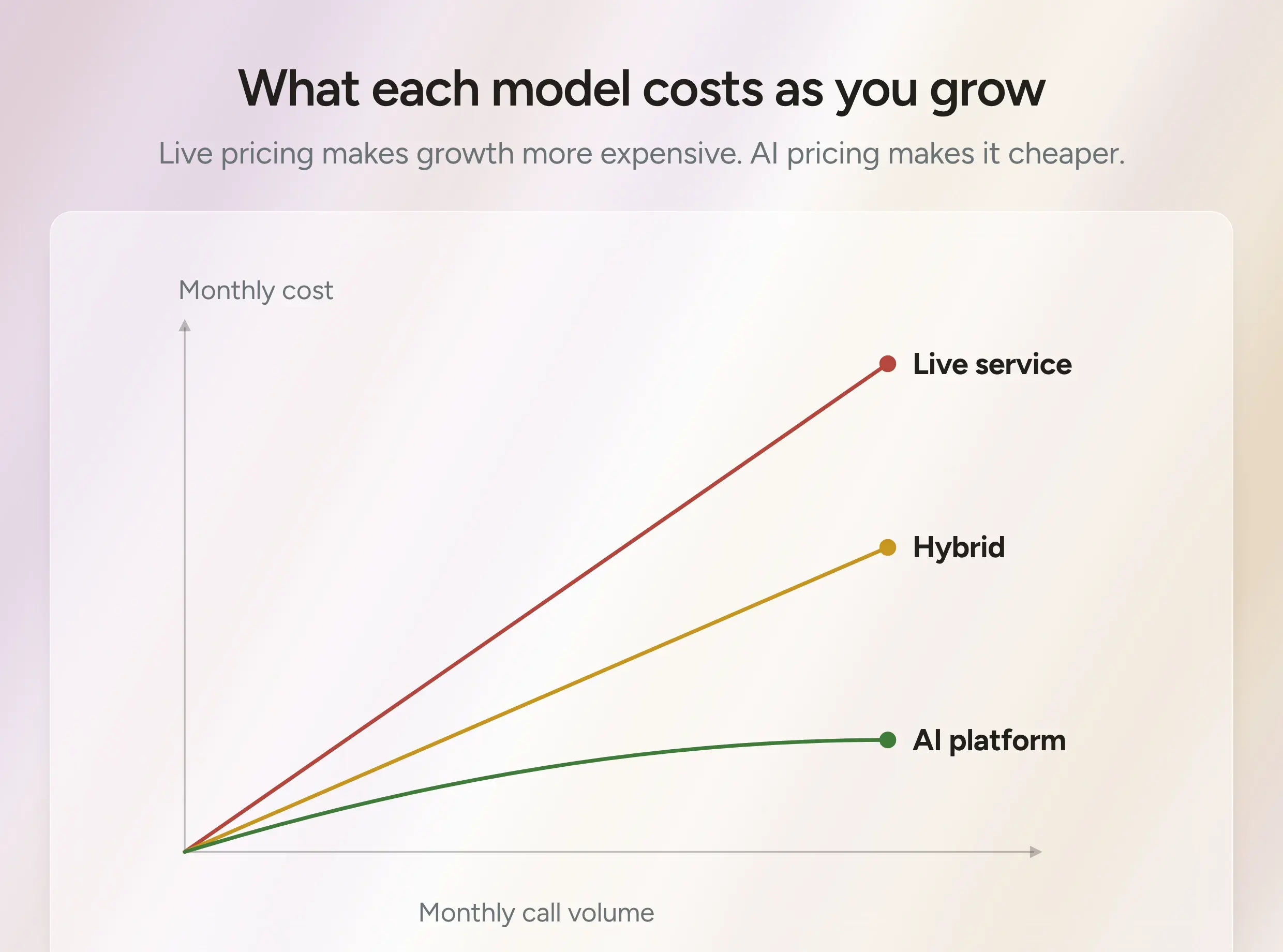
Put those together, and the gap gets wide. Phonely reports that customers cut operational costs by up to 80 percent versus traditional call centers, with zero hold times and every call answered.
The scale behind that is real: one customer now handles 60,000 calls a day, and another replaced 350 agents in a single month, while enterprise outsourcers, including TSA Group and Engage CX, run Phonely operationally, with several backing the company as investors.
Live and hybrid figures are typical market rates as of mid-2026. Phonely figures are the company's published rates and reported customer results.
Which one is actually cheapest depends on how many calls you take and how complex they are. A law firm handling sixty high-stakes calls a month weighs it very differently from a clinic booking three thousand routine appointments. That is why the cost gap looks so different from one industry to the next, which is where the numbers get specific.
What a phone answering platform costs by industry
Industry changes the math, not just the price. Volume decides which pricing model wins, and value decides how much a single missed call costs.
The same monthly fee can be a bargain for one business and a waste for another.
- Healthcare
High call volume meets a hard compliance requirement. The price is driven less by call count than by HIPAA, since handling patient information legally is the line item that separates a medical-grade platform from a generic one.
- Home services
The person who should answer is on a job site, and volume spikes seasonally. That combination is why flat-rate pricing wins here, because per-call or per-minute billing punishes you hardest in your busiest, most profitable months.
- Legal
Low volume, high stakes. Clio's 2024 Legal Trends Report found that only 40 percent of firms answer the phone, down from 56 percent in 2019, so the cost that matters is not the monthly fee but the case you missed, often worth thousands.
- Insurance
Speed is everything because leads are sold to several carriers at once and paid for upfront. A missed call wastes that lead spend and hands the policy to whoever answered first, so instant pickup and after-hours coverage are what you are really buying.
- Real estate and small businesses
In NAR's 2025 Profile of Home Buyers and Sellers, 88% of buyers purchased through a real estate agent. With the channel that is agent-driven, the whole game for an agent is being the one a buyer reaches and stays with, so a missed call is a missed client. For small businesses generally, modest volume and high per-caller value make never being second the whole point.
In every case, the calls you miss cost more than the platform does, which is why these industries keep landing on usage-based AI like Phonely.
In-house receptionist vs an AI platform: which is actually cheaper?
The honest comparison is not salary against subscription. It is what each option costs fully loaded, and what that money actually covers.
A receptionist's sticker price is the wage, a median of $37,230 a year in the US. The real cost is higher. The SBA puts the fully loaded figure at 1.25 to 1.4 times salary once payroll taxes, benefits, and overhead are counted, which lands one receptionist somewhere around $46,500 to $52,000 a year. That buys a single person at a single desk: roughly forty hours a week, no nights or weekends, one call at a time, minus vacation, sick days, and the cost of rehiring when they move on.
An AI platform inverts nearly every line of that. It runs around the clock, picks up every call simultaneously, no matter how many calls at once, and costs a fraction of one salary. It does not take time off or quit. The question stops being whether you can afford to staff the phones and becomes what you are actually paying for.
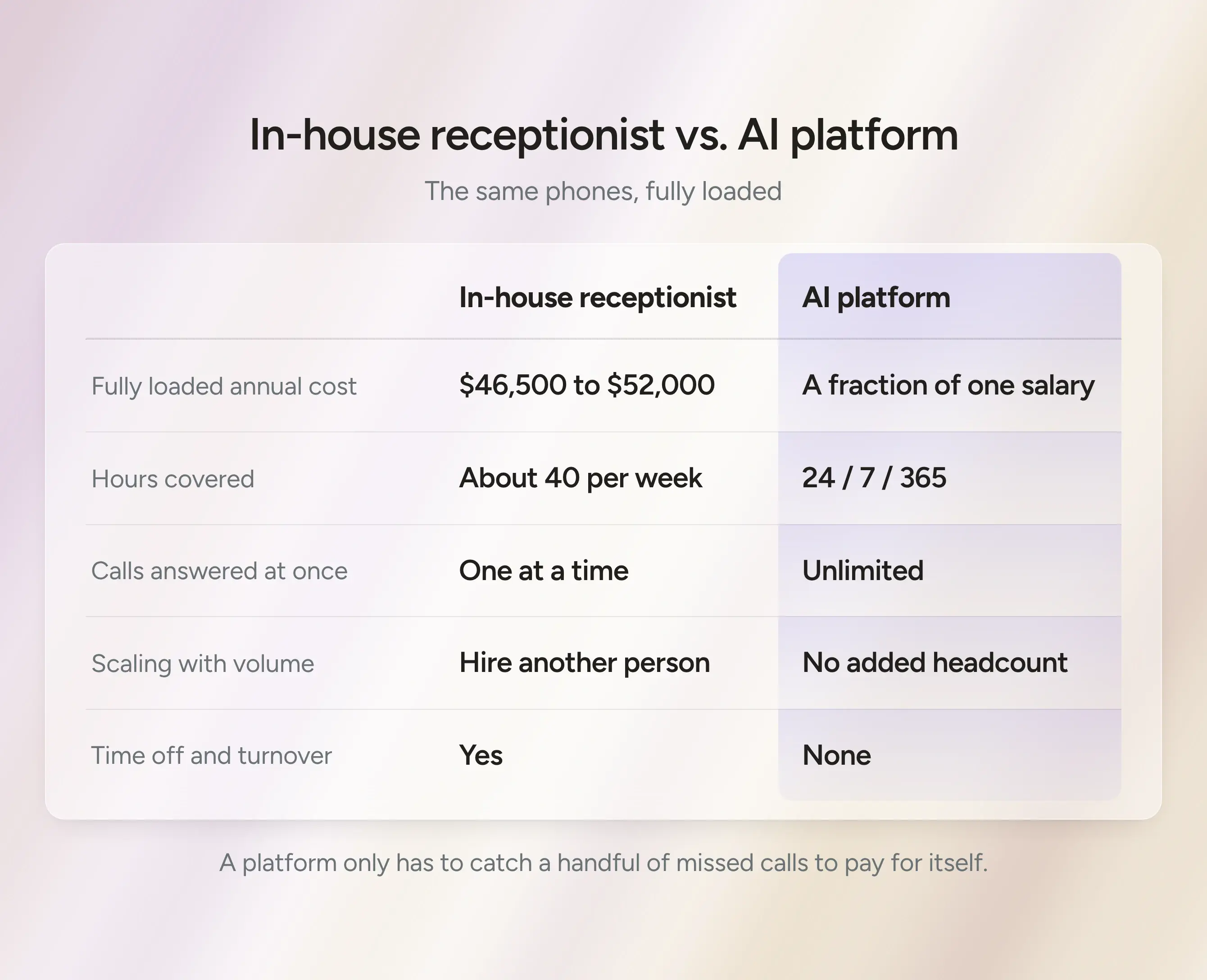
At those numbers, the break-even is almost trivial. A platform that costs a few hundred dollars a month only has to capture a handful of the calls you would otherwise lose, and as the industry breakdown showed, a single recovered job, case, or policy often pays for a year of service on its own.
None of this makes a person the wrong choice everywhere. A skilled receptionist still wins on calls that need real judgment, genuine empathy, or a relationship built over years, which is exactly what a hybrid setup is for, with a person taking the calls that justify their hourly rate.
For most businesses, though, the math points one way. The platform costs less and covers more. Cheaper than a hire is not the same as priced right, and the gap between a good deal and an inflated one comes down to how you buy.
How to avoid overpaying for call answering
Most overpaying is not the provider's doing. It comes from buying at the sticker rate instead of your real usage.
Four steps close that gap:
Step 1: Audit your call data
Pull the last three to six months of call logs before you price anything. You want total calls, average length, the share that arrives after hours, and how often two ring at the same time. That profile, not a salesperson's example, is what tells you which pricing model actually fits.
Step 2: Total your true cost of ownership
Add every line, not just the headline rate: setup or onboarding, per-minute rounding, overage above your plan, after-hours or holiday surcharges, and paid add-ons like transcription or CRM sync. Then run the total at your real volume from Step 1, and again at 120 percent of it. The cheapest base rate often loses once these stack up.
Step 3: Match features to call types
Pay for what your calls require and nothing more. A clinic needs HIPAA handling and scheduling. A contractor needs emergency routing and round-the-clock coverage. A firm needs careful intake. Buying a premium tier for features your call mix never touches is its own quiet form of overpaying.
Step 4: Test on real calls before committing
Run a trial on live calls, not a demo script. Listen to recordings, dial in at odd hours, and throw the platform the messy, off-script questions your callers actually ask. How it handles the awkward ones, and whether it books, routes, and logs correctly, tells you far more than any quote.
Do these four, and the bill stops surprising you. You pay for the calls you want to capture, at a rate that fits how you actually get called.
Phonely pricing: what you get and what you pay
Everything above lands on the same point: the right plan fits your real call pattern. Phonely is built that way. You start free, pay only for what you use, and unlimited concurrent calls come standard on every tier, including the free one.
There are four plans:
Annual billing takes 33% off Starter and Professional. Figures current as of mid-2026; see phonely.ai/pricing for the latest.
A few things hold across the lineup. Every paid plan includes premium voices, call transcripts, and AI analytics, and Phonely is SOC 2 aligned. The capabilities that tend to matter at scale sit at the top: HIPAA with a signed BAA, custom telephony and SIP trunking, hands-on agent buildout, and a dedicated account manager.
The throughline is the one this whole guide has been making. You are not buying a fixed block of staffed hours. You are buying coverage that answers every call, scales without adding headcount, and costs less per minute the more you use it. Most businesses start free or on Starter, move to Professional as volume climbs, and reach Enterprise only when compliance or custom integration enters the picture.
Frequently asked questions
- How much does an AI phone answering platform cost?
An AI phone answering platform typically runs $50 to $300 a month at small-business volumes. Because the pricing is usage-based, the per-minute cost keeps falling as you scale, down to a few cents at the top end. Most providers also offer a free or entry tier: Phonely starts free, with paid plans at $50 and $150 a month and enterprise rates as low as five cents a minute.
- Are there hidden fees in phone answering platforms?
Often, yes. Expect setup or onboarding fees up front, plus charges that build with use, like calls rounded up to the next block and overage once you pass your plan. Then come premiums on nights, weekends, and holidays, and optional extras like call transcription or CRM integration. Flat-rate and usage-based AI plans sidestep most of them, since there is no meter to pad.
- How fast can a phone answering platform be set up?
Faster than hiring for the same role. A self-serve AI platform can often go live the same day, because setup means configuring a number, a voice, and a call workflow rather than recruiting and training someone. Custom integrations or HIPAA-compliant deployments take longer and are usually done with the vendor. Phonely lets you start free and build an agent yourself, with hands-on buildout on Enterprise.