
Key takeaways
- Voice AI security requires three compliance frameworks: SOC 2 for baseline security controls, HIPAA for healthcare data, and PCI DSS Level 1 for payment processing, with each addressing different data protection requirements and regulatory obligations.
- Main threats to voice AI include voice cloning for authentication bypass, unencrypted transmission channels that expose call data, and prompt injection attacks that manipulate the AI into unauthorized actions.
- Secure voice AI platforms encrypt data in transit with TLS 1.2 and at rest with AES-256 without training on your calls.
- Choose vendors with SOC 2 Type II reports and signed business associate agreements for HIPAA compliance.
- Role-based access controls and audit logs prove compliance by tracking who accessed what data and when.
Imagine a caller convinces your agent that they're a locked-out employee and talks their way into a credential reset. No malware, no breached firewall, all it takes is a believable voice and a few details pulled from LinkedIn.
It's not just hypothetical. In one incident, attackers called MGM Resorts' IT help desk, posed as an employee using details found on LinkedIn, and convinced the help desk to hand over login credentials. That one call snowballed into a ransomware shutdown across MGM properties, and the exposed customer data included names, contact details, birthdates, driver's license and passport numbers, and in some cases, social security numbers.
With 1 in every 127 calls to contact centers now being fraudulent, this scenario is becoming routine. For a call center handling thousands of calls daily, that means dozens of fraud threats hit you every single day. Without proper security, those threats turn into real breaches. The question isn't whether voice AI introduces risk, it's whether your platform is built to contain it.
Why voice AI security matters for your business
Every call your voice AI agent handles contains sensitive information: customer names, account numbers, health records, payment details, and private conversations.
A data breach means you lose customer trust, face regulatory fines, and, in some cases, lose the right to operate entirely. For contact centers specifically, the damage compounds across every interaction you've ever handled.
Voice AI adds a new attack surface. Unlike traditional phone trees that just route calls, voice AI systems transcribe, process, store, and route customer information through multiple automated layers. Each layer is a potential vulnerability if the platform isn't built with security from the ground up.
Voice data contains everything a bad actor needs: authentication details spoken aloud, personal identifiers used for verification, and payment information provided verbally. When that data isn't encrypted in transit, stored securely at rest, and protected by proper access controls, you're running a contact center on borrowed time.
Common voice AI security threats
Voice AI faces three attack categories that exploit different system layers:
Voice cloning and authentication bypass
Voice phishing attacks increased by 442% in 2025, and 70% of organizations have experienced some sort of voice phishing attempt. Voice cloning now requires as little as three seconds of audio, and attackers are using synthetic voices to bypass authentication systems and impersonate executives.
The cloned voice bypasses:
- Voice biometric authentication systems
- Phone verification processes
- Live conversations with employees who think they're speaking to an authorized person
When we help call centers implement these systems, the biggest surprise for managers is often how easily a 3-second audio clip from a LinkedIn video can be used to spoof an executive's voice. We've seen attackers pull clips from earnings calls, internal training videos, or even voicemail greetings to build convincing deepfakes.
How to Prevent Voice Cloning Attacks:
- Use multi-factor authentication beyond voice
- Add liveness detection with random follow-up questions
- Disable voice biometric systems for payments and account changes
- Log all authentication attempts
Proofpoint reports that phishing platforms are now fully automated, allowing a single operator to run campaigns against multiple brands simultaneously with AI agents that extract verification codes without human involvement.
Data interception through unencrypted channels
Every call contains structured data: names, account numbers, addresses, and payment details. Without TLS 1.2 encryption, anyone on the network path can capture that data in plaintext.
Call recordings stored without AES-256 encryption create the same exposure. A storage breach hands attackers every conversation you've recorded.
How to Stop Data Interception:
- Require TLS 1.2 minimum in your vendor contract
- Enable AES-256 encryption for recordings and transcripts
- Run a packet capture test on your platform to check for plaintext data
System manipulation and prompt injection
Attackers embed malicious instructions inside normal customer requests. The AI processes the hidden command, exposes internal prompts, or executes unauthorized actions in real time during live calls. By the time monitoring flags the anomaly, the fraudulent action has already been executed.
How to Block Prompt Injection Attacks:
- Set a hard limit for each caller’s input
- Reject requests containing "ignore previous instructions" or "system override"
- Rate-limit API calls by flagging any single number making more than 50 requests in 60 seconds
Security standards that Voice AI must meet
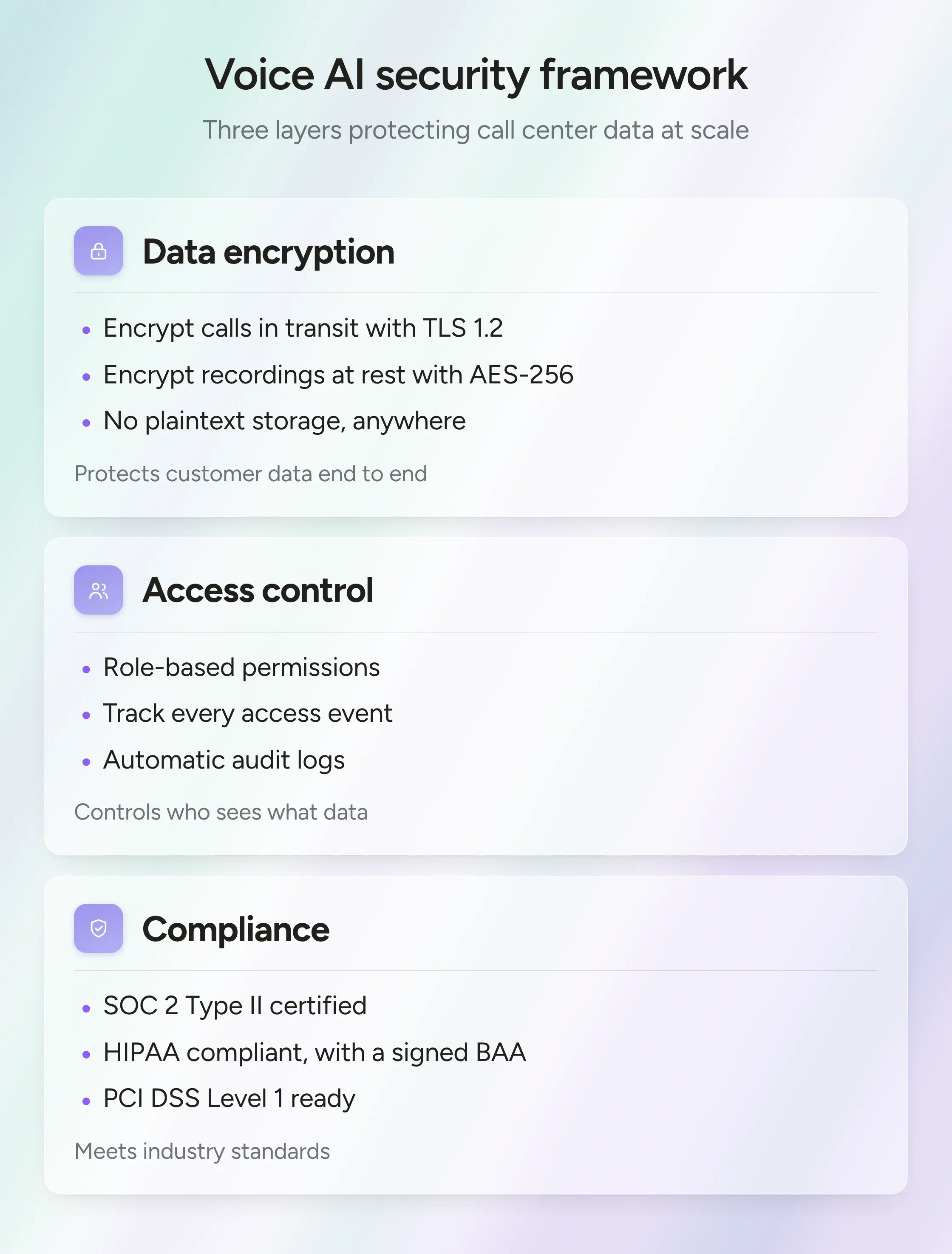
Three compliance frameworks govern how voice AI handles sensitive data: SOC 2, HIPAA, and PCI DSS. If your business falls under any of these regulations, your voice AI platform needs to support them.
Security standards that voice AI must meet
Three compliance frameworks govern how voice AI handles sensitive data. If your business falls under any of them, your platform needs to support it.
SOC 2 compliance explained
SOC 2 is the baseline security standard for service organizations that handle customer data. Developed by the AICPA, it evaluates data management based on five trust service criteria: security, availability, processing integrity, confidentiality, and privacy.
When evaluating a voice AI vendor, look for a SOC 2 Type II report. These audits cover six to twelve months, not just a single point in time.
What SOC 2 covers for your voice AI deployment:
- Only authorized personnel can access call data
- Every access event is logged
- The vendor has a documented security incident process
- Data is encrypted in transit and at rest
- Network security prevents unauthorized access
HIPAA for healthcare businesses
If your contact center handles protected health information, HIPAA applies to every call where a patient discusses symptoms, treatment, billing, or anything that could identify them.
Requirements under HIPAA:
- Encryption for voice data in transit and at rest
- Access controls that limit who can listen to recordings
- Audit logs that track every interaction with PHI
- A signed business associate agreement with your voice AI vendor
- Secure deletion of call recordings according to your retention policy
Your voice AI vendor must sign a BAA. Without it, using the platform for healthcare calls is a HIPAA violation. Some platforms offer zero retention models that process the call, extract structured data for your CRM, and discard the recording.
Pro Tip: Choose zero retention if it is an option. Zero retention extracts what you need (appointment details, prescription info, patient data) and deletes the recording. You keep the data but lose the liability.
PCI DSS for payment data
If your voice AI takes payments over the phone, you need a platform that meets PCI DSS Level 1 requirements.
The standard requires:
- No storage of CVV codes or full card numbers
- Encryption for cardholder data in transit
- Network segmentation to isolate payment systems
- Access controls that limit who can view payment information
- DTMF masking to suppress keypad tones during card entry
Your voice AI platform cannot record, transcribe, or store full card numbers or CVV codes in call recordings or logs. This keeps payment data out of your environment entirely and reduces your PCI compliance scope.
How voice AI protects customer data
Modern voice AI platforms protect customer data across three layers: encryption, storage architecture, and data handling policies.
Encryption happens in two places. In transit, voice AI uses TLS 1.2 or higher to encrypt audio streams between the caller and the platform. At rest, customer data sits in encrypted databases with AES-256 encryption. The encryption keys rotate automatically and are managed separately from the data itself.
Where the data lives matters as much as how it's encrypted. Most enterprise voice AI platforms store call recordings and transcripts in SOC 2-compliant data centers with physical access controls, network segmentation, and redundant backups. The best platforms let you choose your data residency to meet regional compliance requirements.
The third layer is what happens to your data after the call ends. Secure voice AI platforms never train their models on your customer conversations. Your call data stays yours. It's used only to handle the interaction, then stored according to your retention policies or deleted entirely.
We have seen that most contact centers never actually check where their vendor stores data until a compliance audit forces the question. By then, you're discovering that recordings are stored in shared infrastructure without the regional isolation you need for HIPAA or GDPR.
Phonely operates under a zero data retention model for sensitive interactions when configured that way. Healthcare calls under HIPAA and payment calls under PCI can be processed without storing the actual voice recording, leaving only metadata and structured outcomes in your CRM.
What you need for secure voice AI
Secure voice AI starts with the right platform, then depends on how you configure access, monitor activity, and maintain controls over time.
Choosing a voice AI provider
Your vendor sets your security baseline. If they get breached, you get breached. Coverage varies widely across voice AI vendors: some restrict HIPAA to enterprise plans, others charge it as an add-on, and a few call themselves "HIPAA-ready" without being compliant. Phonely meets these standards and encrypts data in transit and at rest by default, while also meeting legal requirements for AI calls.
Vendor evaluation checklist
Confirm a provider can check every box before you commit:
Secure voice AI with Phonely
Phonely builds security into every layer of the platform, not as an add-on you configure later. The system encrypts all voice data in transit with TLS 1.2 and at rest with AES-256 by default. You don't turn encryption on. It's already running.
The platform holds SOC 2 Type II certification, signs business associate agreements for HIPAA-covered entities, and meets PCI DSS Level 1 requirements for payment processing. GDPR and CCPA compliance are built into data handling workflows, with automated deletion, configurable retention policies, and audit logs that track every access event.
Phonely never trains models on your customer data. Your call recordings, transcripts, and customer information stay yours. You control where data is stored, how long it's retained, and who can access it.
Role-based access controls let you limit permissions by job function. Developers see what they need to build. Customer service teams access only the calls they handle. Admins get full visibility with audit trails that prove compliance.