Key takeaways
- An AI voice agent for insurance customer calls is software that answers policyholder calls in natural conversation, handling routine calls such as claims intake, coverage questions, quotes, and renewals on its own and routing complex calls to a licensed person.
- Every call runs through the same five stages: the agent answers and verifies the caller, works out what they need, pulls their real policy details, resolves the call or hands off with full context, then logs and syncs the outcome.
- Voice agents handle repetitive, time-sensitive, and high-volume calls best, including first notice of loss, coverage questions, quotes, renewals, and after-hours or catastrophe surges, while genuinely complex or emotional calls still belong with a licensed person.
- TSA Group, a 4,500-agent insurer, reports a 74% cost reduction, unlimited call concurrency, and more than 15,000 calls handled a day with Phonely.
- A voice agent is only reliable for insurance if it has sub-second latency, catastrophe-scale concurrency, real integration with your AMS, CRM, and policy systems, and insurance-grade compliance with recorded, auditable calls.
- Getting started is quick and does not require replacing your existing systems, so the most reliable way to evaluate a voice agent is to test it on your own call volume.
How do AI voice agents handle insurance customer calls?
An AI voice agent handles an insurance call much like a trained representative would, only instantly and around the clock. It answers on the first ring, understands the caller in natural speech instead of menu presses, pulls up their real policy details, and either completes the request or hands it to a licensed person with full context. Every call is logged and synced back to your systems automatically.
The difference from a traditional phone menu is simple. An old IVR routes calls. An AI voice agent has them.
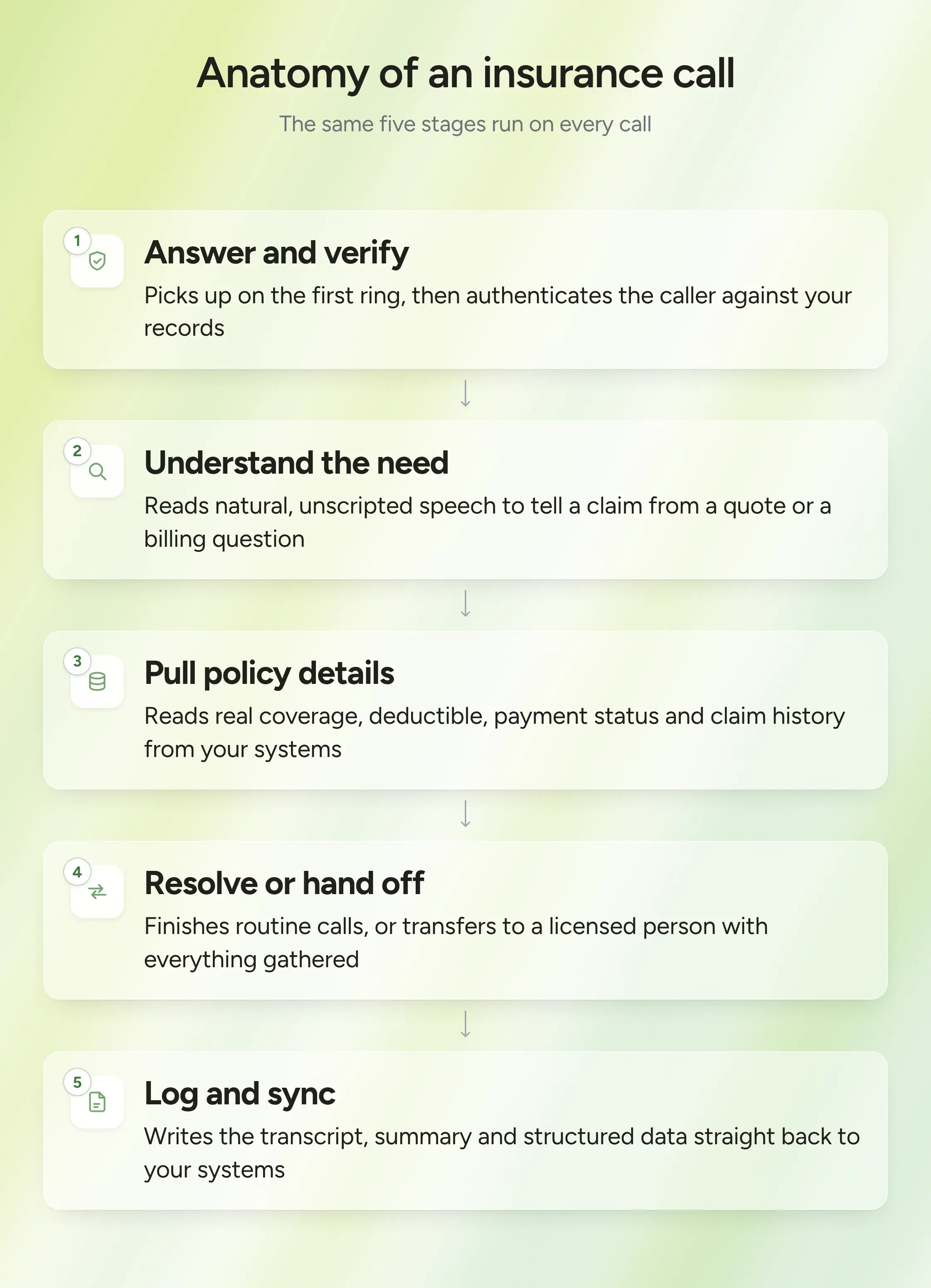
Under the surface, that conversation runs through five stages:
- It answers immediately and confirms who is calling.
The agent picks up at once, with no hold music and no queue, whether the call arrives mid-afternoon or at 2 a.m. during a storm that sends hundreds of calls in together. Before discussing any policy details, it verifies the caller's identity against your records, the same authentication a human representative would run.
- It works out what the caller actually needs.
Insurance callers rarely open with a tidy request. Someone says, "My basement is flooded", or "I think I'm paying too much," not "I would like to file a first notice of loss." The agent interprets natural, unscripted speech, copes with accents, interruptions, and background noise, and works out whether the call is a claim, a billing question, a quote, or a coverage change.
- It pulls the caller's real policy details.
This is the line between a useful agent and a glorified recording. By connecting to your CRM, agency management system, or policy administration system, it grounds the conversation in the caller's actual coverage, deductible, payment status, and claim history, so its answers fit that policyholder rather than a generic script.
- It completes the request or hands off with full context.
For routine calls, the agent finishes the job, whether that means taking a structured first notice of loss, processing a payment, booking an adjuster appointment, or answering a coverage question. For calls that need licensed judgment, it transfers to the right person and passes along everything already gathered, so the caller never starts over.
- It logs the call and updates your systems.
When the call ends, the agent writes a transcript and summary, saves the structured data it captured, flags caller sentiment, and syncs it all back into your systems. The next person to open that policy sees exactly what happened, and you keep a clean record for quality review and compliance.
In practice, it is quick and unremarkable. A caller says she backed into a pole in a parking lot, and the agent verifies her, opens an auto first notice of loss, captures the details, books the adjuster callback, and texts a claim number before she hangs up.
Here is how the two approaches compare on the moments that matter on an insurance line:
The insurance calls AI voice agents handle best
The five-stage sequence from the previous section stays constant, unlike the work it does. A panicked accident report and a routine payment reminder are not the same job, and the gap between them is where a voice agent either proves itself or falls short.
The five call types below are the ones AI voice agents handle well today. The honest counterpoint comes first. Genuinely complex or emotionally raw calls, such as a disputed total loss or a grieving beneficiary, still belong with a licensed person, and a good agent hands those off early.
- First notice of loss and claims intake
A first notice of loss call comes right after something has gone wrong, such as a collision, a break-in, or a flooded kitchen. The caller is often shaken, so the agent has to stay calm while collecting a precise, structured record of what happened, when and where, any injuries, and the damage. The questions shift by claim type, since an auto accident and a water leak need different details.
An AI voice agent does this around the clock, captures the intake in a consistent format, and routes the claim to the right adjuster without the caller waiting for morning. J.D. Power's 2024 U.S. Auto Claims Satisfaction Study names easy, responsive communication with reps as its number one key to a satisfying claim, which is exactly what an always-on agent provides. The same study found that 80% of auto customers who have a poor claims experience have already left their insurer or say they plan to. Handled calmly and accurately, that first call is what stands between a loss and a lost customer.
- Policy and coverage questions
These are the everyday calls, the ones asking whether water damage is covered, what a deductible actually is, or if a new car is on the policy yet. They are common partly because coverage genuinely confuses people. A Trusted Choice survey reported by the Insurance Information Institute found that 56% of Americans do not know that a standard homeowners policy excludes flood damage. Each call on its own is simple, but together they take up a large share of a service team's day.
The risk here is not difficulty but accuracy, because a wrong answer about coverage is not a small mistake. An AI voice agent answers from the caller's actual policy rather than a generic script, so the deductible it quotes and the coverage it confirms are that policyholder's real terms. Routine questions get resolved on the spot, and licensed staff keep their time for the conversations that genuinely need them.
- Quote requests and lead qualification
A quote call is a buying signal, and in insurance, the caller is almost always shopping for more than one carrier at the same time. The opportunity is sizable right now. J.D. Power's 2025 Insurance Outlook reported that the average U.S. auto premium reached a record $2,543 in 2024, up 26% from the year before, and that by May, nearly half of auto customers were shopping for a new policy.
That is a lot of quote calls, and a missed one is just a prospect who reached a competitor instead. An AI voice agent answers everyone, collects the rating details a quote needs, such as drivers, vehicles, and property specifics, qualifies the lead against your criteria, and either provides the quote or books a licensed producer while interest is still warm.
- Renewals, payments, and proactive outreach
Renewals and payments are where revenue quietly leaks. A missed payment can lapse a policy, and a renewal that passes without contact is an opening for a competitor. The risk is measurable. LexisNexis Risk Solutions found that 45% of U.S. auto policies had been shopped at least once in the twelve months ending in December 2024, so policyholder loyalty can no longer be assumed.
AI voice agents work in both directions here. They answer inbound billing and renewal questions, and they place proactive outbound calls, such as a reminder before a payment lapses or a check-in ahead of renewal. Each call verifies the policyholder, handles the payment or the update, and logs the outcome, turning a quiet source of churn into a managed touchpoint.
- After-hours and catastrophe surge calls
Insurance call volume is not spread evenly. It rises at night and on weekends, and it spikes hardest right after a major weather event, exactly when a human team is most difficult to scale. That pattern is not rare. NOAA recorded 27 separate billion-dollar weather and climate disasters in the United States in 2024, the second-highest annual count since records began in 1980.
Each of those events sends a wave of claims and questions onto carriers' phone lines at once. A staffed queue buckles under that load. An AI voice agent does not, because it answers hundreds of calls at the same time with no hold, whether the surge hits at 3 a.m. or in the first hours after a hailstorm. These calls make the clearest case for voice AI, because they are exactly what a traditional operation is least able to absorb.
Across all five, the pattern holds. AI voice agents take the calls that are repetitive, time-sensitive, or arriving faster than a team can answer them. The next section looks at what that has meant in practice for insurance teams already running them.
Inside one insurer's results with Phonely
TSA Group is an insurance team with 4,500 human agents on staff. An operation that size does not adopt new technology lightly, and by the team's own account, it did not believe an AI voice agent could match its conversational quality at scale. That doubt is worth noting because it means the bar was set by people who knew their own calls.
Working with Phonely changed that view. Xander van der Westhuizen, TSA Group's Head of AI Data and Innovation, says Phonely's agents now resolve calls better than their best people, and sound like them. The measurable outcomes behind that are below.
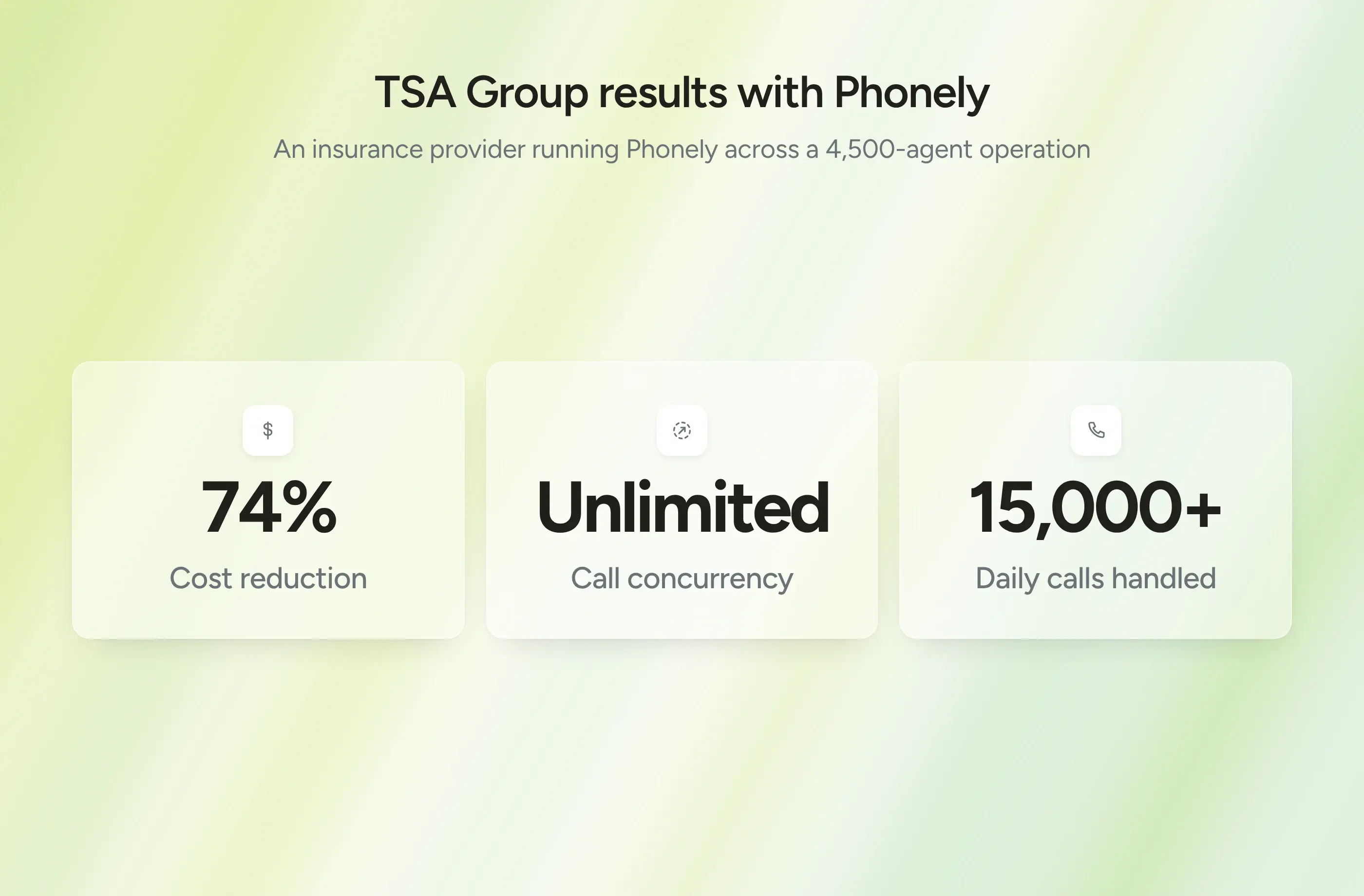
Each figure connects to something the earlier sections set up. The 74% cost reduction is the economic case for moving high-volume, repeatable calls off human teams. Unlimited call concurrency is what absorbs the after-hours and catastrophe surges without forming a queue. And more than 15,000 calls a day is the scale at which both have to operate, not in a pilot but in daily operation.
A result like this is not automatic. It depends on the voice agent being built for the specific demands of insurance calls, which is what the next section covers.
What makes a voice agent reliable for insurance calls?
A voice agent that can hold a pleasant conversation is not the same as one you can put in front of your policyholders. A general-purpose bot might handle a simple question, but insurance calls carry money, deadlines, regulation, and real stress, and they expose a weak agent fast.
Four things separate a voice agent built for that environment from one that only sounds the part.
- Sub-second latency for high-stress calls
In natural conversation, the gaps between speakers are tiny. Research on conversational turn-taking puts the typical gap at roughly 200 milliseconds, about a fifth of a second, so a caller registers any delay almost immediately. A voice agent that pauses for two or three seconds before answering does not sound thoughtful. It sounds broken, and the caller starts repeating themselves or talking over it.
On a routine question, that is a mild annoyance. On a high-stress call like a first notice of loss, minutes after an accident, latency does real damage because a shaken caller reads hesitation as the system failing them. Sub-second response is what keeps the exchange feeling like a conversation, and it is a baseline any insurance voice agent should be expected to clear.
- Catastrophe-scale call concurrency
A human call center has a fixed ceiling. It can staff for an average Tuesday, but it cannot triple its headcount the morning after a hurricane. That is the structural problem with catastrophe volume. Demand spikes exactly when the operation is least able to grow.
A reliable insurance voice agent removes that ceiling. Concurrency, the number of calls an agent can hold at once, is not a vanity metric here. It decides whether the hundredth simultaneous caller after a storm reaches help or a busy signal. Phonely runs unlimited call concurrency. TSA Group's deployment uses it to keep answering through daily inbound volume that would otherwise queue. For catastrophe response, that is the difference between a queue and a phone that simply keeps answering.
- AMS, CRM, and policy admin integrations
A voice agent that cannot see a policy can only take messages. To resolve an insurance call, it has to connect to the systems of record, the agency management system, the CRM, and the policy administration platform. It needs to read and write to them in real time, which is what lets it quote a real deductible, confirm real coverage, or file a real first notice of loss.
The obstacle is that insurance runs on a mix of modern and older software, and not every system of record exposes a clean API. A voice agent limited to API-based connections cannot reach the rest. Phonely closes that gap with prebuilt, browser-based automations that connect to software even when it has no API, so the agent works inside the tools a team already runs instead of forcing a migration.
- Insurance-grade compliance and audit trails
Insurance is a regulated business, and a voice agent inherits that responsibility the moment it answers. The first kind of compliance is data handling, since insurance calls expose policy details, payment information, and sometimes health information. Phonely supports recognized standards, including SOC 2, HIPAA, PCI, and CCPA.
The second kind is the rules governing the calls themselves. In February 2024, the FCC ruled that AI-generated voices count as "artificial" under the Telephone Consumer Protection Act, so an AI agent placing outbound calls is held to the same consent requirements as any other regulated caller. With TCPA statutory damages running $500 to $1,500 per call and no cap, consent and do-not-call handling is something to confirm with any vendor you evaluate.
Audit trails are the quieter half of compliance. Every call an agent handles should be recorded, transcribed, and logged, both for regulatory review and for settling disputes about what was said. Phonely records, transcribes, and analyzes every call, which turns each conversation into a reviewable record rather than a memory.
These four are the difference between a voice agent that demos well and one an insurance team can trust in daily operation.
Answer every insurance call with Phonely
Phonely answers the full range of insurance calls in natural conversation, from first notice of loss to renewals, and picks up the hundredth simultaneous call as readily as the first.
Setup is quick. You describe the calls the agent should handle and connect them to your AMS, CRM, and policy admin tools through prebuilt browser-based automations, so it runs on the software you already use with nothing to migrate. Every call is recorded, transcribed, and analyzed from day one.
The honest test is your own call volume.
Frequently asked questions
- Can AI voice agents handle FNOL and claims calls?
Yes. First notice of loss and routine claims intake are structured calls, so a voice agent can collect the policy number, date, location, and a description of what happened, then route the file to your team. Genuinely complex or disputed claims still belong with a human adjuster. Phonely is built for exactly this kind of structured intake.
- Are AI voice agents compliant with insurance regulations?
Not automatically. Compliance depends on the platform and how you configure it. On data handling, the platform should clear the standards your business is held to, and Phonely's compliance covers SOC 2, HIPAA, PCI, and CCPA. For the calls themselves, the FCC's 2024 ruling brought AI-generated voices under the TCPA's 'artificial' classification, so outbound AI calls fall under the same consent rules that govern any other regulated outreach. Work that requires a licensed producer, such as binding coverage, stays with a licensed person.
- Will AI voice agents replace human insurance agents?
No. They take the high-volume routine calls, such as coverage questions, quotes, renewals, and after-hours overflow, which frees your licensed staff for the complex, advisory, and emotionally difficult conversations where human judgment matters most. The realistic outcome is a split workload, not a replaced workforce.