
Summary
- Top Retell AI alternatives in 2026 include Phonely, Bland AI, Synthflow, Vapi, PolyAI, Cognigy, Five9, and Sierra. Phonely leads with omnichannel voice, chat, SMS, and API from one dashboard, no-code deployment, built-in analytics, and SOC 2, HIPAA, CCPA, and PCI compliance.
- Retell AI's pricing is harder to forecast than the $0.07/min headline suggests. Branded caller ID, verified numbers, and AI quality assurance are all paid add-ons that stack up at volume.
- The right alternative depends on your team. Phonely, Synthflow, and Sierra work without developers. Bland AI and Vapi are built for engineering teams. PolyAI, Cognigy, and Five9 are enterprise platforms where implementation typically involves a longer setup process.
- Compliance coverage varies more than most buyers expect. Only Phonely, PolyAI, and Sierra include HIPAA as standard. Synthflow restricts HIPAA to its enterprise plan, Vapi charges it as a $1,000/month add-on, and Bland AI describes itself as HIPAA-ready rather than compliant.
- Post-call analytics separate good platforms from great ones. AI summaries, sentiment analysis, and custom reporting turn every conversation into data that improves the next one.
Why are teams moving away from Retell AI?
Retell AI is a capable voice AI platform with sub-second latency, a visual agent builder, and per-minute pricing starting at $0.07. For developer-led teams running voice pilots, it's a solid starting point.
Most teams start exploring alternatives when they hit one of a few common walls: engineering dependency that slows down day-to-day changes, limited SMS and chat maturity compared to the voice product, unpredictable costs at scale as paid add-ons for branded caller ID, verified numbers, and an AI quality assurance stack up, or an integration library that's still catching up to what most tech stacks need.
We evaluated eight platforms across pricing, channel coverage, compliance, integrations, and how fast a non-technical team can get to production:
Comparing Retell AI alternatives at a glance
8 best Retell AI alternatives in 2026
1. Phonely
Phonely is an omnichannel AI platform that handles voice, chat, SMS, and API from a single dashboard. Where most Retell AI alternatives focus on telephony and treat other channels as extras, Phonely was built to deliver consistent experiences across every channel from day one.
The platform is built by a team of PhD researchers and is trusted by over 10,000 businesses processing more than 100,000 calls per day. It carries SOC 2, HIPAA, CCPA, and PCI compliance, one of the broadest compliance stacks in the voice AI space.
Setup is fast. About 70% of businesses go live in under five minutes using Phonely's visual workflow builder, which requires no coding. You pick from 1,000+ natural voices or clone your own, upload a knowledge base or connect your website, plug in your CRM and scheduling tools through prebuilt integrations, and deploy.
Enterprise teams that need more complex configurations get dedicated support to build and optimize at scale.
How does Phonely compare to Retell AI on pricing, channels, and compliance?
The table below breaks down how Phonely and Retell AI compare across the features that matter most when switching platforms: free tier, channel coverage, no-code setup, voice options, language support, integrations, post-call analytics, compliance, and scale.
Phonely's browser-based automations let you connect software that doesn't have an API. Most platforms in this space limit you to tools with native integrations or webhook support. Phonely sidesteps that entirely, which is a significant advantage for teams running older or niche software in their stack.
Compliance plays a bigger role than most teams expect during vendor evaluation. Phonely carries SOC 2, HIPAA, CCPA, and PCI certification across its platform. Retell covers SOC 2 Type II with HIPAA available on its enterprise plan. For teams in healthcare, insurance, or financial services where PCI or CCPA are hard requirements, Phonely's coverage is ready out of the box.
What happens after every call?

Most voice AI platforms end at the conversation. Phonely calls don't.
After every call, the platform automatically generates AI summaries, sentiment analysis, and custom reports. You can access everything through Phonely's built-in analytics dashboard or pipe it directly into your existing monitoring tools.
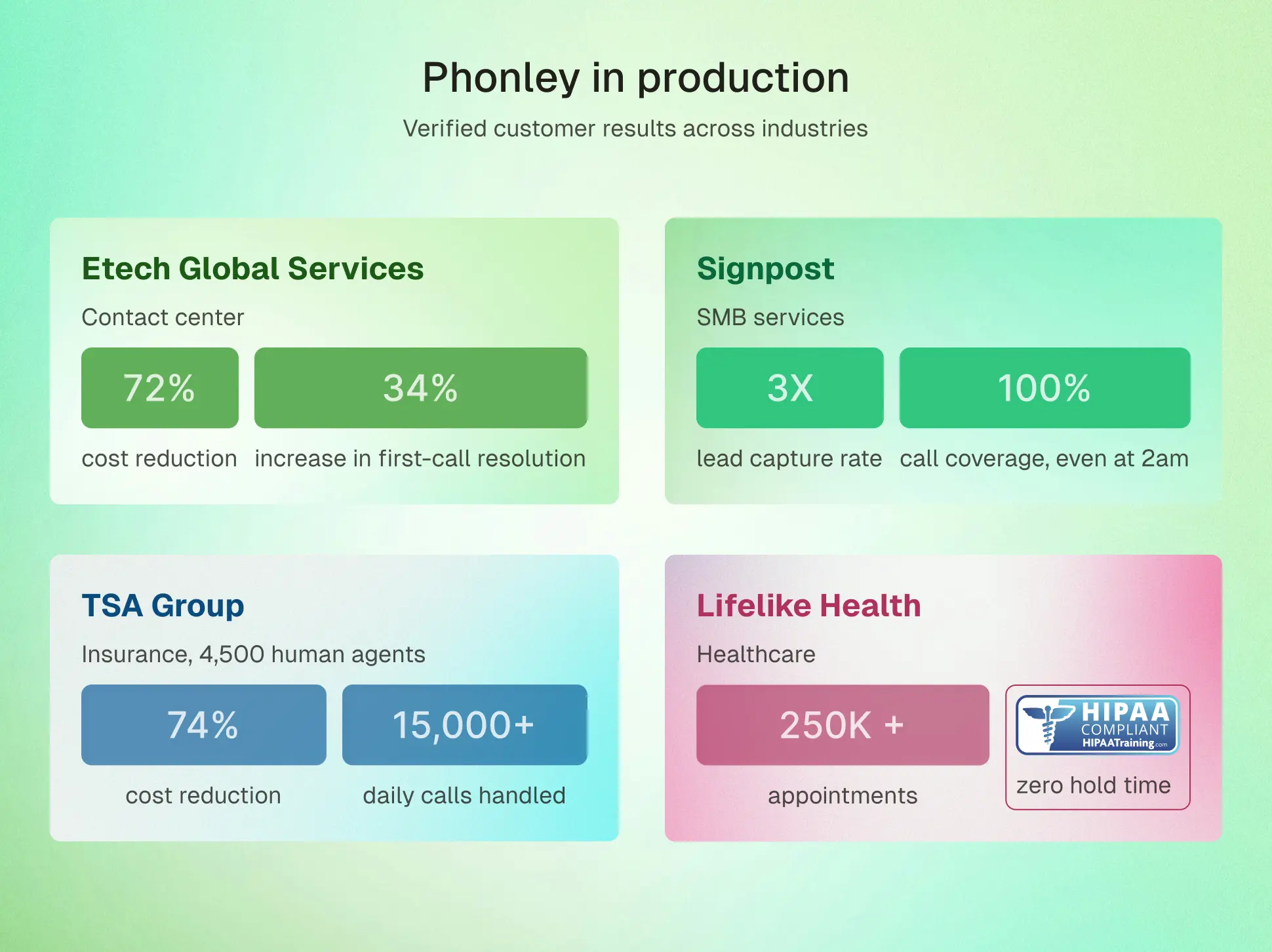
Here's what that looks like in production:
Best for: Teams that need omnichannel coverage, built-in analytics, and fast no-code deployment without engineering dependency.
Pros
- Omnichannel from day one: voice, chat, SMS, and API on a single platform
- 100 free minutes to test in production, not a limited sandbox
- 1,000+ voices with voice cloning across 100+ languages
- Visual workflow builder with no coding required
- AI summaries, sentiment analysis, and custom reporting built in
- Browser-based automations for tools without APIs
- SOC 2, HIPAA, CCPA, and PCI compliant
- Built by PhD researchers, trusted by Fortune 500 companies
Cons
- Pricing is not publicly listed on the website, which may slow down early-stage evaluation
- Enterprise deployments with complex workflows may require onboarding support from Phonely's dedicated team
- Newer platform compared to enterprise incumbents like Five9 or Cognigy
Pricing
100 free minutes to start. Start free or talk to sales.

2. Bland AI
Bland AI is an API-first voice platform for technical teams that want programmable control over call logic. You build conversation flows through Conversational Pathways, connect to CRMs via webhooks, and run agents across voice, SMS, and chat. Enterprise customers can self-host models on their own infrastructure.
Bland offers a visual Pathways builder, but enterprise deployments typically involve Bland's own forward-deployed engineers to handle implementation and integrations. Pricing is layered, with per-minute rates from $0.14 to $0.11 depending on plan, plus separate billing for transfers, SMS, and outbound attempts.
Best for: Engineering teams that want deep API control and can manage QA internally.
Pros
- Full API control over call flows, prompts, and routing
- Self-hosted model option for data residency requirements
- SOC 2 and HIPAA-ready
- Scales up to 100 concurrent calls on the Scale plan and unlimited calls on the Enterprise plan
Cons
- Implementation typically requires engineering resources or Bland's forward-deployed team
- Pricing layers (subscription + per-minute + transfers + SMS) make cost forecasting complex
Pricing
Free Start plan at $0.14/min. Build at $299/month ($0.12/min). Scale at $499/month ($0.11/min). Enterprise is custom. Transfers, SMS ($0.02/msg), and outbound attempts ($0.015/call) are billed separately.
3. Synthflow
Synthflow is a no-code voice AI platform with a visual Flow Designer, in-house telephony, and 200+ integrations. It supports voice, chat, SMS, and WhatsApp from a single platform.
Free to start with 5 concurrent calls and usage-based billing. Enterprise plans begin at 10,000+ minutes/month with unlimited concurrency and SIP trunking.
SOC 2 and ISO 27001 come standard. HIPAA is enterprise-only.
Best for: Teams that want a no-code setup with room to scale.
Pros
- No-code Flow Designer with multi-agent support
- In-house telephony with low latency and 99.99% uptime (SLA on enterprise)
- 4.5/5 on G2 with 1,000+ reviews
Cons
- HIPAA is restricted to an enterprise plan
- Per-minute cost typically $0.15–$0.24 after LLM and telephony
- White-label is $2,000/month outside the enterprise
Pricing
Voice engine $0.09/min + LLM + telephony. Enterprise is custom.

4. Vapi
Vapi is a developer-focused platform for building voice AI agents through a fully API-native architecture. Everything is exposed as an API, with support for bring-your-own models across transcription, LLM, and text-to-speech, including self-hosted options.
The platform supports 100+ languages, automated testing, A/B experiments, and tool calling for connecting external APIs. It integrates with 40+ apps, including Twilio, Salesforce, HubSpot, and ElevenLabs.
Best for: Engineering teams building custom voice stacks who want full control over every component.
Pros
- API-native with thousands of configurations
- Bring your own models for STT, LLM, and TTS
- 300M+ calls processed, 500K+ developers on platform
- Automated testing and A/B experimentation are built in
Cons
- The platform fee of $0.05/min is for hosting only. LLM, voice, and telephony are billed separately on top
- SOC 2 and HIPAA require an enterprise plan or paid add-ons (HIPAA is $1,000/mo on PAYG)
- Call history limited to 14 days on PAYG
- Requires developer resources for setup and management
Pricing
$0.05/min hosting + model providers at cost. 10 concurrent calls included, $10/extra line/mo. SMS/Chat at $0.005/msg. Enterprise pricing is custom with an annual contract.
5. PolyAI
PolyAI is an enterprise conversational AI platform focused on lifelike voice agents for enterprise teams. Its Agent Studio lets teams build once and deploy across voice, chat, and SMS, with integrations into Salesforce, NICE, and Genesys out of the box.
The platform covers 10 industries, including healthcare, insurance, financial services, and hospitality. Enterprise controls, escalation rules, and performance monitoring are built in.
Compliance covers SOC 2, HIPAA, PCI DSS, and ISO 27001.
Best for: Large contact centers that prioritize voice realism and need proven enterprise-scale deployment.
Pros
- Agent Studio for building, monitoring, and scaling agents across channels
- Direct integrations with Salesforce, NICE, and Genesys
- Proven at enterprise scale across 10+ industries
Cons
- No public pricing, requires a demo request
- Primarily a voice-focused enterprise platform, it may be more than smaller teams need
- Agent Developer Kit is still in beta
Pricing
Pricing is customized depending on your requirements.
6. Cognigy
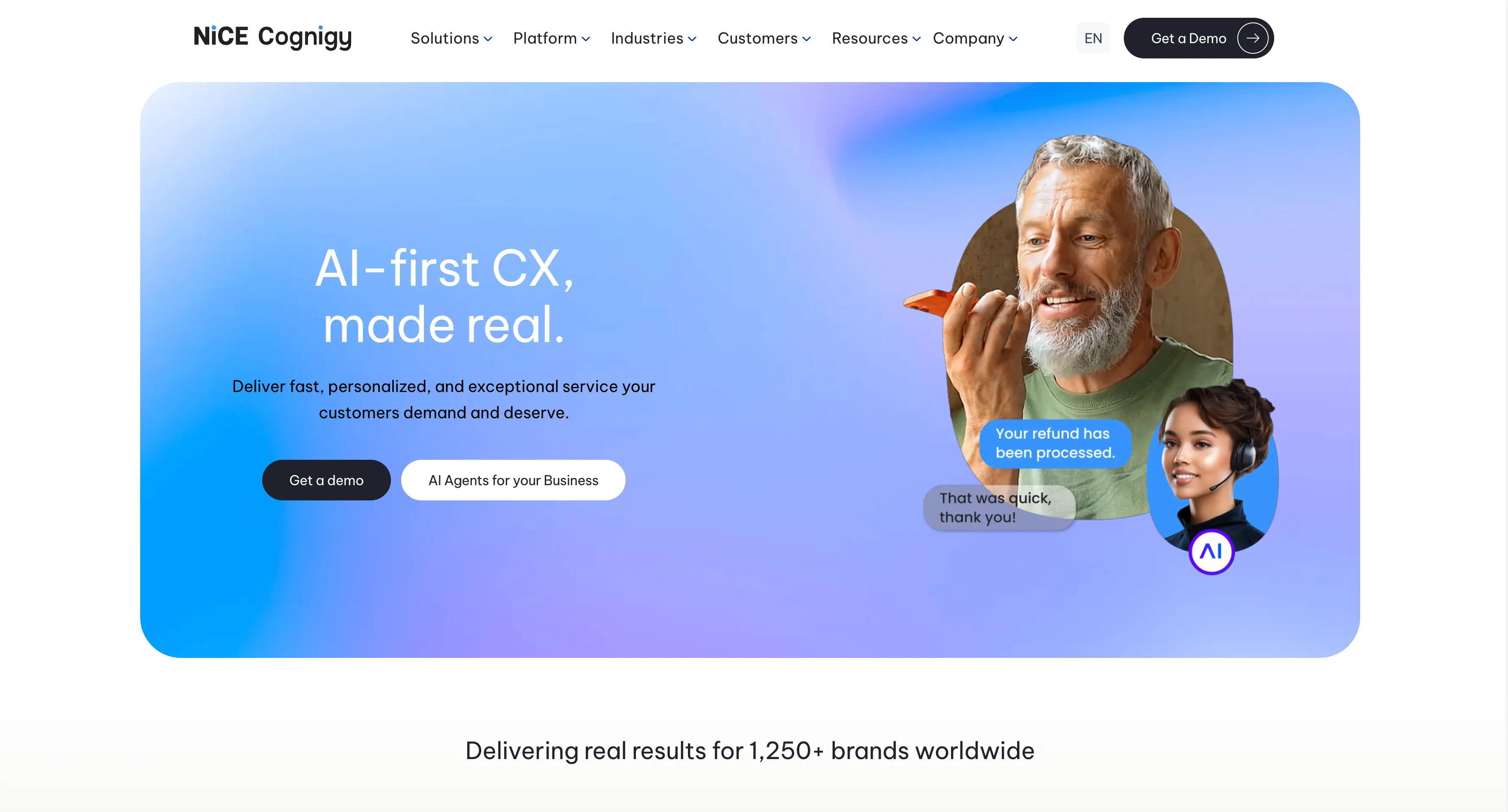
Cognigy (now NiCE Cognigy) is an enterprise conversational AI platform for voice, chat, and messaging with built-in Agent Copilot for live agent assist. It integrates directly with Avaya, AWS, Genesys, NICE, Microsoft, and 8x8.
The platform serves 1,250+ brands, including Lufthansa, Toyota, DHL, and Frontier Airlines, processing 1 billion+ interactions annually. Named a Leader in the Forrester Wave™ 2026 for Conversational AI Platforms.
Best for: Global enterprises with complex contact center stacks needing omnichannel orchestration.
Pros
- Forrester Wave™ 2026 Leader in Conversational AI
- Direct integrations with 6 major contact center platforms
- Agent Copilot for real-time live agent support
- 1Bn+ annual interactions across 1,250+ brands
Cons
- No public pricing, enterprise sales process required
- Broad feature set may require onboarding and training
- Primarily focused on large enterprise deployments
Pricing
Pricing is customized depending on your requirements.
7. Five9
Five9 is a cloud contact center (CCaaS) platform with built-in AI capabilities through Genius AI. It covers voice, email, chat, SMS, social, mobile, and video as native channels, with AI Agents, AI Agent Assist, AI Summaries, and Workflow Automation layered on top.
The platform serves 3,000+ global customers, including Alaska Airlines and Exact Sciences, and has been named a Gartner Magic Quadrant Leader for CCaaS 8 times. Five9 claims 99.999% uptime.
Best for: Teams already running Five9 infrastructure or contact centers looking for a full CCaaS platform with native AI.
Pros
- Gartner Magic Quadrant Leader for CCaaS, 8 times
- Omnichannel across voice, email, chat, SMS, social, mobile, and video
- Built-in AI Agent Assist, AI Summaries, and Workforce Engagement
- 3,000+ customers with 99.999% uptime
Cons
- Full CCaaS platform, not a standalone voice AI tool
- Pricing requires a custom quote via their pricing page
- Best suited for teams that need a complete contact center stack
Pricing
Five solution bundles available. Pricing requires a custom quote.

8. Sierra
Sierra is an AI agent platform built around brand-aligned customer experiences. Its Agent OS lets teams deploy a single agent across chat, SMS, WhatsApp, email, voice, and ChatGPT, with or without engineering support.
The platform includes Ghostwriter for building production-ready agents from SOPs and transcripts, plus built-in Insights, Experiments, and Live Assist. Customers include SoFi, SiriusXM, Rocket Mortgage, WeightWatchers, and DIRECTV.
Compliance covers SOC 2, ISO 27001, ISO 42001, HIPAA, and the EU AI Act.
Best for: Customer-centric brands that want personalized, brand-aligned AI across every channel.
Pros
- Single agent across 6 channels: chat, SMS, WhatsApp, email, voice, ChatGPT
- Ghostwriter builds agents from SOPs, transcripts, and plain English
- Outcome-based pricing: pay for value delivered
- SOC 2, ISO 27001, ISO 42001, HIPAA, EU AI Act compliant
Cons
- No public pricing, outcome-based model requires sales engagement
- Enterprise-focused platform with major brand clientele
- Voice is one channel among many, not the primary focus
Pricing
Outcome-based, billed on value delivered rather than per minute or per seat.

How to set up Phonely as your Retell AI alternative
Moving from Retell to Phonely doesn't require a long migration or a dedicated engineering sprint. About 70% of businesses go live in under five minutes. The whole setup takes five steps:
Step 1: Start free or book a demo
Sign up for a free account to start testing with 100 free minutes, or book a demo if your team needs a walkthrough. No contracts, no commitments upfront.
Step 2: Choose from 1,000+ voices and teach your agent your business
Pick from over 1,000 natural voices across 100+ languages and accents, or clone your own voice directly from the platform. Then upload your knowledge base or connect your website so Phonely can learn how your business talks, what it offers, and how it handles customer questions.
Step 3: Plug into your existing tools with prebuilt integrations
Connect your CRM, appointment scheduling software, payment tools, and anything else your team relies on. Phonely's prebuilt integrations handle most of this out of the box. For tools that don't have an API, browser-based automations fill the gap without custom dev work.
Step 4: Go live on phone, SMS, and chat from a single platform
Deploy your agent across voice, SMS, chat, and API from one dashboard. No separate setup per channel. No stitching together third-party tools. Your agent runs consistently across every channel from the moment you launch.
Step 5: Turn every conversation into actionable insights
After every call, Phonely automatically generates AI summaries, sentiment analysis, and custom reports. Access everything through the built-in analytics dashboard or pipe it into your existing monitoring tools. You're not just answering calls. You're learning from everyone of them.
Ready to see it in action? Start free or talk to sales and have your first agent live in minutes.
Frequently asked questions
Which Retell AI alternatives work without developers?
Phonely, Synthflow, and Sierra all offer no-code builders that let operations teams launch and manage agents without engineering support. Phonely uses a visual workflow builder where about 70% of businesses go live in under five minutes. Synthflow has a visual Flow Designer. Sierra's Ghostwriter builds production-ready agents from SOPs, transcripts, or plain English.
Bland AI and Vapi are developer-first. PolyAI, Cognigy, and Five9 are enterprise platforms where setup typically involves the vendor's team.
Can I use a Retell AI alternative for healthcare or other regulated industries?
Yes, but compliance coverage varies significantly across platforms.
Phonely holds SOC 2, HIPAA, CCPA, and PCI certifications. PolyAI covers SOC 2, HIPAA, PCI DSS, and ISO 27001. Sierra lists SOC 2, ISO 27001, ISO 42001, HIPAA, and the EU AI Act.
Other platforms have restrictions. Synthflow only offers HIPAA on its enterprise plan. Vapi charges $1,000/month for HIPAA as an add-on. Bland AI describes itself as HIPAA-ready rather than HIPAA-compliant. Always verify directly with the vendor before deploying in a regulated environment.
How does Retell AI's pricing actually break down?
Retell AI's headline rate starts at $0.07 per minute, but total cost depends on your LLM, TTS provider, and add-ons.
Branded caller ID adds $0.10 per outbound call. Verified numbers cost $10/month each. AI quality assurance runs $0.10 per minute on top. At high volumes, these layers make monthly spend significantly harder to forecast than the base rate suggests.
Retell offers $10 in free credits to start, though actual minutes depend on your LLM and voice provider. Phonely offers 100 free minutes upfront, no configuration needed.