.jpg)
Key takeaways
- AI IVR outperforms traditional IVR on resolution, personalization, cost, and scalability. Traditional IVR still fits low-volume, simple routing setups.
- According to Gartner, traditional IVR only resolves 14% of service issues through self-service. AI IVR bridges that gap using speech recognition, intent understanding, and real-time action.
- McKinsey's 2025 research found that AI agents in contact centers cut cost per call by 50% while improving customer satisfaction. Phonely customers like Etech Global Services have reported 72% cost reductions.
- Most businesses can switch from traditional IVR to AI IVR in days, not months. This guide walks through the four steps.
Most businesses already know their phone tree frustrates callers. What's changed is that there's now a system that can actually resolve calls, not just route them. This guide breaks down how traditional IVR and AI IVR compare, where the real differences show up, and what it takes to make the switch.
What is traditional IVR?
Traditional IVR (interactive voice response) is the phone tree technology that's been routing customer calls since the early 1990s.
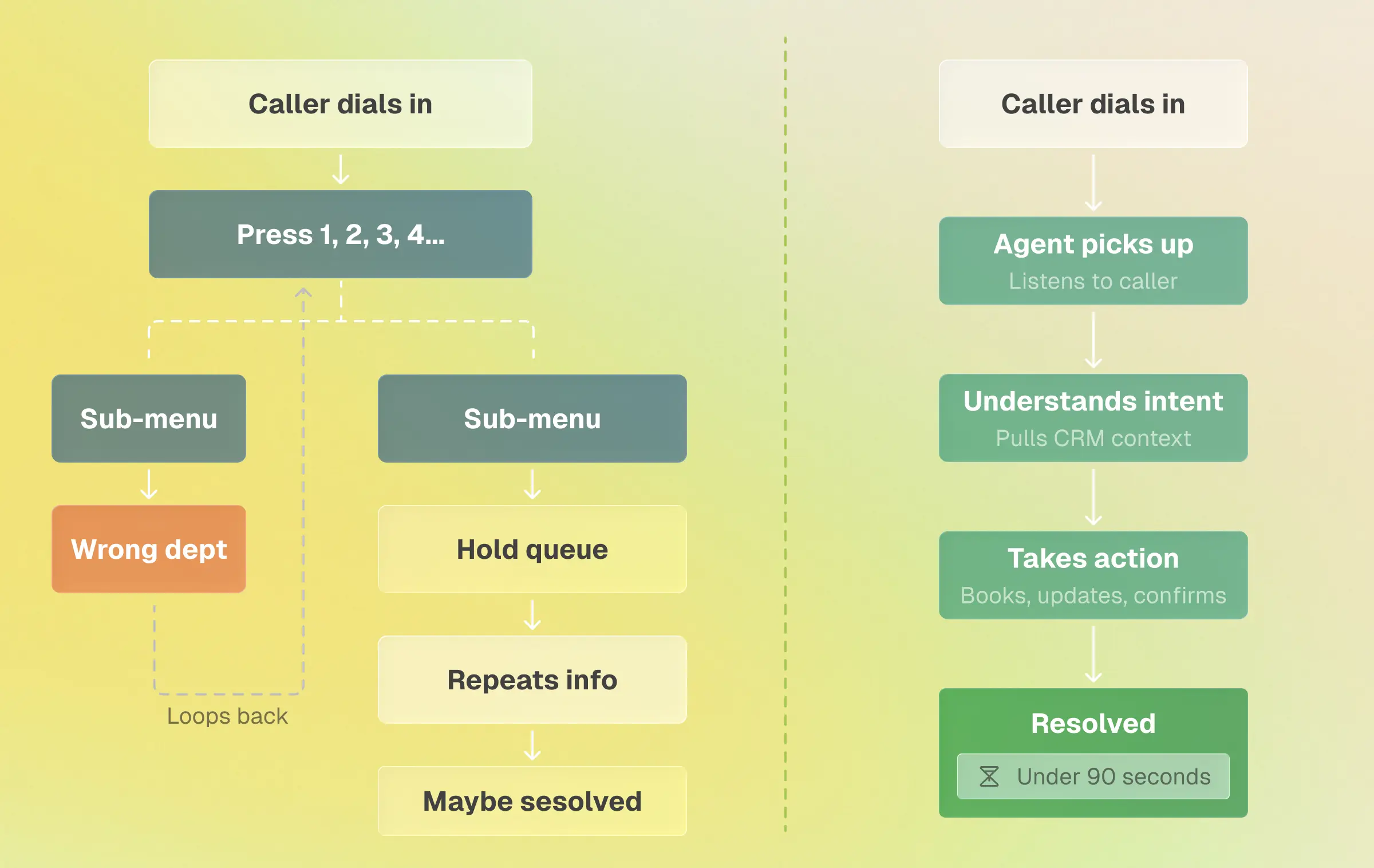
Callers navigate a fixed keypad menu, pressing 1 for billing, 2 for support, until they reach the right department or hit a dead end.
For simple tasks like checking a balance or confirming store hours, it gets the job done. But the moment a caller's issue doesn't fit neatly into the menu, they either loop back to the start or sit in a hold queue.
Where traditional IVR falls short
The system can only handle what it was pre-programmed for. There's no room for context, nuance, or a caller who just wants to explain their problem in plain English.
Gartner's 2024 research found that just 14% of service issues get fully resolved through self-service, and 45% of customers said the system didn't even understand what they were trying to do. It's not that the technology is broken. It's that customer expectations have moved on, while the phone tree hasn't.
38% of callers now abandon before the one-minute mark. Not because people don't want help, but because the system isn't giving it to them fast enough.
Traditional IVR was built when callers had patience and no alternatives. That's no longer the case, and AI IVR is picking up where the phone tree left off.
What is AI IVR?
AI IVR replaces the fixed phone tree with a conversational AI agent that listens, understands what the caller needs, and responds in natural language.
There's no menu. No keypad. The caller raises their concern, and the system figures out the rest. It can handle multi-part requests, ask clarifying questions, and take action during the call, not just route it.
How AI IVR works
Traditional IVR matches a keypad input to a branch on a decision tree. AI IVR operates on a completely different stack:
Speech recognition (ASR) converts the caller's voice to text in real time. Modern models handle accents, background noise, and informal phrasing without needing the caller to slow down or repeat themselves.
Natural language understanding (NLU) determines what the caller actually means. "I want to cancel" and "I'm thinking about leaving" point to the same intent, and the system recognizes that.
Large language models retain context across a full conversation, generate natural responses, and decide when to act versus when to ask a follow-up question. This is what separates AI IVR from older speech-enabled menus that could recognize a few keywords but couldn't hold a conversation.
Why businesses are moving to AI IVR
The technology has caught up with expectations. Gartner projects that by 2029, AI will autonomously resolve 80% of common service issues, driving a 30% reduction in operational costs.
But this isn't about removing humans from the equation. A 2025 Gartner poll of 163 customer service leaders found that 95% plan to keep human agents and use AI to handle the routine volume so their teams can focus on complex, high-value calls.
That balance is exactly what platforms like Phonely are designed around. The AI handles the calls it can resolve. The ones it can't get routed to your team with full context, so nobody starts from scratch.
How does AI IVR compare to traditional IVR?
Here are the key differences across the features that matter most when evaluating both systems:
What are the key differences between AI IVR and traditional IVR?
Personalization vs one-size-fits-all scripts
Traditional IVR delivers the same menu to every caller. A ten-year customer with a quick question hears the same eight options as a first-time caller with a complex issue.
That disconnect carries real cost. McKinsey found that 71% of consumers expect personalized interactions and that fast-growing companies drive 40% more of their revenue from personalization than their slower-growing peers.
AI IVR addresses this by connecting to your CRM and customer data in real time. It can greet returning callers by name, reference their last interaction, skip irrelevant steps, and adapt responses based on account history, which altogether create a pleasant and personalized experience. Phonely's prebuilt integrations pull this data from your existing tools automatically, so the AI has full context before the caller finishes their first sentence.
Cost and scalability
Traditional IVR keeps costs predictable but doesn't reduce them. You still need the same number of live agents for everything the menu can't handle. Scaling means more branches, more agents, or both.
AI IVR absorbs the call volume that would otherwise require human agents. McKinsey's 2025 research found that companies introducing AI agents into their contact centers saw a 50% reduction in cost per call while customer satisfaction scores went up.
Phonely customers are already seeing this at scale. Etech Global Services reported a 72% cost reduction with a 34% increase in first call resolution. TSA Group, with 4,500 human agents on staff, handles 15,000+ calls a day through Phonely and found that the AI agents resolve calls better than their top performers.
Integration with your business systems
Traditional IVR integrations are limited and fragile. Connecting a new tool usually means a custom development project, and changes to any connected system can break the call flow.
AI IVR platforms work differently. The AI reads customer records to personalize the call, then books appointments, updates CRM fields, and sends confirmations while the caller is still on the line.
Phonely connects to CRMs, scheduling tools, and payment systems through prebuilt connectors. For tools without a formal API, it uses browser-based automations so even legacy software stays part of the workflow.
Which system fits your business?
How do you switch from traditional IVR to AI IVR?
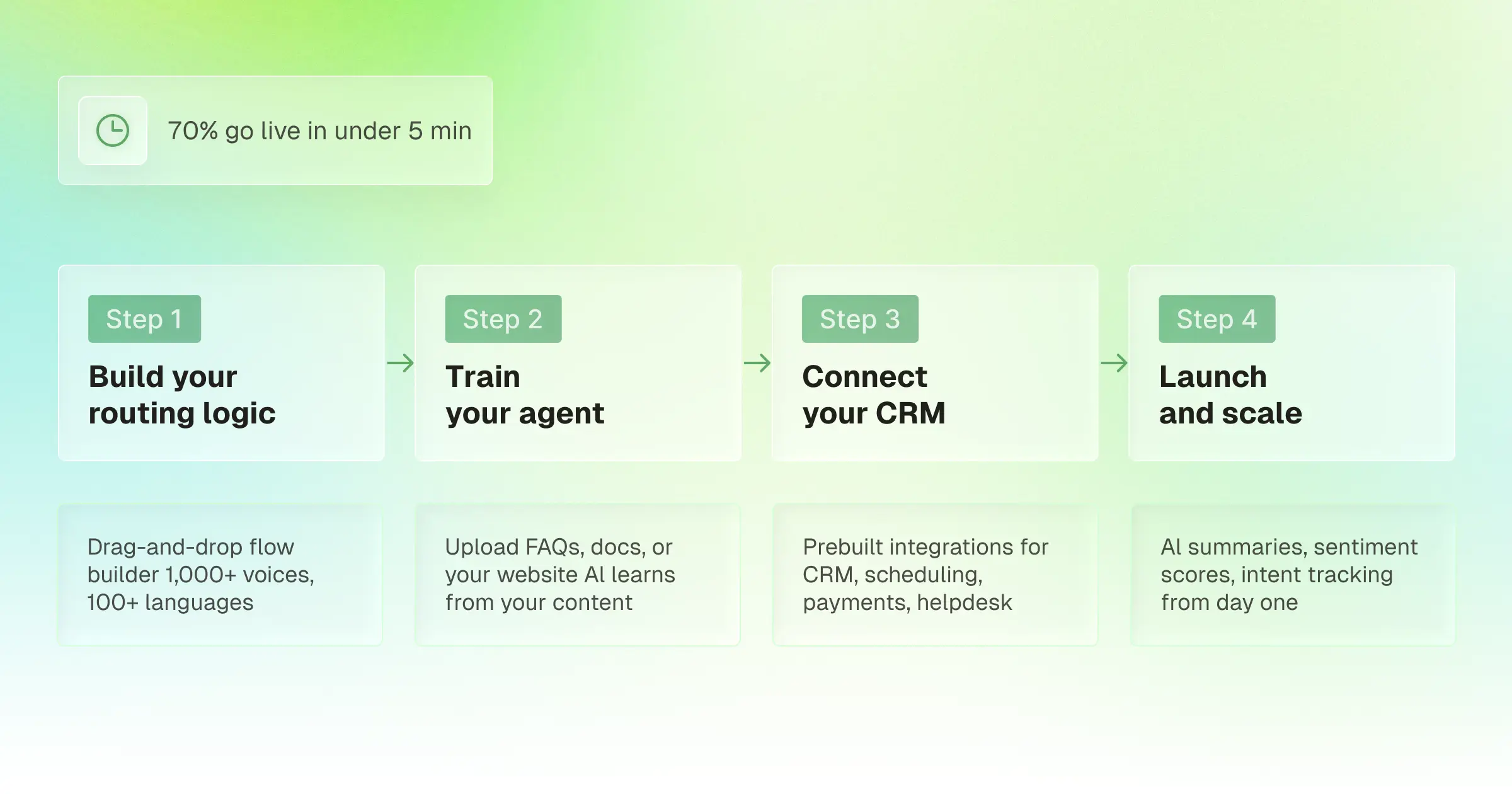
Switching sounds like a big project, but most businesses are up and running faster than they'd expect. Phonely is designed for speed. 70% of businesses get started in under 5 minutes. Enterprise deployments with advanced workflows and compliance requirements take longer, but Phonely's team handles the setup alongside you.
Here's what the process looks like:
Step 1: Build your routing logic in the visual flow builder
Map out how calls should be handled using Phonely's drag-and-drop flow builder. Set up greeting prompts, decision points, transfers, and fallback paths without writing any code. You can customize conversation flows, call scripts, tone of voice, routing logic, qualification questions, and escalation paths, all from one interface.
This is also where you choose how your agent sounds. Pick from 1,000+ natural voices across 100+ languages and accents, or clone your own voice directly from the platform.
Step 2: Train your agent on your knowledge base
Upload your FAQs, policy documents, product guides, or connect your website. Phonely learns from your content and uses it to answer caller questions accurately. The more context you give it, the more calls it handles without needing a human.
Step 3: Connect your CRM and phone system
Link your existing tools using Phonely's prebuilt integrations. CRM, scheduling software, payment systems, and helpdesk. Your AI agent can then book appointments, update records, and trigger workflows during live calls, not after them.
For tools that don't have a formal API, Phonely uses browser-based automations to connect them, so even legacy systems stay part of the workflow.
Step 4: Launch and scale with post-call analytics
Go live and start tracking performance from day one. Every call generates an AI summary, sentiment score, and intent classification through Phonely's call analytics dashboard. You can build custom reports inside the platform or pipe the data into your existing monitoring tools.
Use these insights to spot gaps in your knowledge base, fine-tune call flows, and measure resolution rates. This is the feedback loop traditional IVR never had.
Upgrade your IVR with Phonely
Traditional IVR served its purpose for three decades. But caller expectations have changed, and static phone trees can't keep up.
AI IVR gives your callers faster resolutions, your team fewer repetitive calls, and your operation room to scale without scaling headcount.
Phonely brings this together in one platform. Conversational AI agents with 1,000+ voices, prebuilt integrations, real-time analytics, and enterprise-grade security (SOC 2, HIPAA, GDPR, PCI). Built by PhD researchers. Trusted by Fortune 500 companies.
Your first 100 minutes are free. Start free or talk to sales.
Frequently asked questions
Can AI IVR fully replace traditional IVR?
For most use cases, yes. AI IVR handles everything traditional IVR does (routing, information delivery, data collection) and adds the ability to resolve calls through natural conversation. Some businesses keep a basic keypad fallback for edge cases like poor audio quality or accessibility needs, but the primary call flow runs through the AI agent.
How long does switching take?
It depends on complexity. 70% of businesses get started with Phonely in under 5 minutes for a basic setup. Mid-market and enterprise deployments with custom integrations, compliance configurations, and multi-department routing typically take days to a few weeks, with hands-on support from Phonely's team.
Is AI IVR secure enough for healthcare and finance?
Yes. Security is where the gap between providers shows up fast. Phonely supports SOC 2, HIPAA, GDPR, CCPA, and PCI compliance as standard. Protection covers phone calls, SMS, email, and other channels through encryption, access controls, and strong data-handling practices. For regulated industries like healthcare and financial services, this isn't optional. It's the baseline.