
Key takeaways
- AI voice agents engage in real-time conversation with callers to understand intent and route calls intelligently, whereas traditional IVR systems force callers through rigid, linear menu trees that require multiple selections before reaching resolution.
- AI voice platforms are projected to reduce agent labor costs by $80 billion in 2026.
- AI voice agents understand natural speech and access live customer data during calls without requiring callers to navigate menus or press buttons.
- AI voice agents cut costs with fewer abandoned calls, higher first-call resolution, lower agent turnover, and reduced labor spend.
- Technical requirements for AI voice systems include CRM integration and compliance certifications with deployment through prebuilt connectors.
Seven in ten companies say their phone menu resolves less than a third of the calls it handles. The other two-thirds get bounced to a human, or give up before they get there. AI voice agents work differently: the caller speaks naturally, is understood on the first try, and is resolved or routed without pressing a single button.
Contact centers rely heavily on traditional IVR systems to handle incoming calls. These menu-driven tools became the industry standard, cheap, predictable, and ultimately frustrating for customers. But the competitive landscape is shifting.
Phonely, in partnership with TSA Group, is bringing voice AI to contact centers that can prepare your organization for higher call volumes, faster resolutions, and lower costs.
Key differences between AI Voice Agent and traditional IVRs
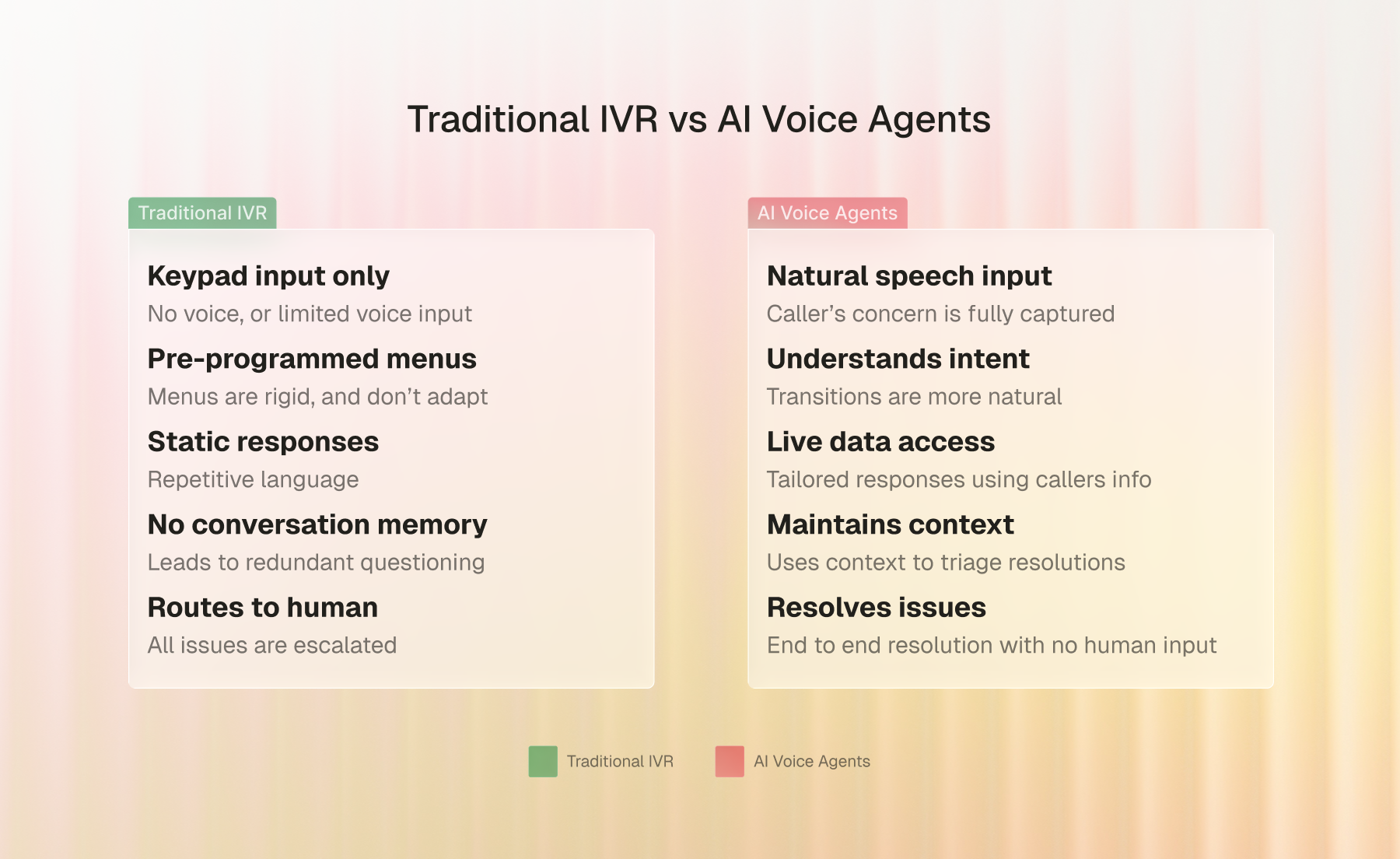
AI voice agents and traditional IVR systems both handle incoming calls automatically. But how they work is fundamentally different.
The hidden costs of outdated phone systems
Traditional IVR systems advertise simple pricing. Cloud solutions average $15 to $150 per user monthly. On-premise systems require $500 to $25,000 upfront plus ongoing maintenance.
The advertised number is rarely the real cost.
Hidden expenses add up:
- Phone numbers: $5 to $10 monthly per local number, $10 to $30 monthly per toll-free number
- Per-minute telephony charges for inbound and outbound calls
- Voice recording: $200 to $10,000, depending on complexity
- Premium support: 10 to 30 percent more monthly
Upkeep is where IVR costs pile up. Replacing worn hardware, running software upgrades, and reconfiguring menus for any small change are all steps that incur a separate charge, and they keep coming long after setup.
On-premise systems require regular maintenance and IT personnel salaries. Those are ongoing expenses on top of initial setup costs.
Total cost of ownership includes setup fees, customization, integration costs, storage fees, and telecommunications charges. According to Gartner, labor expenses can represent up to 95% of contact center costs, and conversational AI deployments are projected to reduce agent labor costs by $80 billion in 2026.
AI voice platforms replace this cost structure with transparent per-minute pricing.
How AI voice agents outperform IVR phone systems
Traditional IVR systems route calls using pre-programmed decision trees. The caller presses buttons or speaks keywords. The system branches based on input. Each branch leads to another menu or a transfer.
AI voice agents listen, understand intent, access live data, and take action inside connected systems during the call, and only transfer when necessary.
How AI voice agents work differently from IVR
AI voice agents use natural language understanding to detect caller intent from spoken sentences, which leads to a more dynamic conversation when compared to traditional IVR with rigid menu trees.
What this means in practice:
- Processes full context, not just keywords
- Handles follow-up questions mid-conversation
- Switches topics without losing the thread
- Asks for clarification when needed
Real example: A caller says, "I got a letter saying my premium went up, but I never got a renewal call."
An IVR system hears "premium" and routes to billing.
An AI voice agent doesn’t hear a keyword and route to a queue. It responds in real time. The caller never presses a button, never repeats themselves, never gets transferred. Two issues in one conversation, under three minutes.
Integration capabilities matter
IVR systems trigger basic actions like creating tickets or sending confirmation emails. They cannot pull live customer data, update records during calls, or execute multi-step workflows.
AI voice agents connect directly to CRMs, schedulers, payment processors, and help desks through APIs. When a caller asks about a specific claim, the agent pulls up the claim, updates information in the system, lists outstanding items, and emails a summary before the call ends.
There’s no ticket backlog, follow up or after call work necessary. The voice agent handled the end-to-end.
AI agents' hidden advantage: customer insights
Every call through a traditional IVR is a black box. You know the caller pressed 2, then 4, then hung up. You don't know what they actually wanted, what words they used, or why they gave up. The data ends at the keypad.
AI voice agents turn every call into structured data. Because the agent transcribes and understands the full conversation, you get a record of what callers are actually asking for, in their own words: Which questions spike on Mondays. Which product does the renewals team keep fielding complaints about? Where callers hesitate before they convert.
With AI voice agents, you're turning your phone conversations into a live read on what customers want and where your business needs to improve. The data is actively surfaced, whereas with an IVR, it's blindly tagged as dead air or caller hung up.
Choosing AI voice agents over IVR for your business
Contact centers handling high call volumes with repetitive requests see the clearest return. FAQs, appointment scheduling, order status checks, and account lookups are workflows where AI voice agents deliver immediate value.
The per-call economics matter. Traditional call center operations cost significantly more per call when a human agent handles it compared to AI voice agents handling the same request.
Every abandoned call is lost revenue and a frustrated customer in one. Most phone customers say being placed on hold is their top grievance. Not bad agents or wrong answers. High call abandonment is most often the result of long hold times. Poorly designed phone trees with seemingly endless menu options test customer patience.
Where AI voice agents save you money
The savings go beyond the lower per-call cost of automation. They show up across the metrics that drive contact center spend:
- Fewer abandoned calls. Long hold times are the top driver of abandonment, and every abandoned call is lost revenue and a frustrated customer. AI picks up on the first ring, so callers aren't waiting in a queue to begin with.
- Higher first-call resolution. When routine issues are resolved on the first contact, you cut the repeat calls that inflate volume and cost. Fewer callbacks mean less load on your team.
- Lower agent turnover. Contact centers face high annual turnover, and each replacement costs thousands before a new hire is productive. Taking the repetitive calls off your agents' plates makes the job more sustainable and keeps experienced staff longer.
- Reduced labor cost. Labor can account for up to 95% of contact center costs. Automating routine, high-volume calls is where AI makes the largest dent, with conversational AI projected to cut agent labor costs by $80 billion in 2026.
- Better customer satisfaction. Faster answers and fewer transfers lift CSAT, which protects the revenue tied to customer retention.
Technical requirements for AI voice systems
Deploying an AI voice agent means connecting three things: your phone infrastructure, your CRM, and the business tools your team runs on. How each one connects depends on whether you're on cloud or on-premise, and how much you need synced back to your systems.
Moving from IVR to AI voice agents
Switching from IVR to AI voice doesn't require ripping out your existing phone system.
Most AI voice platforms plug into what you already have through a standard phone connection called SIP trunking. Your current phone provider keeps routing calls. The AI layer sits on top.
If you use cloud phone systems like Twilio, Vonage, or RingCentral, the connection takes minutes to a few hours through prebuilt integrations.
If you run on-premise phone systems, IT configures a SIP trunk connection. This takes a few hours but requires no hardware changes.
Your existing phone numbers stay the same. Customers dial the same numbers they always have. The switch happens on the backend.
CRM and database connections with AI agents
CRM integration determines whether an agent operates with full context or in isolation.
An agent connected to your CRM knows purchase history, open tickets, and prior interactions before the conversation begins.
Integration patterns:
- Native integration
- Prebuilt connectors
- Custom APIs
Successful deployments use bidirectional sync. The CRM reflects what happened on the call without manual updates.
Answer every call with Phonely
Future leaders in the call center space are the ones whose voice AI picks up the phone, holds the conversation, and knows when to bring in a human.
Fine-tuned models deliver speed and precision together. Security and compliance come built-in.
Every call your IVR drops is a customer who found their answer somewhere else. Phonely picks up on the first ring, handles the routine requests on the spot, and passes the rest to your team with full context.
Phonely and TSA Group bring together voice AI and decades of contact center experience, automating the routine calls and leaving your agents free for the ones that need a person.