
Warm Transfer vs. Cold Transfer
Key takeaways
- A warm transfer passes the caller to another agent with full context, while a cold transfer (or blind transfer) sends them through with no context. The difference drives higher customer satisfaction scores (CSAT), stronger first call resolution (FCR), and better retention on complex calls.
- Cold transfers are faster but force customers to repeat themselves, which is a top customer experience (CX) friction point.
- Manual warm transfers add 30 to 90 seconds per call, so understaffed contact centers default to cold transfers.
- AI voice agents flip the economics: context sharing and whisper messages deliver warm-transfer quality at cold-transfer speed.
- Use cold transfer for simple routing and warm transfer for VIPs, complex issues, sensitive calls, and sales handoffs.
Let’s understand how warm and cold transfers work in practice, when to use each, and how they impact key contact center KPIs such as CSAT, first call resolution (FCR), and average handle time (AHT).
We will also examine how AI voice agents are transforming call handoff workflows and delivering warm-transfer quality at cold-transfer speed while removing the briefing overhead that has historically made context-rich transfers costly to scale.
What is a call transfer in a contact center?
A call transfer routes an active call from one agent to another agent, department, or queue, making it one of the most critical moments in customer experience.
Why are call handoffs the highest-friction moment in customer service?
A Gartner research shows that customer loyalty is built by reducing effort, not by exceeding expectations. The single biggest source of effort during a service call is repeating information, which almost always happens during a handoff.
What's the difference between warm transfer, cold transfer, and blind transfer?
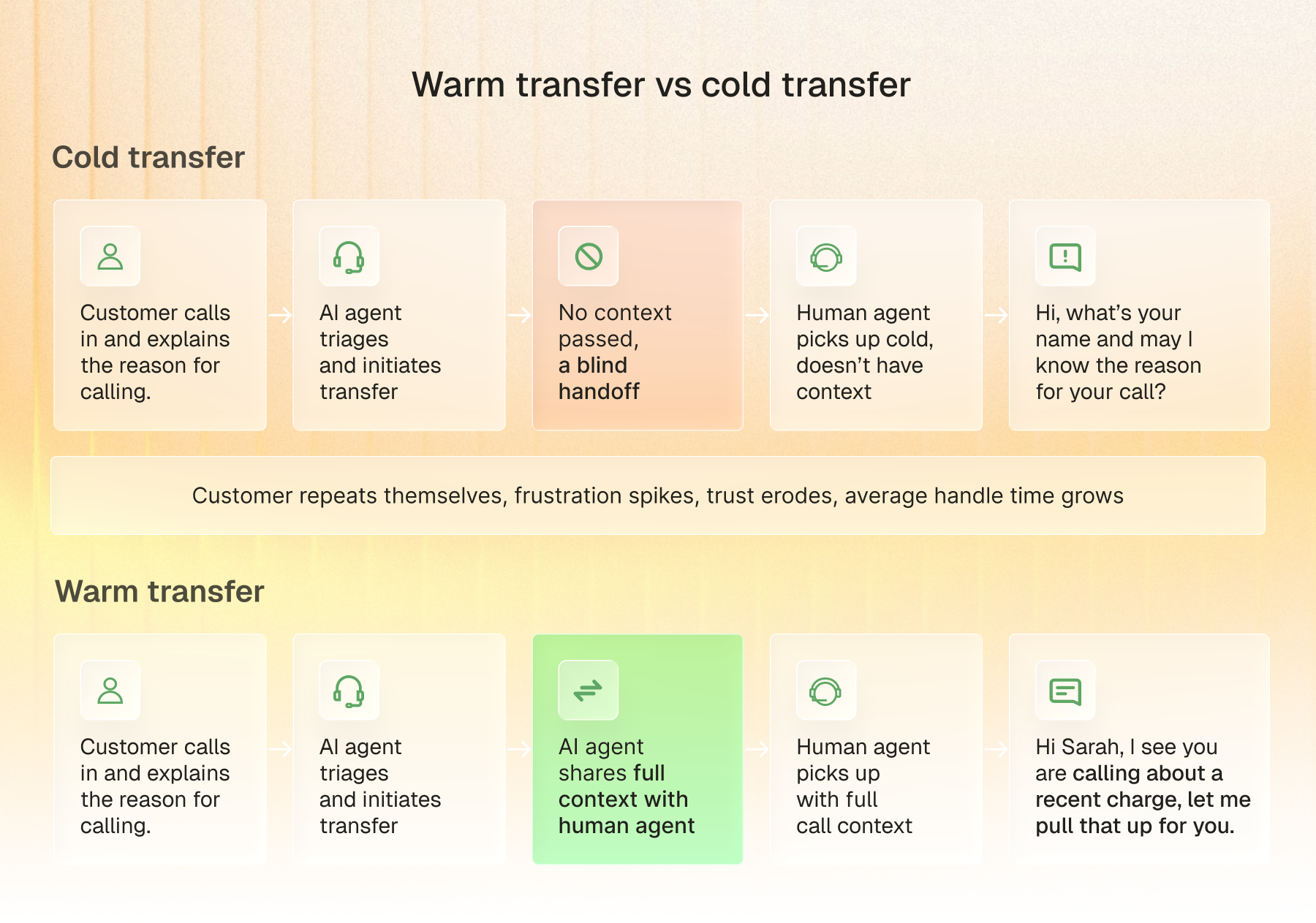
A warm transfer, also known as an attended transfer, involves a formal briefing where the initial agent provides the recipient with essential caller context before the handoff.
In contrast, cold or blind transfers are synonymous terms for a process that sends the caller through with zero context and no prior confirmation from the receiving agent.
What is a warm transfer?
A warm transfer is a handoff where the first agent briefs the receiving agent on the caller’s name, intent, and situation before transferring. It is also referred to as an attended transfer, a soft transfer, and a consultative transfer.
Modern platforms like Phonely let an AI voice agent execute the warm transfer automatically.
How a warm call transfer works step-by-step
1. The first agent takes the call and identifies if it needs routing.
2. Caller is placed on hold with a brief explanation.
3. The agent dials the receiving party and briefs them on the name, issue, and context.
4. The receiving agent confirms readiness.
5. The first agent completes the transfer, sometimes via a three-way introduction.
What are the characteristics of a warm (attended) transfer?
A warm transfer is defined by the following critical pillars:
- The preservation of caller context
- The receiving agent’s confirmation of readiness
- Clear communication with the customer regarding the handoff process.
Failure to execute any of these elements effectively causes the interaction to collapse into a cold transfer, merely adding unnecessary procedural steps without delivering the intended value.
Warm transfer example: What an attended transfer looks like in practice
A customer calls her bank about a fraudulent charge. This is exactly the kind of call a financial services AI template handles. Agent A briefs specialist Maya before transferring, so Maya opens with, "Hi, I see you're calling about the charge on your card ending in 4821." No repetition needed. That one detail turns a stressful moment into a reassuring one.
What is a cold transfer?
A cold transfer (sometimes called a blind, direct, or unattended transfer) is the most basic form of handoff. The first agent initiates the transfer, connects the call to the destination, and exits the conversation without speaking to the receiving agent.
What actually happens during a cold transfer?
A cold transfer follows a simple three-step sequence that most contact center agents can complete in under ten seconds:
- Accept the call. The first agent answers, identifies the caller's need, and decides another team or specialist is better suited to help.
- Click transfer. Using the phone system or cloud-based contact center software, the agent initiates a transfer to the appropriate queue, department, or extension.
- Dial the destination and disconnect. The agent sends the call to its new destination and immediately drops off the line.
If the destination line happens to be busy or unattended, the caller can end up in voicemail, stuck in another queue, or disconnected entirely. This kind of blind handoff is one of the leading causes of repeated calls and lower first-contact resolution rates.
Key characteristics of a cold transfer
A cold transfer is defined by four core traits that shape how the call is handled and how the customer experiences it:
- Zero context is passed along. The receiving agent gets no notes, no summary, and no background on the caller's issue. Everything the first agent learns stays with the first agent.
- No confirmation from the receiving agent. Because the two agents never speak, there's no way to verify the right person or department is actually available to take the call.
- The initial agent disconnects immediately. Once the transfer is triggered, the first agent is out of the picture, which means there's no safety net if something goes wrong mid-handoff.
- No guarantee of a successful pickup. The call may land in a queue, hit voicemail, or drop entirely, depending on the availability of the receiving line.
Cold transfer example: How a blind handoff plays out in practice
Same scenario: Agent A says, "Let me transfer you" and clicks transfer. The customer hears, "Fraud department, account number please?" and has to explain everything from scratch.
How warm and cold transfers affect customer satisfaction (CSAT) and call center efficiency
Handoff quality drives the metrics that matter most: CSAT, FCR, AHT, and retention, and shapes brand perception long after the call ends. McKinsey's research on the state of customer care highlights that the moments between agents are now a defining signal of CX quality.
Let’s take a look at how the two kinds of transfers impact customer experience and operational efficiency:
- The cost of making customers repeat themselves
Asking customers to repeat their name or account details exposes a workflow that wasn't designed around them, and effort is a stronger loyalty predictor than satisfaction. Cold transfers restart the conversation; warm transfers carry intent, history, and context forward, keeping the experience continuous.
- The hidden operational cost of poor handoffs
Re-explaining inflates AHT, and misroutes can push contact volume up 15–30%. Phonely's breakdown of contact center pricing shows where these costs hide and how smarter routing eliminates them.
- When speed beats context
Not every call needs a warm transfer. For simple misroutes or high-volume queues like order status, briefing overhead outweighs the benefit.
Warm transfer vs. cold transfer: side-by-side comparison
The table below compares warm and cold transfers across the six dimensions that matter most to a contact center:
Warm transfers carry the caller's story forward so the next agent continues seamlessly, while cold transfers drop context entirely, forcing customers to repeat information and quietly building friction into every handoff.
Cold transfers look efficient because the first leg ends quickly, but total AHT grows. Industry research and studies by SQM Group consistently show that transferred calls deliver a 12% lower CSAT and 14% lower First Call Resolution (FCR) than calls handled straight through.
Warm transfers flip that equation: the first agent's 30-60 second briefing raises personal AHT by 5-10%, but that small investment pays back in higher FCR, stronger CSAT, and better brand perception, while distributing workload evenly between agents instead of shifting it onto the customer.
And though manual warm transfers carry a tangible briefing cost, AI-powered warm transfers eliminate that operational overhead almost entirely, delivering context-rich handoffs with maximum call center efficiency.
When to use a warm transfer vs. a cold transfer
The decision to utilize a warm transfer versus a cold transfer is governed by three primary variables: the complexity of the issue, the lifetime value of the customer, and the emotional sensitivity of the situation.
Identifying these factors ensures that high-stakes interactions receive the necessary context, while routine inquiries are handled with maximum efficiency.
Best scenarios for warm transfers (high-stakes, sensitive, or complex calls)
Warm transfers are the ideal choice for managing VIP accounts, resolving multi-step technical issues, and navigating sensitive topics such as healthcare or financial services. They are equally critical for SDR-to-AE sales handoffs, where preserving context is essential to maintaining deal momentum.
Best scenarios for cold transfers (simple routing and internal handoffs)
Cold transfers are most appropriate for correcting wrong-department misroutes, directing callers to automated IVR destinations, or handling inquiries sufficiently simple that a manual briefing would result in more lost time than saved value.
How to handle call transfers the right way
Call transfers make or break customer experience, and doing them well comes down to four disciplined practices: pass customer context (who's calling, what they need, what's been tried) before connecting so agents avoid repetition and cut resolution time; train teams on short transfer scripts like "I'm connecting you with Sarah in billing, she has your details" to keep handoffs smooth; set clear call routing rules and escalation triggers to prevent misrouted calls and long queues; and measure success through warm vs. cold transfer ratio, post-transfer CSAT, FCR, and repeat-explanation rate, metrics that reveal the friction AHT alone hides.
How AI voice agents are redefining warm transfers
An AI voice agent captures the caller's full context and then carries it into the handoff automatically. The best contact centers blend AI and human agents like a unified team.
- Automatic call summaries and CRM updates before transfer
AI voice agents generate real-time call summaries and sentiment analysis, giving the receiving agent a complete case view the moment they connect.
- Cutting hold times and misroutes with AI-powered call routing
Fewer misroutes mean fewer cold transfers, shorter hold times, and lower average handle time (AHT).
Warm transfers used to mean a trade-off: better CX for slower calls. AI voice agents have eliminated that. McKinsey found early gen-AI deployments in customer care deliver gains across agent efficiency, operational costs, and CX at once.

Common warm transfer and cold transfer mistakes that hurt CX
Three mistakes account for most handoff damage:
- Sending a cold transfer without checking the agent's availability
The worst cold transfers are dropped calls. If the receiving line is unstaffed, the customer lands in voicemail. Always confirm availability first.
- Skipping context on high-stakes warm transfer calls
A warm transfer that skips the briefing is a cold transfer with extra steps. On complex or VIP calls, the briefing is the value.
- Failing to measure transfer quality with the right KPIs
Volume and duration alone tell you nothing. Add post-transfer CSAT, repeat-information rate, and FCR.
How Phonely powers effortless warm transfers
Phonely's AI voice agents qualify, authenticate, and resolve calls on the front end, then execute a contextual warm transfer in seconds. Warm transfer is available on Phonely's Professional plan and above.
Every call generates a structured summary, caller identity, intent, key facts, attempted resolutions, and sentiment, delivered to the receiving agent before they pick up.
Phonely integrates with your existing CRM and telephony stack, with ready-to-use templates you can adapt for industries like healthcare, legal, and real estate.