How To Improve First-Call Resolution Rates with AI
Key takeaways
- Intelligent routing improves first-call resolution by capturing caller intent before the call connects, loading customer context from the CRM in real time, deploying AI voice agents to resolve routine calls end-to-end, and routing complex calls to the right human with full context on the first try.
- The industry FCR benchmark is 70%, with 80% or higher qualifying as world-class. Every 1% improvement in FCR drives a matching 1% lift in customer satisfaction and a 1% reduction in operating costs.
- Nearly one in five calls (19%) gets transferred, and those transfers cut FCR by 14%. Intelligent routing addresses the root cause by reading caller intent in natural language and pulling CRM context before the call connects.
- The fastest FCR lever is AI-first triage. When AI voice agents resolve routine calls end-to-end, every contained call already counts as resolved on first contact. Phonely customers like Etech Global Services have lifted FCR by 34% using this approach.
What is a first-call resolution?
First-call resolution (FCR) is the percentage of customer issues fully resolved on the first interaction, with no callbacks, transfers, or follow-ups needed. It is one of the most predictive metrics in customer service because high FCR correlates directly with higher CSAT, lower operating costs, and stronger customer loyalty.
FCR calculation formula:
FCR Rate = (Issues resolved on first contact ÷ Total eligible interactions) × 100
SQM Group's 2025 research puts the industry-wide FCR average at 70%, meaning nearly one in three customers still has to call back about the same issue.
The financial case is just as direct. The same research ties the two sides together: a single point of FCR gain returns about a point of CSAT and shaves a point off operating cost. For a midsize operation, that compounds to roughly $286K in annual savings.
FCR ranks above almost every other contact center metric because it ties cost and experience. Every repeat call burns agent time on the front end and customer trust on the back end, so one point of improvement moves both sides of the ledger at once.
The two methods for measuring FCR
Calculating FCR is easy. Deciding what counts as resolved is where most teams go wrong.
- External measurement uses a post-call survey to ask the customer whether their issue was resolved. The customer decides. This is the method used for industry-standard benchmarks and the most accurate read on how your service actually feels.
- Internal measurement tracks whether the same customer calls back within a defined window, usually 1 to 30 days. It is easier to automate from CRM and call data, but the data shows it consistently inflates the FCR rate, running 10 to 20 points higher than customer-validated surveys, because the organization's view of resolution often diverges from the customer's.
Run both. External surveys set the honest baseline. Internal tracking gives operations a daily signal. If the two numbers drift apart, the gap is the insight. It usually means agents are closing tickets that the customer does not consider closed.
FCR also varies significantly by industry:
Source: SQM Group industry benchmarking. The 2024 benchmark report confirms the same ranking still holds, with retail leading and tech support and telco still trailing, and the aggregated average remaining near 70%.
Industry averages are starting points, not ceilings. Routing decides how much higher you can go.
What is intelligent call routing?
Intelligent call routing is the practice of directing every inbound call to the best available destination based on real-time signals, instead of forcing callers through a fixed menu tree. Where a traditional IVR asks the caller to sort themselves into a queue, intelligent routing uses caller intent, customer history, agent skills, and live availability to make that decision in the background.
The whole idea rests on one thing: the right call reaching the right destination on the first try, every time.
Most IVRs are a tax on your customer's time. McKinsey reports that seven in ten companies run an IVR that contains 30% or less of its calls, which means the system mostly just stalls callers before handing them to a human anyway. That is not automation. It is a more expensive way to delay the same conversation.
That failure shows up downstream as longer queues, more transfers, and lower first-call resolution.
Intelligent routing fixes the front door. By reading signals the caller has already given (the phone number they called from, the menu option they chose, what they actually said when prompted, the open case in your CRM), the system makes a routing decision before the caller has to explain anything twice.
Routing decisions usually pull from:
- Caller intent captured through natural language input or menu selection
- Customer history and account context are pulled from the CRM in real time
- Agent skills, language, and authority levels matched against the call type
- Live queue health and agent availability to avoid routing to a busy team
- Call priority based on account status, urgency, or SLA tier
When all five signals work together, transfers drop, average handle time shortens, and FCR rises. When one or two are missing, the system reverts to looking like a smarter version of a traditional IVR.
This is where the technology has shifted fastest. The old model assumed every call needed a human at the end of the line, and routing was about finding the right human. AI voice agents have changed the math.
For a growing share of routine inquiries, the right destination is no longer an agent on any team. It is an AI agent that can resolve the call entirely, with handoff to a human only when complexity demands it.
The point is that intelligent routing in 2026 is no longer just an agent-matching problem. It is a triage problem with more than one valid endpoint.
Traditional IVR vs. intelligent routing
Traditional IVR was built to be a switchboard. Intelligent routing is built to be a triage layer that thinks before it transfers. The difference shows up in every downstream metric: transfers, handle time, abandonment, and most directly, first-call resolution.
How intelligent routing improves FCR
Every call that lands on the wrong agent or in the wrong queue starts a friction chain: hold, transfer, context loss, re-explanation, escalation, callback. Each step adds time and erodes the chance of resolution on the first interaction.
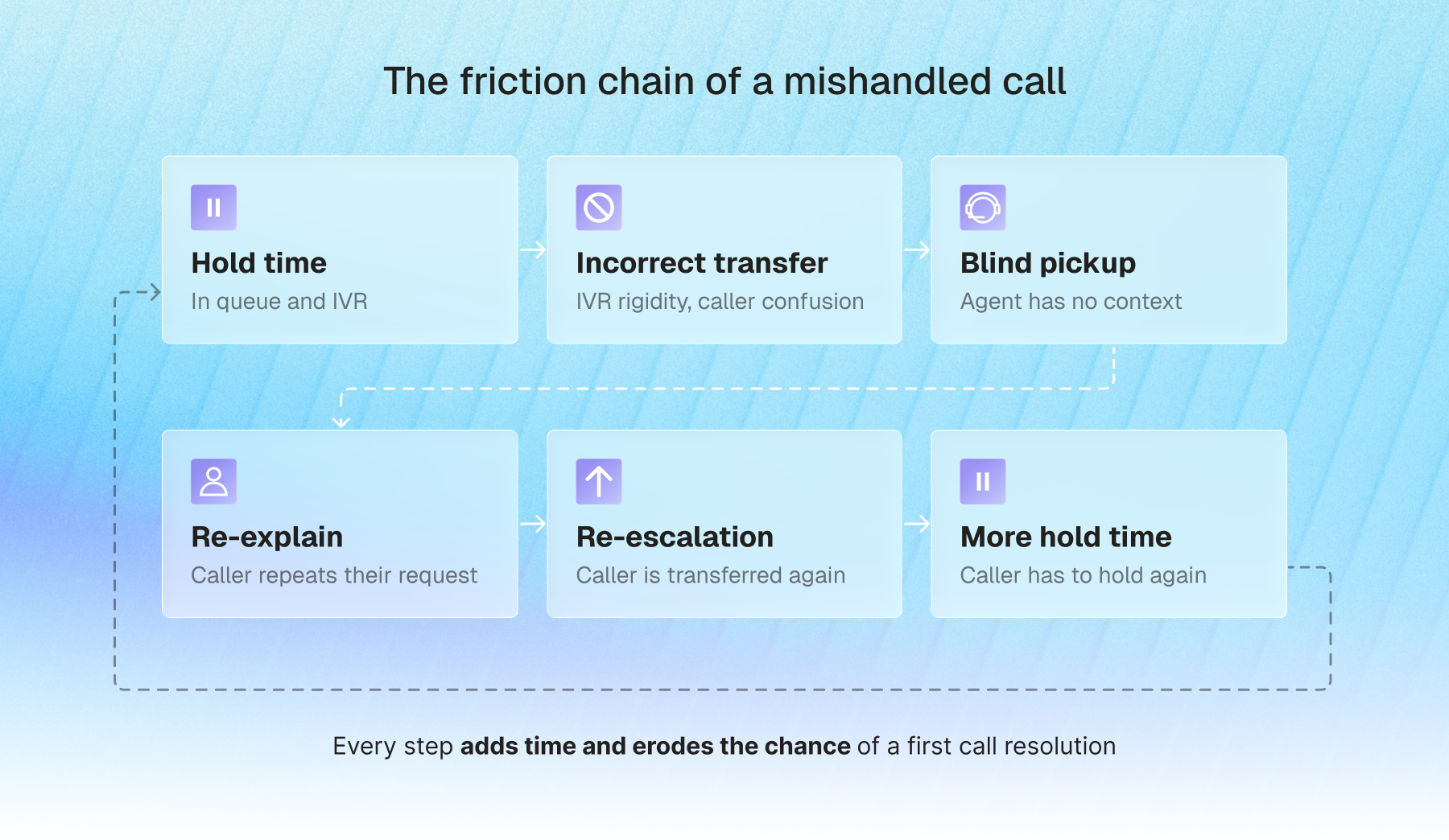
Intelligent routing interrupts that chain at four points:
- It eliminates wrong-team starts.
Research shows that 19% of calls in the average contact center end up transferred to another agent, and FCR drops by 14% on transferred calls.
The research points to two main causes: the IVR did not route the customer to the right agent, and gaps in agent knowledge or skills.
Intelligent routing addresses the first one directly.
- It preserves customer context.
McKinsey notes that most companies still operate non-personalized IVR systems, where every caller is treated the same, regardless of the data already available.
Intelligent routing pulls account data, recent interactions, and open cases from the CRM before the call connects, so the agent starts the conversation already up to speed.
- It matches authority to the call, not just skill.
Calls that land with an agent who needs to escalate for a refund, credit, or service exception become near-certain non-FCR calls.
Mature intelligent routing systems can route by authority tier alongside skill set, so the resolution happens in the same interaction.
- It hands routine calls to AI.
This is the shift that moves FCR fastest.
For routine, high-volume call types like account checks and payment status, an AI voice agent handles the call end-to-end, with no queue, transfer, or callback. Complex calls still move to a human, but with full context and the right authority tier already selected.
These four mechanisms compound, which is why intelligent routing is one of the highest-impact levers on FCR.
Steps for improving FCR resolution rates
Five steps turn intelligent routing into FCR gains: capture intent before routing, load context before answering, let AI resolve what AI can resolve, route the rest to the right human on the first try, and tune the system weekly.

Each step earns a few percentage points on its own:
Step 1: Capture caller intent before the call connects
Most contact centers gather intent the slow way: a menu tree that forces callers to translate their problem into the company's taxonomy. Intelligent routing starts earlier.
Two changes to make:
- Replace the first menu prompt with a natural-language opener like "In a few words, what brings you in today?" NLU extracts intent from the answer.
- Run pre-call lookups against caller ID, recent activity, and open tickets. The system has a working hypothesis about the call before the caller speaks.
When intent classification happens at the start, every downstream routing decision has something real to work with. Without it, the rest of the system is operating on a guess.
Step 2: Pull customer context from your CRM in real time
A routing decision without context routes the call correctly to the wrong starting point.
Connect the routing layer to:
- The CRM (account status, contract tier, lifecycle stage)
- Order and case management (recent transactions, open tickets, last interactions)
- Identity and authentication systems (verified status, fraud flags)
The goal is that whoever answers the call, a human agent or an AI agent, opens with the customer's full picture instead of a blank screen.
Step 3: Let an AI voice agent resolve routine calls end-to-end
The fastest FCR move is removing routine calls from the human queue entirely.
Account balance checks, appointment confirmations, payment status updates, and basic policy questions do not need a human agent. They need a competent voice that can pull a CRM record, give an answer, and close the loop.
Every call an AI agent resolves end-to-end counts as a first-call resolution by definition. If routine calls make up a meaningful share of your inbound volume, automating them lifts your blended FCR without changing how human-handled calls perform.
Step 4: Route complex calls to the right human on the first try
For everything the AI agent does not handle, the routing system needs to choose the right human agent the first time, not the third.
Three signals matter most:
- Skill match. Has this agent successfully handled this call type before?
- Authority match. Does this agent have the authority to make the decision the call requires, like a refund, exception, or credit?
- Live availability. Is the agent actually free, not "available but at lunch"?
Where all three work together, transfers fall and FCR climbs. Where anyone is missing, the call still has a good chance of starting in the wrong place.
If the AI agent gathered notes before handing the call off, pass them through. A human picking up with context already loaded answers faster than one who has to re-extract the story.
Step 5: Analyze every call and tune your routing logic
Routing logic that is not reviewed becomes routing debt.
Set up a weekly review of three signals:
- Misroute rate. Calls that needed a transfer after the first connection.
- AI-to-human escalation rate. Calls the AI passed to a human, broken down by reason.
- Repeat call rate within 7 to 14 days. The truest signal of non-FCR.
Each signal points to a different fix. A high misroute rate usually means an intent model or CRM field needs work. A spike in AI escalations usually means a new edge case that the AI has not been trained on. A high repeat call rate often means a policy or process problem, not a routing one.
Treat routing as a product, not a project. Ship one change a week. Watch what moves.
Each step makes the next more effective. Tune them weekly, and the gains compound. The next section ranks the specific strategies that move FCR fastest once the five-step foundation is in place.
4 intelligent routing strategies that move FCR the fastest
Most intelligent routing systems use a combination of four strategies, not just one. Each handles a different question: who is calling, what they want, who can solve their problem, and whether a human is needed at all.
The fastest FCR gains come from layering them, not picking between them:
- Skills-based routing
Skills-based routing matches each call to the agent best equipped to handle it. Agents get profiled by call type, product line, language, or certifications. The system picks the available agent with the highest skill match for the incoming call.
This is the foundation most contact centers start with. Research data shows that the agent is the source of error in 38% of non-FCR calls, so matching skill to call type cuts that error meaningfully.
The limit of skills-based routing alone is that it assumes the call type is known at routing time. If the caller's real issue does not match the menu path they picked, the skill match is wrong from the start.
- Intent-based routing with conversational AI
Intent-based routing uses natural language understanding to figure out what the caller actually wants, in their own words, then routes based on that intent rather than menu paths.
The accuracy difference is substantial. Menu-tree routing depends on the caller correctly self-classifying their problem into the company's taxonomy. NLU-based intent capture works on the words the caller actually used.
When intent is captured accurately at the start, the rest of the routing system acts on a verified intent rather than an assumption. This is also what unlocks AI-first triage (the fourth strategy below): you cannot hand routine calls to AI agents reliably unless you know with confidence what the caller wants.
- Data-driven routing using CRM and call history
Data-driven routing uses customer information the company already has (account tier, recent activity, open cases, support history) to make routing decisions a menu tree never could.
A few examples:
- A customer with an open ticket gets routed back to the agent who handled it originally
- A high-tier account reaches a priority queue with shorter wait times
- A customer who has called three times this week about the same issue gets auto-escalated
This is where personalization actually starts. Without it, every caller looks the same to the routing system, no matter how much data the company already has on them.
- AI-first triage with human fallback
The most aggressive FCR strategy, and the one that moves the metric fastest. An AI voice agent answers every call and resolves what it can resolve end-to-end. The rest gets handed to a human, with full context and the right routing already in place.
The math here is not subtle: containment removes the failure points that drag FCR down in the first place. Calls that get escalated reach a human who already has the intent classified, the customer context loaded, and the relevant authority tier preselected. Three things skills-based routing alone cannot deliver.
This is the strategy that turns intelligent routing from a smarter IVR into something fundamentally different. It also compounds with the other three: skills-based routing works better, intent-based routing scales further, and data-driven routing personalizes more effectively when AI is handling the simple stuff.
These four strategies work in layers, not in isolation. The order to invest in them depends on which failure mode is hurting FCR most: agent error (skills), intent misclassification (NLU), lack of personalization (data), or routine call volume (AI-first). The next section covers the KPIs that tell you which to fix first.
Which KPIs prove your routing is improving FCR?
FCR by itself is a lagging indicator. It tells you the score after the game is over. To prove routing is actually improving FCR (and to diagnose what to fix when it is not), track five KPIs together.
- First-call resolution rate
Sustained performance in the high 70s is solid; clearing 80% is the world-class line. Slipping under 70% points to a weak spot in routing, enablement, or process. Measure through post-call surveys for the most accurate read.
- Transfer rate
The most direct signal that routing is failing is at the front door. The industry average sits near one in five, and those transfers are where FCR leaks fastest. If this number is not falling as routing improves, the changes are not reaching the actual front door. Usually, that means intent capture is broken at the IVR layer.
- Repeat call rate
The truest operational proxy for non-FCR. Track callers who phone back with the same intent. Because FCR, by definition, means no repeat calls, this metric is the inverse of FCR by construction. Pick a window between 7 and 30 days. Shorter windows underreport, longer windows pick up unrelated calls.
- AI containment rate
For contact centers running AI-first triage, this measures the share of calls the AI handles to completion without escalation. As noted earlier, most companies sit well below the 30% containment mark, so clearing it already beats the baseline. A stalled containment rate usually means the AI is not being given the right intentions to handle, not that it is incapable.
- Customer satisfaction (CSAT)
The downstream confirmation. Research shows FCR and CSAT are strongly correlated across virtually any type of customer service. If FCR climbs but CSAT does not, the routing changes are solving operational problems while creating experienced ones. Watch them together, never separately.
Read together, these five KPIs catch what each one alone would miss. Track them as a system, not a scorecard.
How Phonely improves first-call resolution with intelligent routing
Phonely is the voice AI platform built around the routing principles this article has covered. Intent capture, context loading, AI resolution, and human handoff run in a single stack, which is what lets Etech Global Services move both numbers at once: more calls resolved on first contact, far lower cost to resolve them.
What customer results look like
Etech Global Services, a contact center, deployed Phonely's AI voice agents and reported a 34% increase in first-call resolution, a 72% cost reduction, and unlimited call concurrency.
Other Phonely customer outcomes:
- Lifelike Health (healthcare). 0 seconds hold time, 250,000+ appointments booked, HIPAA certified and compliant
- Signpost (SMBs). 100% calls answered, 3x lead capture rate, 0 seconds time to lead
- TSA Group (insurance). 74% cost reduction, 15,000+ daily calls handled. With 4,500 human agents on staff, TSA's Head of AI Data and Innovation, Xander van der Westhuizen, reports that Phonely's agents resolve calls better than their best human agents.
How Phonely delivers on each FCR lever
The platform maps directly to the routing strategies in the previous sections.
Most businesses are live in under five minutes, with SOC 2, HIPAA, and PCI compliance built in.
Answer every call right the first time with Phonely.
Your first 100 minutes are free. Start free or book a demo.