A customer calls at 6:05 p.m., reaches voicemail, and books with a competitor instead. On a busy Monday morning, callers wait on hold until they give up. For most businesses, every missed or delayed call is lost revenue.
Hiring more staff is one solution. Increasingly, though, businesses are turning to the best voice AI platforms in 2026 to answer, route, and resolve calls around the clock.
Voice agents moved from pilot projects to production this year. Amazon Ring now routes all of its inbound calls through one. Grand View Research estimates the voice agent platform market at about $3.5 billion in 2026, and 91% of customer service leaders told Gartner they are under pressure to adopt AI.
Top 10 Voice AI Platforms: Quick Picks
- Phonely for businesses that generate revenue over the phone
- Retell AI for teams that want a production-ready, all-in-one builder
- Vapi for developers who want full control
- ElevenLabs Agents for natural-sounding voices and multilingual calls
- Bland AI for high-volume outbound calling
- Sierra for large consumer brands
- Decagon for support teams unifying chat, email, and voice
- PolyAI for high-stakes inbound calls
- Parloa for large, regulated contact centers
- Synthflow for mid-market teams that want no-code building with vendor support
Best Voice AI Platforms in 2026
1. Phonely
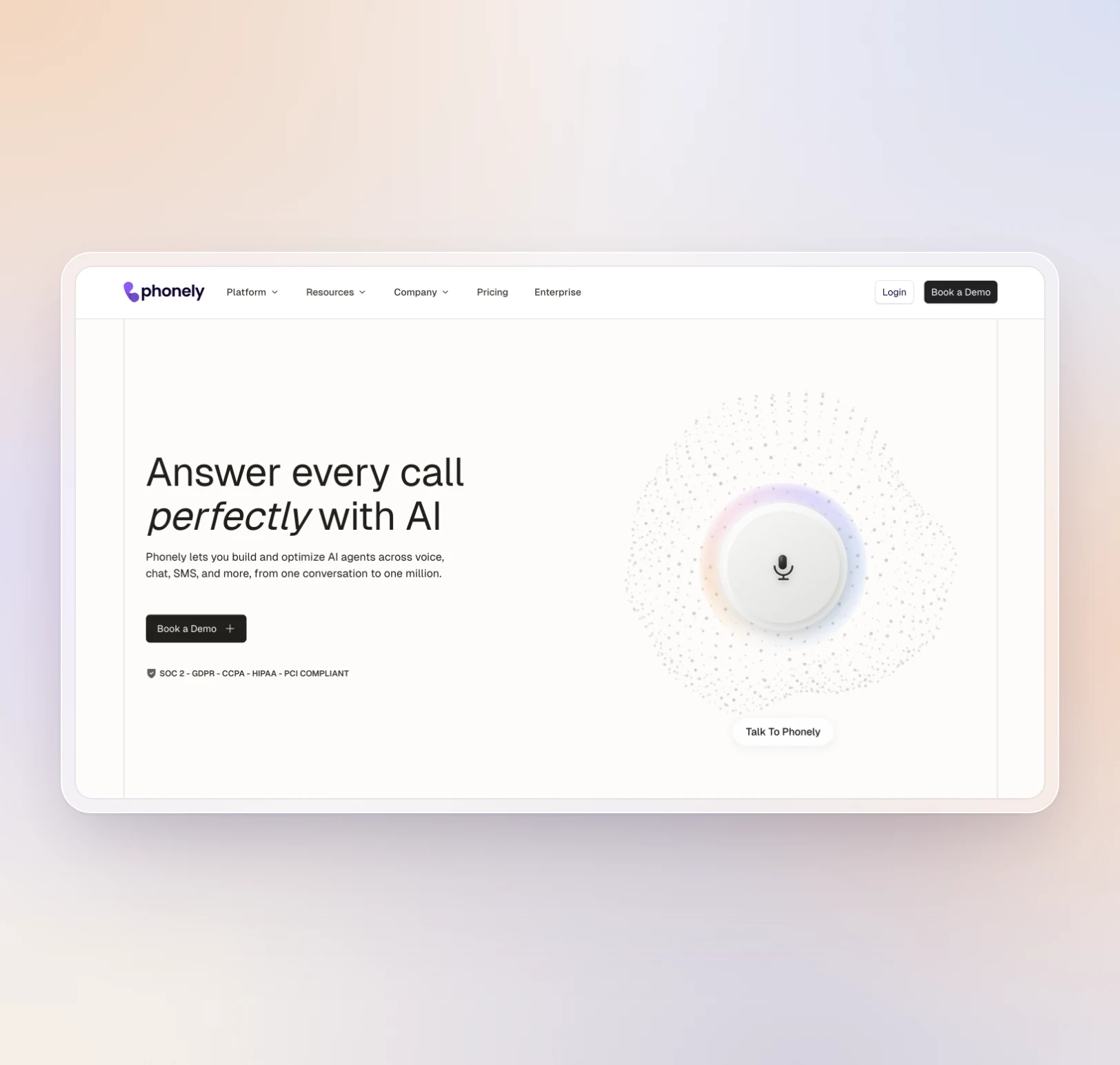
Phonely is a revenue-focused voice AI software platform that builds and optimizes voice agents for businesses that generate revenue over the phone. Its proprietary model, trained on more than 10 million calls, works alongside call analytics and A/B testing to help improve conversion rates and net revenue per call.
Phonely pros:
- Proprietary voice model trained on more than 10 million real calls
- Call analytics and A/B testing measured against conversion rates and revenue per call
- Hands-on implementation support from Phonely's voice AI specialists
- Permanent free plan with 100 minutes per month
- Unlimited concurrent calls on every plan
Phonely cons:
- Outbound calling and conversational SMS require the Pro plan
- HIPAA BAAs are available on Enterprise plans only
What you should know:
- Phonely is backed by Y Combinator and works with companies including LendingTree and HealthInsurance.com.
- Its voice model can be fine-tuned for customer accents and specific use cases. Phonely reports that the model outperformed models from OpenAI, Anthropic, and Google on its internal call benchmarks.
- Phonely's researchers, engineers, and voice AI specialists build agents around your business requirements, connect them to your existing systems, and test real customer scenarios before launch.
- Agents are optimized continuously using call data. Analytics show where callers drop off and which questions convert, while A/B testing compares voices, prompts, and workflows.
- Warm transfers with context and escalation detection hand callers to your team without making them repeat themselves.
- It integrates with HubSpot, Salesforce, Google Calendar, Outlook, Slack, and Zapier, and offers REST APIs, webhooks, outbound SMS, and outbound AI email.
- Phonely lists SOC 2, GDPR, HIPAA, and PCI compliance, with a HIPAA BAA on Enterprise plans.
- Businesses can start with a free consultation to estimate potential revenue gains, and qualifying businesses may receive a free proof of concept using their own calls.
Best fit:
- Businesses that generate revenue over the phone, such as lending, insurance, and sales teams, that want measurable gains in conversion and revenue per call.
Customer results:
“We evaluated every AI voice platform on the market. Across natural conversation, integrations, workflows, reporting, and analytics, nothing else came close.”
- Manu Dwievedi
AVP of Product Strategy & Innovation
Etech Global Services
2. Retell AI

Retell AI is an all-in-one voice agent platform that manages the phone line, speech recognition, and language model for you, so your team can focus on designing the conversation instead of building the infrastructure.
Retell AI pros:
- Fastest setup and the top reliability score in Cekura's tests
- Testing, warm transfers, and voicemail detection built in
- Billed by the second, and unanswered calls are free
Retell AI cons:
- Several production features cost extra
- Support is slow on pay-as-you-go
What you should know:
- In Cekura's month-long evaluation, Retell had the fastest setup time and the highest reliability score (75.6% across an 82-call benchmark).
- Built-in simulation testing lets you rehearse conversations before going live.
- Voicemail detection keeps your agent from delivering its message to an answering machine.
- A knowledge base, PII removal, and quality-assurance tools are available as paid add-ons.
- Support on the pay-as-you-go plan can be slow, so build some buffer into your launch timeline.
- Retell is SOC 2 certified and HIPAA-ready, with SSO and custom compliance terms on Enterprise plans (50+ simultaneous calls).
Best fit:
- Teams with some technical capacity that want a production-ready agent quickly, without managing infrastructure.
3. Vapi
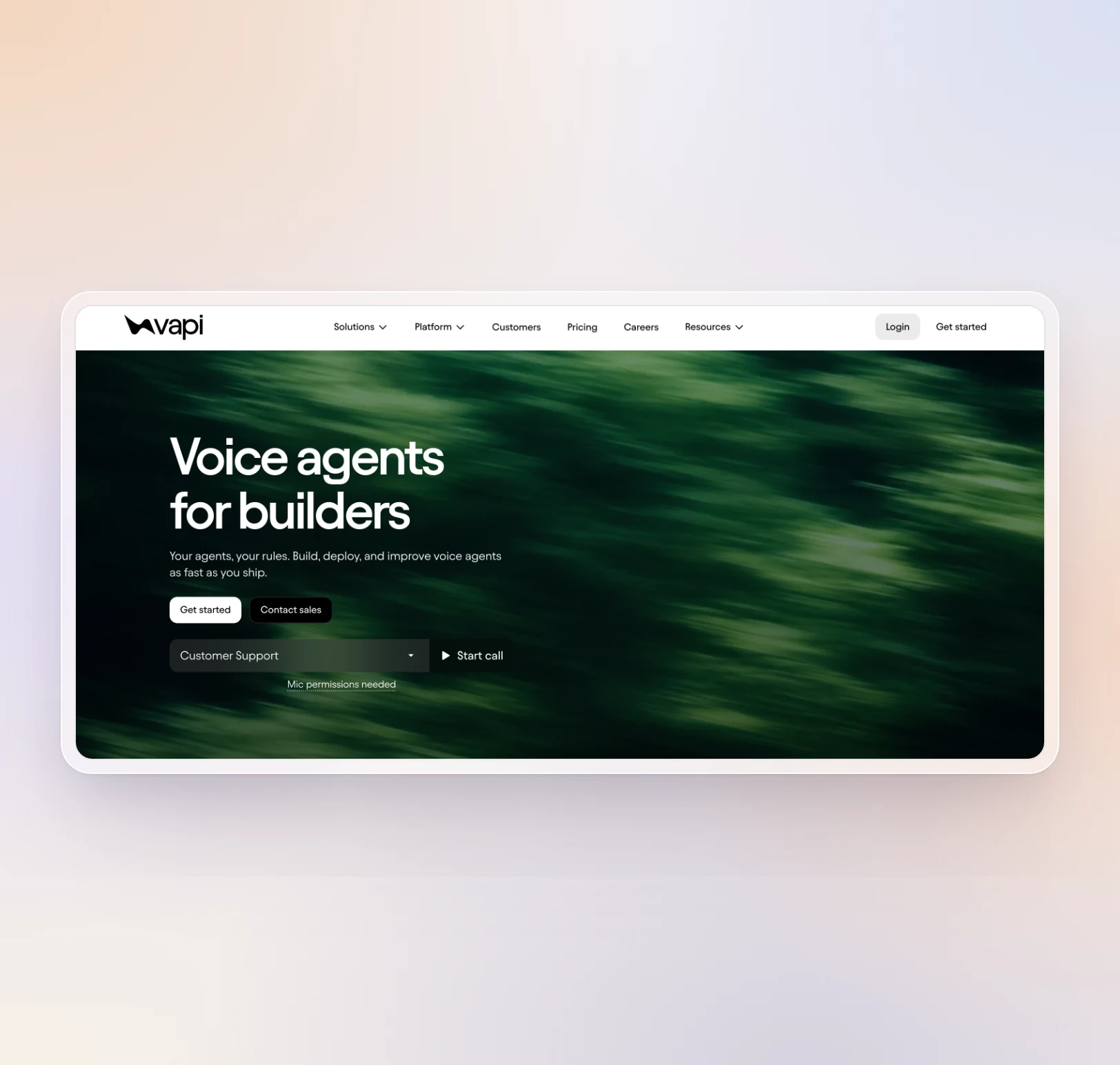
Vapi is a developer-first orchestration platform that lets engineering teams choose their own speech, language, and voice providers and run them on Vapi's hosted infrastructure.
Vapi pros:
- Pick your own speech, language model, and voice providers
- Provider costs passed through with no markup
- Proven at serious scale
Vapi cons:
- You build and monitor the whole stack yourself
- HIPAA support costs $2,000/month extra
What you should know:
- Vapi raised a $50 million Series B in May 2026 at a valuation of roughly $500 million, and it has processed more than one billion calls.
- After evaluating more than 40 vendors, Amazon Ring now routes 100% of its inbound calls through Vapi (TechCrunch). Intuit and New York Life are also customers.
- The advertised $0.05 per minute covers hosting only. Transcription, the LLM, voice, and telephony are billed separately.
- Vapi scored 59.8% in Cekura's reliability benchmark, behind Retell and ElevenLabs. Results depend heavily on how your team configures the stack.
Best fit:
Companies with in-house engineers who want full control over every layer. Teams without developers will be better served elsewhere.
4. ElevenLabs Agents
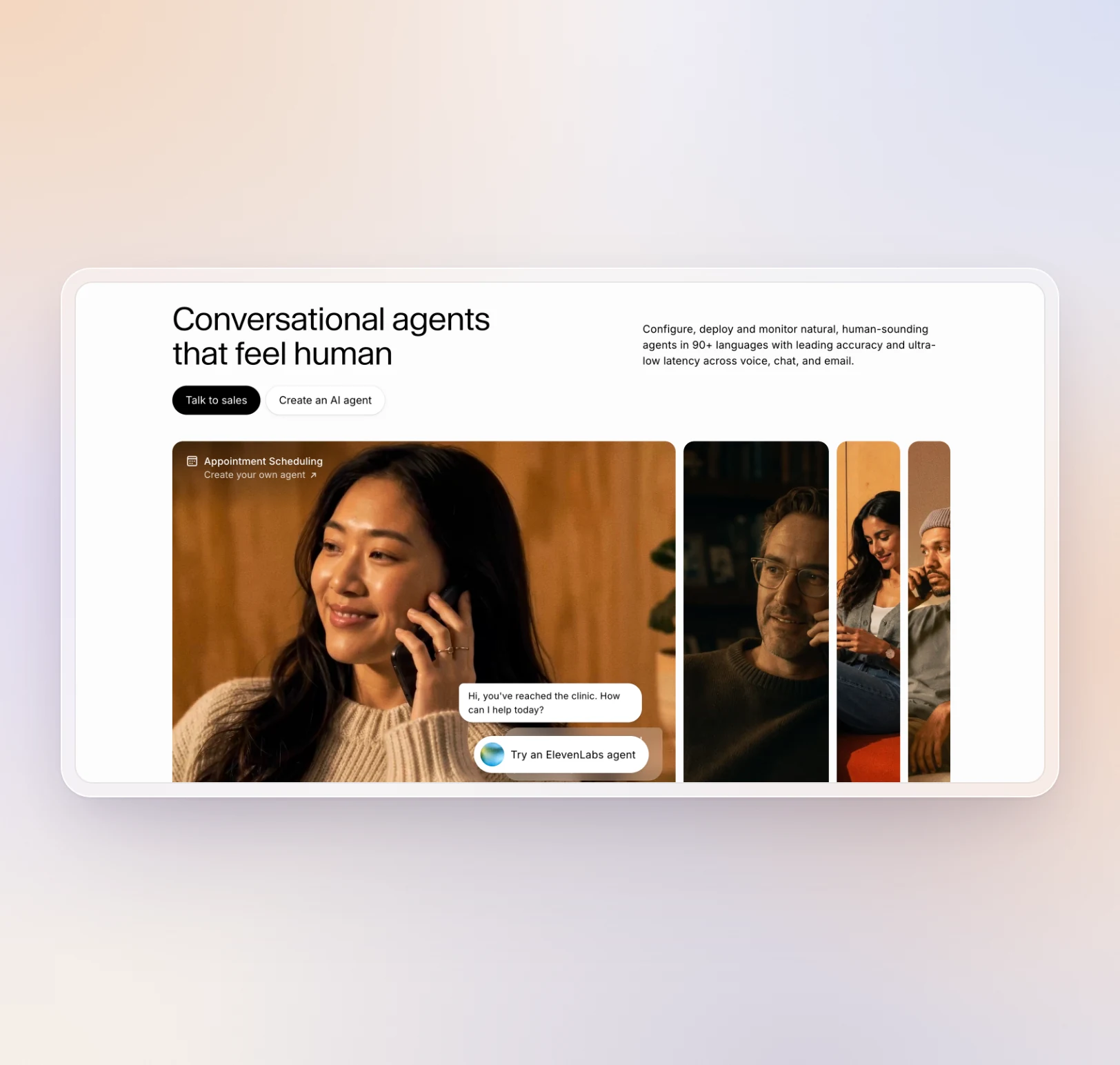
ElevenLabs Agents (now called ElevenAgents) is the voice agent platform from ElevenLabs, the company best known for lifelike AI voices, voice cloning, and multilingual speech.
ElevenLabs Agents pros:
- Known for some of the most natural-sounding voices in AI, plus voice cloning
- Flat per-minute rate, with LLM costs passed through at no markup
- Strong security certifications on every paid plan
ElevenLabs Agents cons:
- You bring your own phone line
- HIPAA and data residency are Enterprise only
What you should know:
- ElevenLabs raised $500 million at an $11 billion valuation in February 2026 and now sells a full agent platform, not just voices.
- It scored 69.5% in Cekura's reliability benchmark, second among the platforms tested.
- Telephony isn't included. You connect your own line through Twilio or SIP.
- A great voice doesn't replace good workflow design. You'll still need reliable routing, CRM integrations, and a clear path to a human agent.
- Certifications include SOC 2 Type II, ISO 27001, PCI DSS Level 1, and GDPR. HIPAA BAAs and data residency (US, EU, or India) are Enterprise only.
Best fit:
- Brands where the voice is part of the customer experience, such as premium hospitality, consumer apps, and multilingual support lines.
5. Bland AI
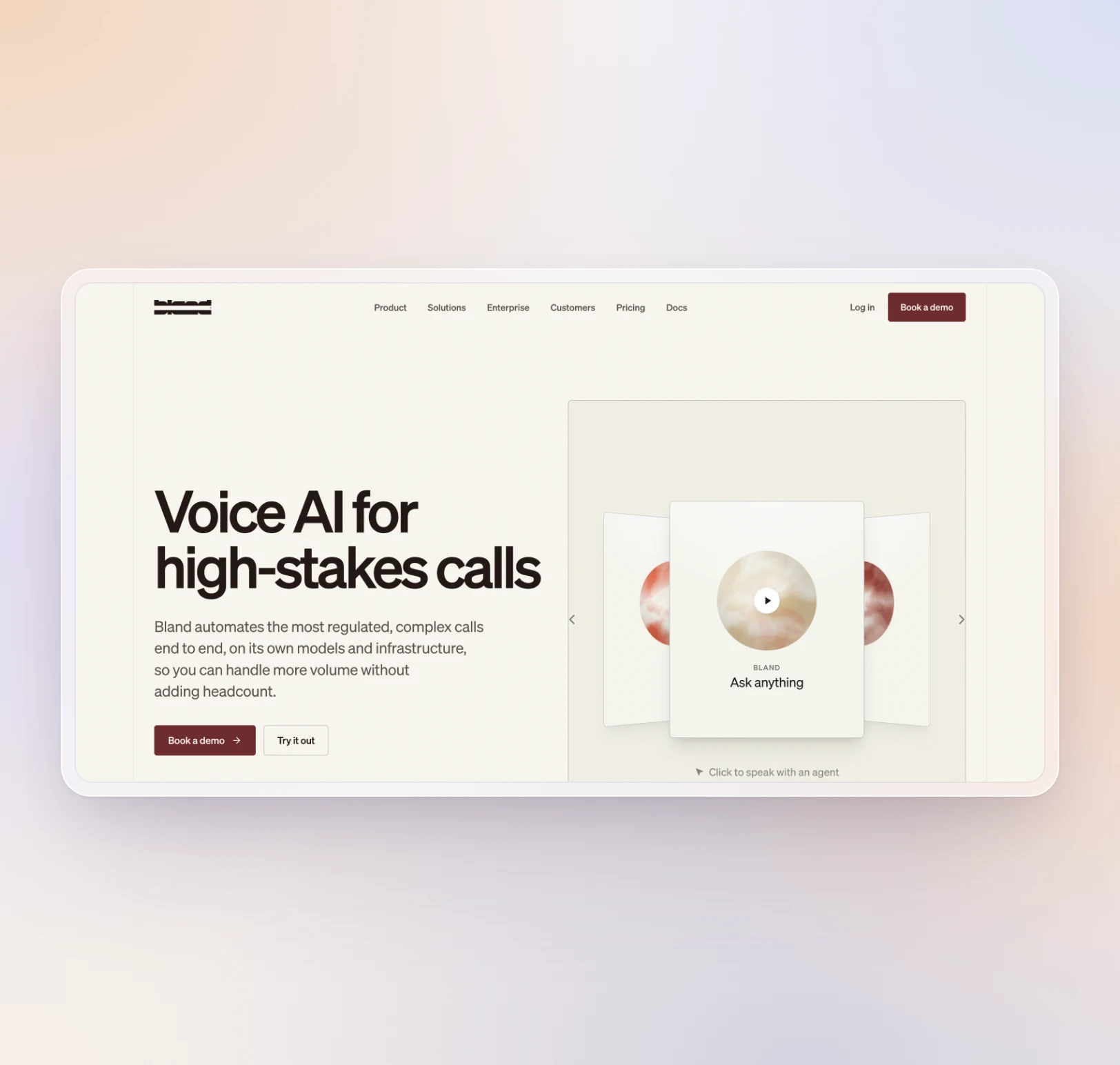
Bland AI is a phone-calling platform built for high-volume programs such as outbound sales, appointment reminders, and lead qualification.
Bland AI pros:
- Built for volume, with daily call limits in the thousands
- One rate covers both the language model and speech
- The broadest compliance list among self-serve options, including on-premises deployment
Bland AI cons:
- Steep learning curve and no sandbox
- Transfers and phone service cost extra
What you should know:
- Bland raised a $50 million Series C in June 2026, with participation from HubSpot Ventures.
- It offers the broadest compliance coverage among the self-serve platforms: SOC 2 Type II, HIPAA, GDPR, and PCI DSS.
- Regulated organizations can deploy it self-hosted, in a private cloud (VPC), or on-premises.
- Its conversation builder, Pathways, has a steep learning curve, and there's no sandbox environment for testing.
- Some reviewers report real-world latency above the advertised figure, although at least one of those reviews was published by a competitor.
- The Scale plan only becomes more cost-effective than Build above roughly 20,000 minutes per month.
Best fit:
- Sales and growth teams running large outbound campaigns, follow-ups, and reminders.
6. Sierra
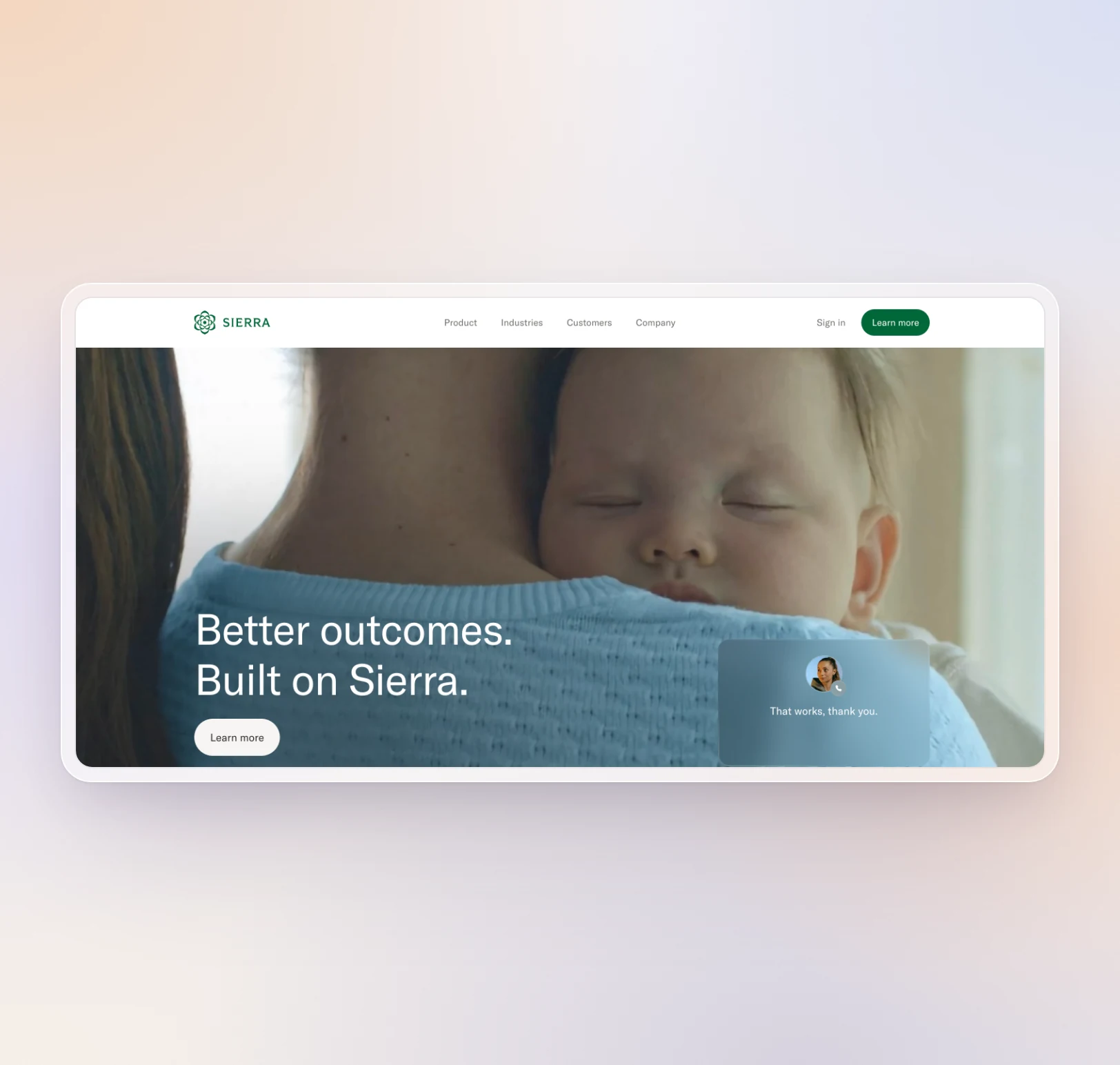
Sierra is an enterprise customer-experience platform, founded by Bret Taylor and Clay Bavor, that powers AI agents for some of the world's largest consumer brands.
Sierra pros:
- Outcome-based pricing, so the vendor gets paid when problems get solved
- Track record with big household-name brands
- Can build agents from your existing procedures and call recordings
Sierra cons:
- Six-figure contracts and long implementations
What you should know:
- Sierra raised approximately $950 million at a $15.8 billion valuation in May 2026.
- Voice overtook text as its primary channel in October 2025.
- Customers include WeightWatchers, Sonos, SiriusXM, ADT, Cigna, Nordstrom, and Rocket Mortgage.
- Pricing is based on outcomes rather than minutes, which ties the vendor's revenue to resolved customer issues instead of call length.
- According to reviewers, transfers to human agents are typically not charged.
Best fit:
- Large enterprises. Expect six-figure contracts and a lengthy implementation.
7. Decagon
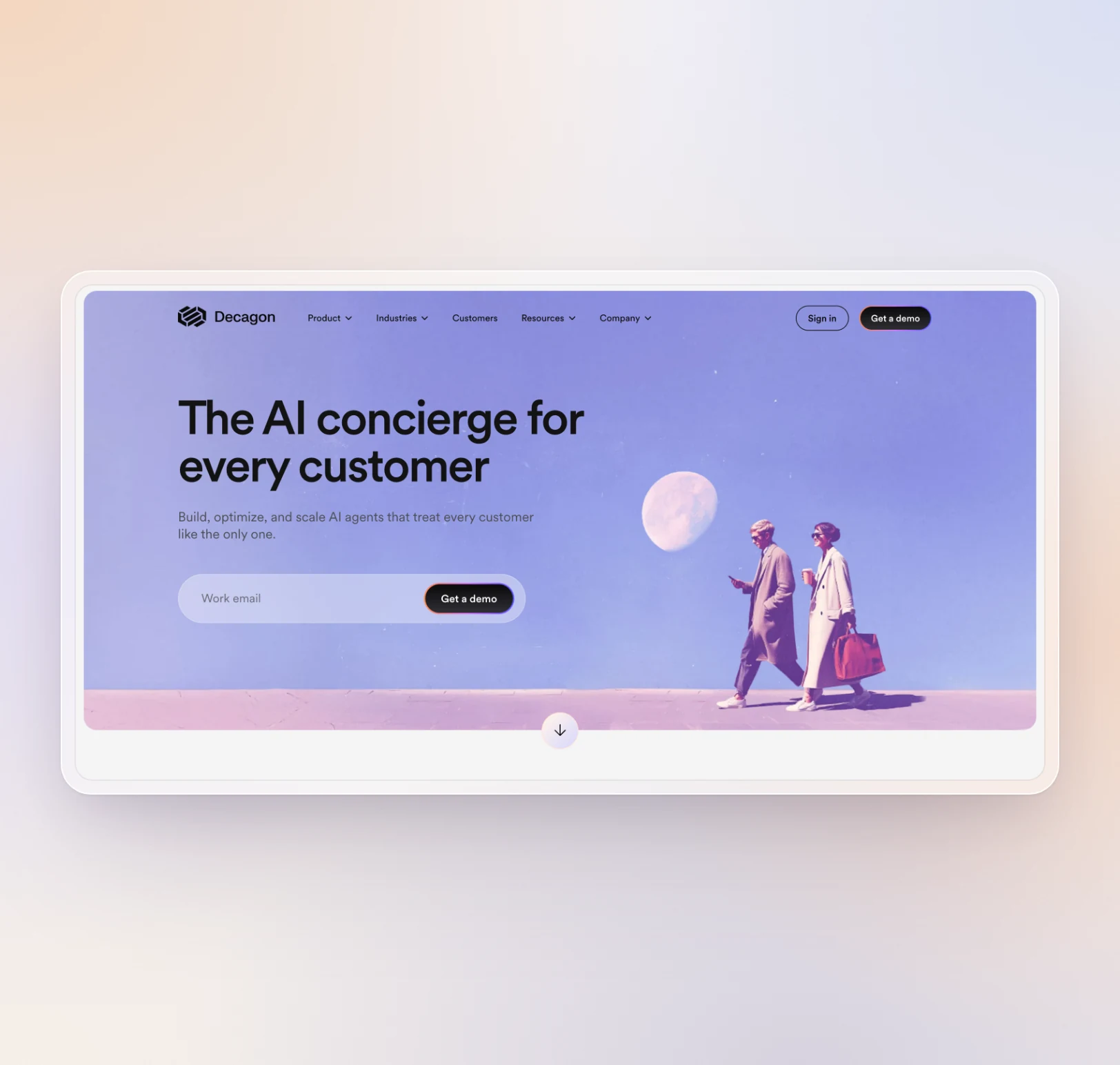
Decagon is an AI customer-support platform that resolves requests across chat, email, voice, and SMS through a single agent.
Decagon pros:
- Agent behavior is written in plain language, not code
- Customer context carries across every channel
Decagon cons:
- No self-serve access, and setup takes weeks
- Support use cases only
What you should know:
- Decagon raised $250 million at a $4.5 billion valuation in January 2026, in a round led by Coatue and Index.
- Customers include Hertz, Avis Budget, Chime, Affirm, and Deutsche Telekom.
- Agent behavior is defined in plain-language "Agent Operating Procedures," so support managers can review and update it without engineering help.
- Customer context carries across channels, so callers don't have to repeat what they shared earlier by email or chat.
- Outbound voice and memory capabilities launched in spring 2026.
Best fit:
- Enterprise support teams. Decagon focuses on customer support rather than sales, and access is through its sales team only.
8. PolyAI
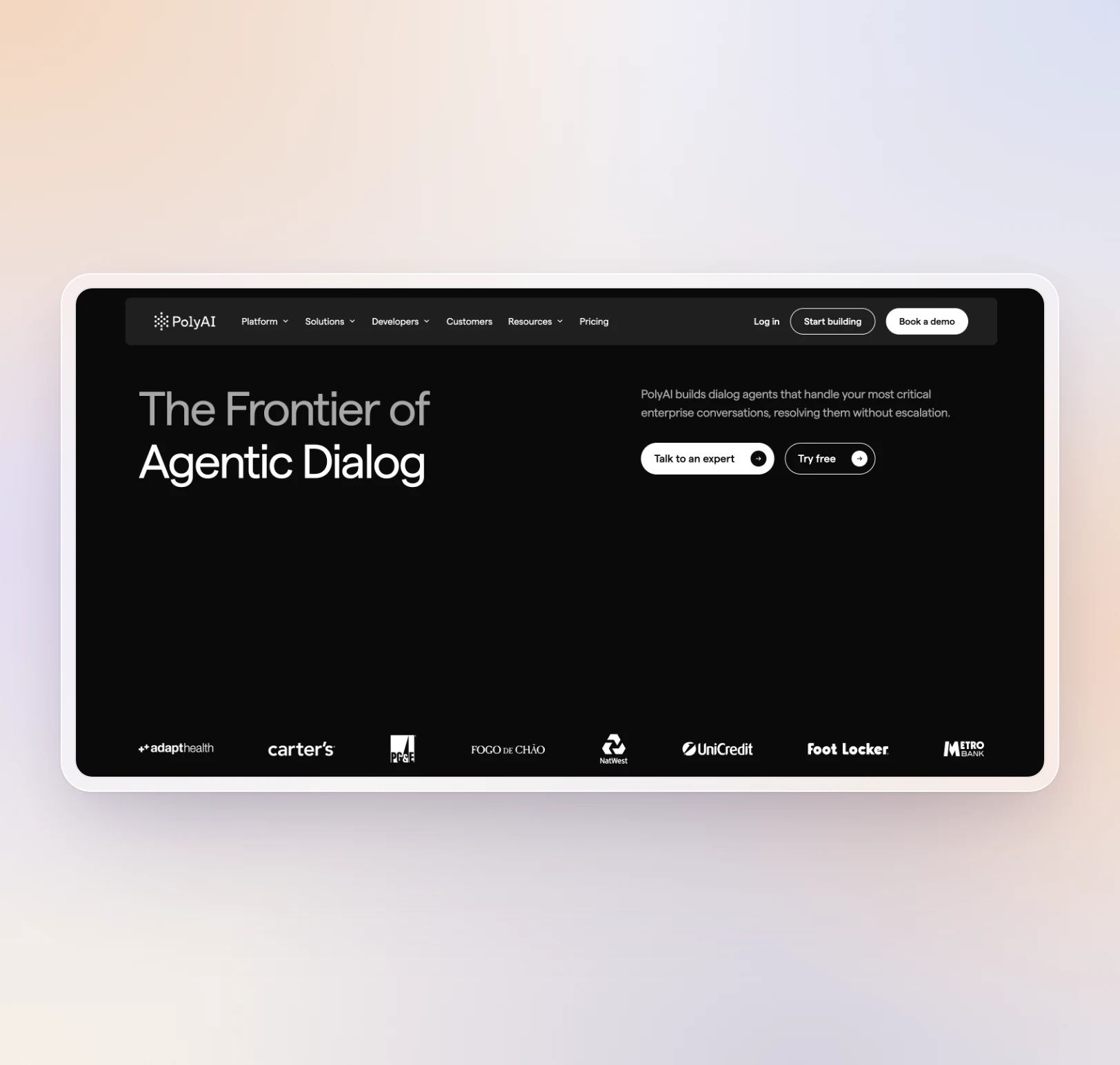
PolyAI builds voice-first enterprise agents trained on real customer-service calls, designed for high-stakes inbound lines at hotels, banks, and utilities.
PolyAI pros:
- 45 languages and more than 2,000 live deployments
- Plugs into the major contact-center platforms
- New Epic integration for healthcare
PolyAI cons:
- No public platform pricing or free trial
What you should know:
- PolyAI serves more than 100 enterprise customers, including Marriott, Caesars, PG&E, UniCredit, and Foot Locker.
- It closed an $86 million Series D in December 2025, bringing total funding to more than $200 million.
- It integrates with Amazon Connect, Five9, Genesys, NICE CXone, Zoom, and SIP, so it typically fits into your existing phone infrastructure.
- 2026 releases include an Epic integration for healthcare (August) and its Dialog-RSN-1 model on AWS SageMaker.
- PolyAI cites a 391% ROI from a Forrester study that PolyAI commissioned, so weigh that figure accordingly.
Best fit:
Enterprises handling high volumes of complex inbound calls.
9. Parloa
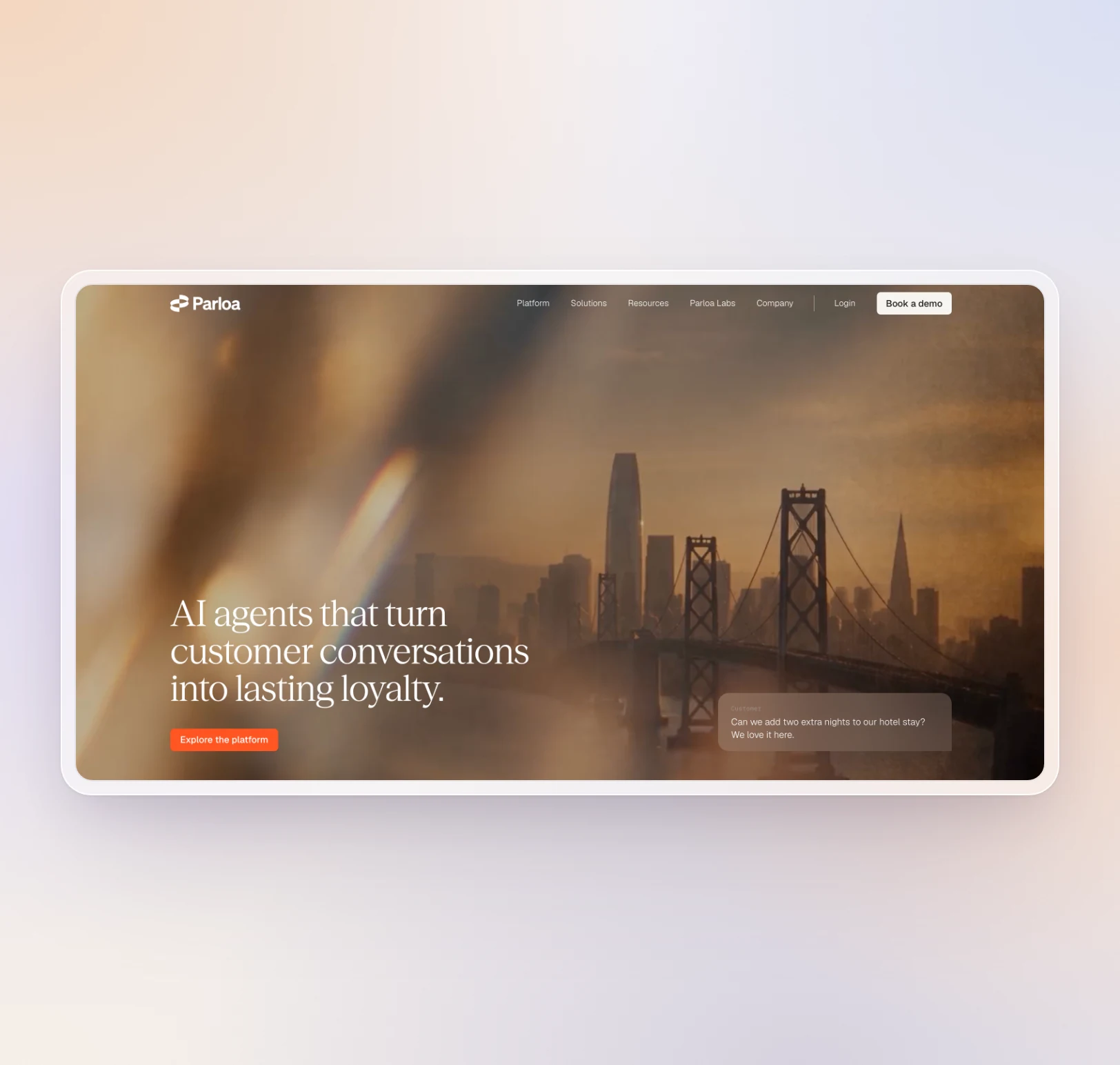
Parloa is a Berlin-founded AI agent management platform for large contact centers, with testing, monitoring, and compliance tools built in.
Parloa pros:
- Built voice-first, with testing, QA, monitoring, and compliance tools included
- Strong presence in Europe, growing fast in the US
Parloa cons:
- Custom pricing only
What you should know:
- The platform was built voice-first, with quality assurance and monitoring included rather than added on later.
- Parloa raised $350 million at a $3 billion valuation in January 2026, bringing total funding to more than $560 million.
- It's expanding in the US, with offices in New York and San Francisco.
Best fit:
- Enterprises running contact centers in both Europe and the US that need to meet regulatory requirements in both regions.
10. Synthflow
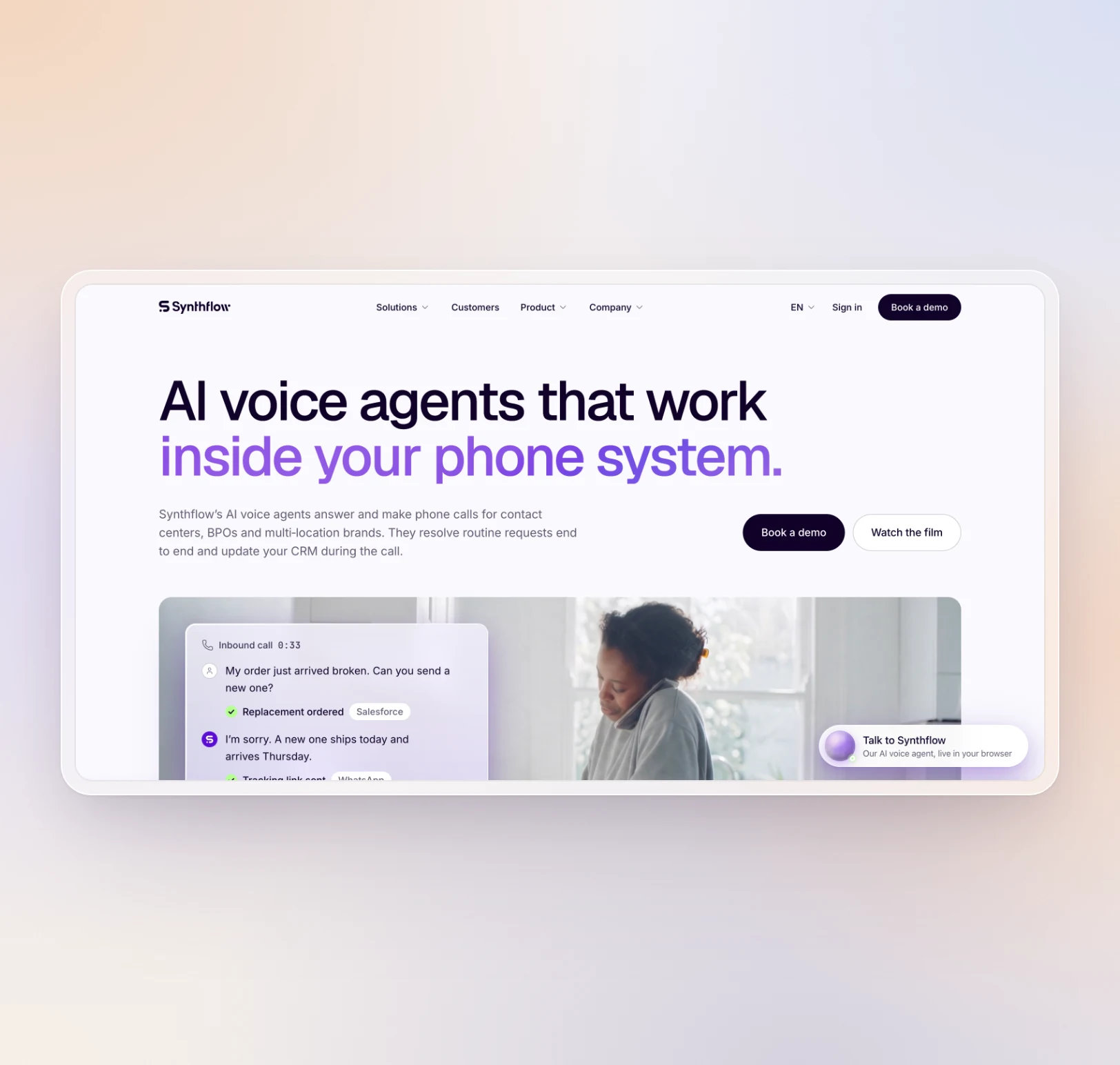
Synthflow is a no-code voice agent builder that, since June 2026, is sold only to enterprise customers on annual contracts.
Synthflow pros:
- No-code builder with hands-on help from the vendor
- Long list of compliance certifications
Synthflow cons:
- Annual contracts only, with no free plan or trial
- HIPAA compliance is self-attested
What you should know:
- Synthflow discontinued its self-serve plans in June 2026. It now has no free plan, no trial, and no published per-minute rate.
- Many comparison articles still list its former $29-per-month plan, so check publication dates when researching.
- The current offering pairs a no-code builder with vendor-led implementation support.
- Listed certifications include SOC 2 Type 2, ISO 27001, GDPR, HIPAA (self-attested), and PCI DSS.
- Before signing, confirm implementation scope, included minutes, concurrency limits, and support terms.
Best fit:
- Mid-market teams without dedicated engineers that want a vendor to help build their agent.
Voice AI Pricing Compared
Voice AI platforms use a few different pricing models. Here is what they’re offering:
Is AI Calling Legal? What to Check Before You Launch
Voice agents speak directly with your customers, and regulations around AI calling tightened in 2026. Before launch, confirm the following:
- Disclose that callers are speaking with AI
The EU AI Act's disclosure rule (Article 50) applies from August 2, 2026. If you serve callers in the EU, your agent must identify itself as AI.
- Obtain consent before outbound AI calls
In the US, the FCC treats AI-generated voices as an "artificial voice" under the TCPA, so outbound AI calls require prior express consent. Keep records of consent for every number you call.
- Treat "HIPAA-ready" as a starting point
A platform's HIPAA support does not make your deployment compliant on its own. You need a signed BAA, and your configuration, data flows, retention policy, and staff access all matter. Check whether HIPAA is included or an add-on: it costs $2,000/month on Vapi and is Enterprise-only on ElevenLabs.
- Protect caller data
Ask about PII redaction, retention limits, encryption, and access controls for transcripts.
- Keep the agent within approved boundaries
Limit it to approved information, set guardrails, and test edge cases such as accents, background noise, interruptions, and distressed or vulnerable callers.
- Always provide a path to a human
Design the handoff process before you design the greeting.
We recommend reviewing your setup with legal counsel before launch.
Voice AI Platform FAQs
How Much Does an AI Voice Agent Cost per Minute?
Most self-serve platforms land between about $0.07 and $0.31 per minute once you add speech, the language model, the voice, and the phone line. Advertised rates are lower (Vapi starts at $0.05/min for hosting alone). Enterprise suites are priced by contract, and AI receptionists for small businesses sell monthly bundles starting around $25 to $50.
Are AI Phone Calls Legal?
Yes, with conditions. In the US, the FCC treats AI voices as an "artificial voice" under the TCPA, so outbound AI calls need prior express consent. In the EU, the AI Act requires telling callers they're speaking with AI as of August 2, 2026. Call recording laws also vary by location.
Can AI Voice Agents Transfer Calls to a Human?
Yes. Most platforms in this guide support warm transfers, where the agent passes both the caller and the conversation so far to a person. Ask each vendor what context gets passed along and how transferred minutes are billed. Bland, for example, charges an extra $0.03 to $0.05 per minute for transfers.
What's the Best Free Voice AI Platform?
No platform is fully free for production use, but several offer free plans or credits for testing: Phonely (a permanent free plan with 100 minutes per month), Retell AI (10incredits),Vapi(5 in credits), ElevenLabs (15 free minutes per month), and Bland AI (a free Start plan, then $0.14 per minute). The small-business receptionist apps offer 7- to 14-day free trials.
Vapi vs. Retell: Which Is Better?
Choose Vapi if you have engineers who want to pick every component and monitor the stack themselves. Choose Retell if you want a faster, more managed path to production. Retell scored higher in Cekura's reliability benchmark (75.6% vs. 59.8%), though that's one test from a company that sells testing tools.
Can AI Answer Inbound Calls for My Business?
Yes. Answering inbound calls, booking appointments, handling common questions, and routing callers to the right person are among the most common uses for voice agents today. A small business can get started with an AI receptionist in a day. Larger teams usually start with one call type (like appointment booking), test it with real callers, and expand from there.
Choosing Your Voice AI Platform
There is no single best voice AI platform for every business. The right choice depends on your team, your call volume, and your budget.
Start by identifying which category fits your organization, compare the total cost at your expected call volume, and test the agent with real callers before rolling it out on your main line.
Whatever you choose, make sure callers can always reach a person when they need one. Even the best AI voice agents will encounter questions they cannot answer, and a smooth handoff protects the customer experience.