Key takeaways
- The best AI services for answering business calls in 2026 include Phonely, Smith.ai, Goodcall, Synthflow, Rosie, RingCentral AI Receptionist, and Nextiva XBert. Phonely leads with near-instant response speed on calls, with chat, SMS, and an API to connect your tools, any-language support with 1,000+ voices, call recording and analytics, and SOC 2, HIPAA, CCPA, and PCI compliance.
- Phonely fits businesses that want speed and any-language coverage at any scale.
- Pricing models vary more than the prices: per minute, per call, per unique caller, flat monthly, or added to a per-user phone plan. Compare cost at your real volume.
- What separates a natural agent from a frustrating one shows up live: response speed (people reply in about 200 milliseconds, and laggy systems sound robotic), handling interruptions and messy speech, and what it can finish on its own.
- Test any agent against your own past recordings before trusting it with real callers, not just a vendor demo. For healthcare or legal calls, confirm HIPAA compliance and a signed BAA first.
Missed calls are usually a coverage problem. When everyone on the team is already on a call, the next caller rolls to voicemail.
That costs you. In Hiya's 2024 State of the Call study, 66% of companies called voice "essential" or "very important" to goals like making sales, while 46% of calls from unidentified numbers went unanswered, even from legitimate businesses.
Reaching for AI to answer those calls is the easy part, and the harder question is which of these services to trust, because they differ far more than their homepages let on.
This guide ranks the seven AI answering services worth shortlisting, shows which few things actually make or break a call once it is live, and matches each to the way your calls actually come in.
Best AI for answering business calls: quick comparison
The best AI for business calls, compared
- Phonely
Phonely is an AI phone agent that answers business calls and handles chat and SMS, no humans required, and plugs into your tools through its API. It is built to hold the same quality from a single call to over a million, which is why it turns up in both small-business and Fortune 500 setups.
It keeps latency low enough that callers do not feel the lag that gives most voice AI away, and it uses A/B testing to refine each agent over time, comparing openings, questions, and call flows and keeping the versions that book and resolve more calls.
In 2025, Phonely rebuilt its inference stack with Maitai and Groq to close that gap. By its own benchmark, the move cut time-to-first-token by 73.4% and completion time by 74.6%, while lifting answer accuracy from 81.5% to 99.2% across four model iterations, past GPT-4o's 94.7% benchmark. On a live call, that jump from fast to almost instant is the whole experience.
What it handles:
- Real-time appointment booking, CRM updates, call routing, and post-call summaries
- Replies in any language, with 1,000+ voices and voice cloning, so a caller who switches from English to Spanish mid-sentence is not left waiting
- Every call is recorded, transcribed, and analyzed. Phonely also learns from your existing call recordings, so an agent picks up how your team already handles common calls before it takes a single one, and its Ask AI feature lets you build and adjust that agent yourself in minutes.
- Prebuilt integrations with Salesforce, HubSpot, Google Calendar, and Zapier
- SOC 2 and HIPAA compliance for regulated work in healthcare, legal, and finance
TSA Group, a contact center running 4,500 human agents, says Phonely's agents resolve calls better than their best people. Phonely reports the average business cuts operational costs by up to 80%, across a base of 10,000+ businesses handling 100,000+ calls a day.
Pricing is usage-based and starts at zero.
- The free plan includes 100 minutes a month, roughly 50 calls, so you can test it on live calls before paying.
- Paid plans run $50 a month for Starter and $150 for Professional, or $33 and $100 billed annually.
- Enterprise is custom, priced as low as 5 cents a minute, and adds full agent buildout, SIP trunking, and a signed HIPAA BAA.
One thing to model first: once you pass a plan's included minutes, Phonely bills are averaged per minute, so your real monthly cost follows call volume, not a flat fee.
Two things to weigh before you choose it:
- If you are a true solo operator who only needs basic message-taking, Phonely's depth in workflows, languages, and scale is more than the job requires, and a simpler tool will set up faster.
- And the heaviest lifting sits on the Enterprise tier: full agent buildout, custom integrations, SIP trunking, and a dedicated account manager. On the self-serve plans, you build and tune the agent yourself.
The fastest way to judge any of this is to hear it.
- Smith.ai
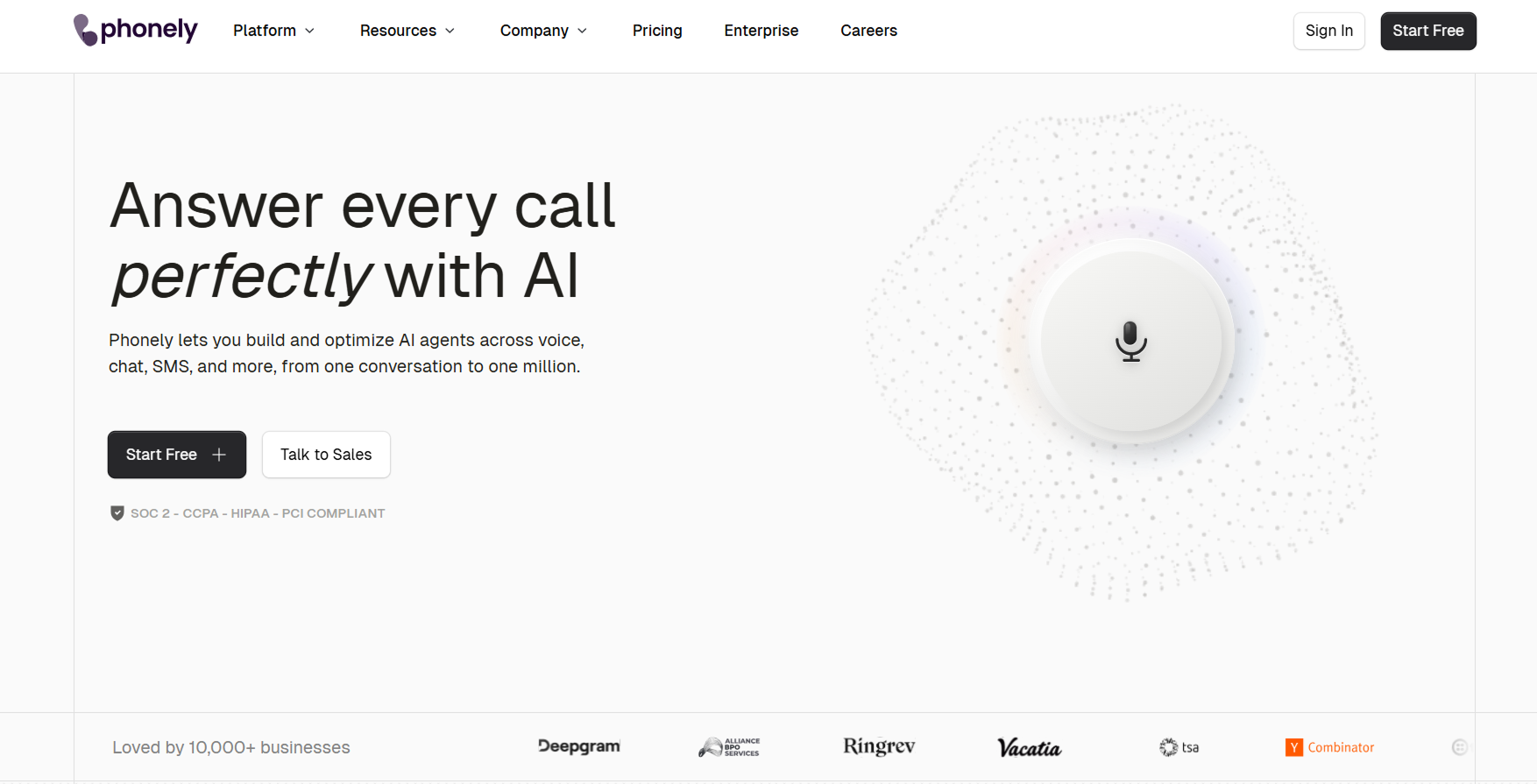
Smith.ai is a hybrid service: its AI Receptionist answers first, then hands off to a live North America-based agent when a call gets complex. It calls itself the first AI-led service to pair the bot with around-the-clock human support, and has answered business calls since 2015.
The AI qualifies leads, schedules appointments, and filters spam, but routes anything complex to one of 500-plus trained North American agents, any hour. It tells the caller before transferring, so there are no cold handoffs. For a firm where one mishandled call is costly, that backup is the draw.
What it handles:
- Lead qualification and intake, with up to 10 short-answer questions per caller
- AI scheduling through Calendly, live on the call
- CRM sync to HubSpot, Salesforce, Clio, and 7,000-plus apps via Zapier
- Recording, searchable transcripts with PII masking, and instant summaries
- Spam screening of 20 million-plus known numbers before the AI answers
- On-demand live-agent handoff at $3 per call
The track record backs it: Smith.ai says it has handled more than 20 million calls and is trusted by 5,000-plus businesses.
Smith.ai bills per call, not per minute. Self-service plans start at $150 a month for 75 calls, with a done-for-you tier at $500 a month for 300 calls. No setup fees, no contracts, and a 30-day money-back guarantee.
Where it fits less well: It costs more than pure-AI tools, by the company's own admission, and the deepest customization sits on the annual plans. If your volume is high and routine, a pure-AI platform costs less per call.
- Goodcall
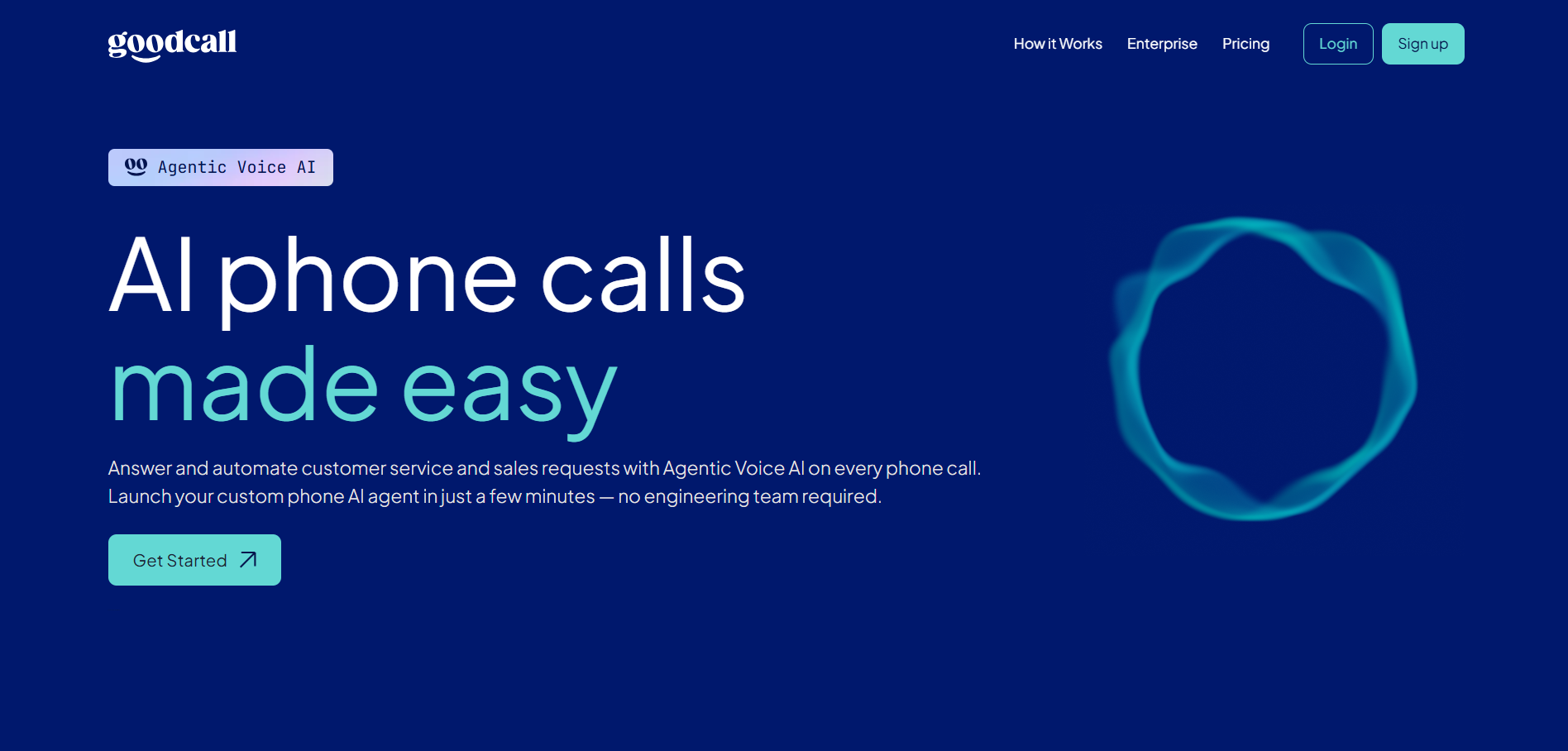
Goodcall is an agentic voice AI phone agent you set up yourself, without a developer. You point it at a website, a Google listing, or a few company details, shape the agent's logic, and go live in minutes on a Goodcall number. It came out of Google in 2017 and has launched 50,000-plus agents across more than 60 million voice interactions.
Goodcall says it doesn't lock features behind lead-capture forms, so you can adjust your agent yourself without waiting on support, and every call is checked through a mix of human and automated review.
What it handles:
- Support for routine caller questions, through customizable skills and flows
- Appointment booking synced to your calendar and CRM
- Lead capture that pushes each caller's details straight to your CRM, a Google Sheet, SMS, or email
- An operator workflow that by default transfers calls it cannot handle to your business line, configurable to a person, department, message, link, or callback
- A dashboard reporting automation rates, call length, and what callers were after
- SOC 2 Type II, ISO 27001, and HIPAA compliance
Pricing is per agent and billed by "unique customer" rather than by minute, call, or token. Plans run $79 (Starter), $129 (Growth), and $249 (Scale) a month, each with a monthly customer allowance and $0.50 per additional customer. A 14-day free trial is included.
Where it fits less well: Each agent runs on a new Goodcall number, so keeping your existing business number means forwarding calls to it through conditional call forwarding. And with per-agent pricing plus per-customer overages, multi-location or high-traffic operations can see costs stack up.
- Synthflow
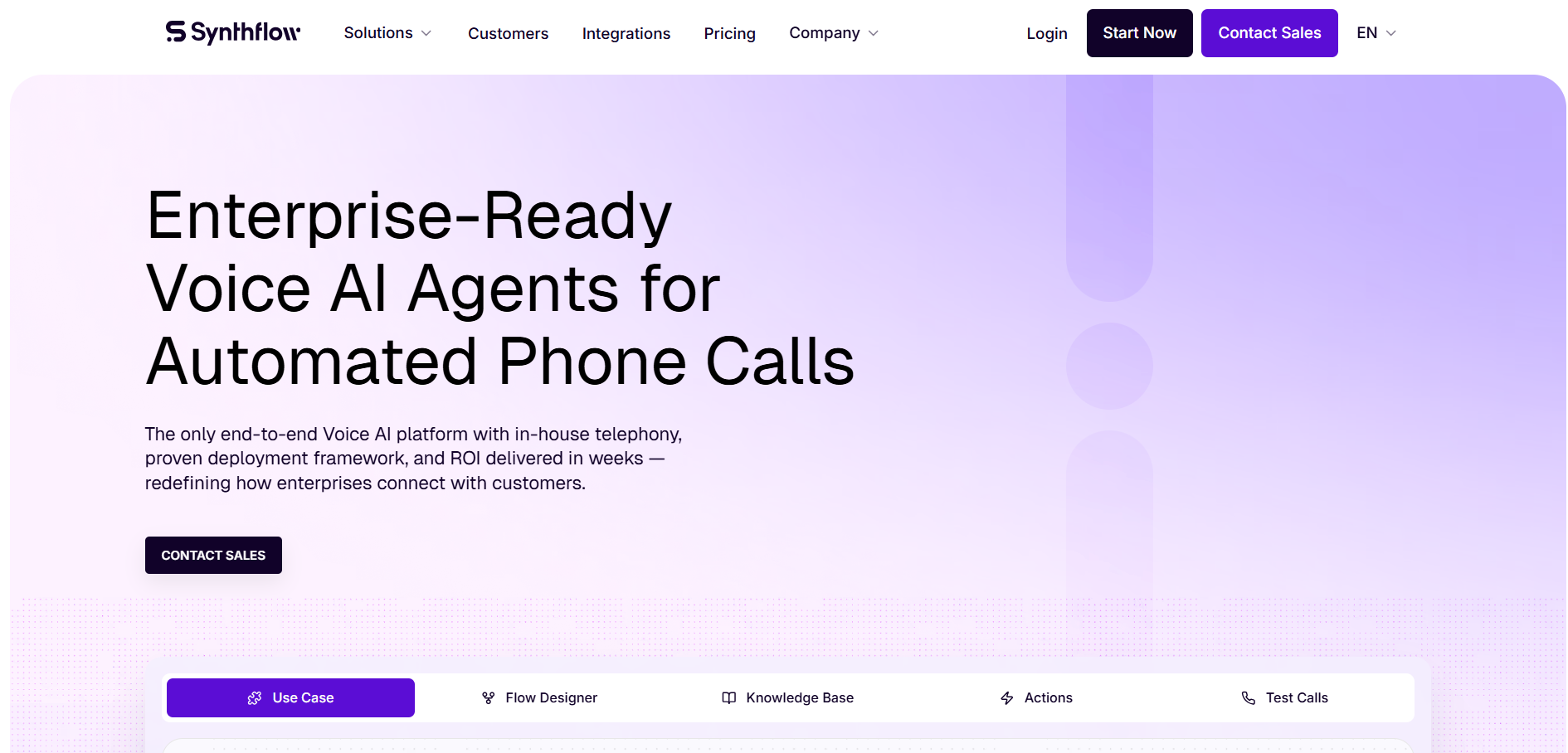
Synthflow is an end-to-end voice AI platform aimed at enterprise call automation. Instead of a ready-made receptionist, it gives you a builder: a flow designer, a knowledge base, actions, and test calls, so you assemble an agent's logic and trial it before going live. It runs its own in-house telephony, and you can bring your own model or telephony instead.
What it handles:
- Customer service, receptionist, answering service, appointment setting, AI IVR, and concierge use cases
- Lead qualification and real-time booking into a connected calendar
- Voice plus text: API, web widget, SMS, and WhatsApp
- SOC 2 on every plan and HIPAA on Enterprise
- A white-label, reseller toolkit for agencies selling under their own brand
Synthflow says its agents handle more than 65 million voice calls a month across 30-plus countries.
Pricing is usage-based and modular: pay-as-you-go has no platform fee, billing separately for the Voice Engine, your model ($0.02 to $0.05/min), and telephony. Enterprise is custom, for 10,000-plus minutes a month, adding native telephony and a 99.99% SLA.
Where it fits less well: Cost is assembled from separate parts, so your true per-minute rate is harder to predict than a flat plan.
- Rosie
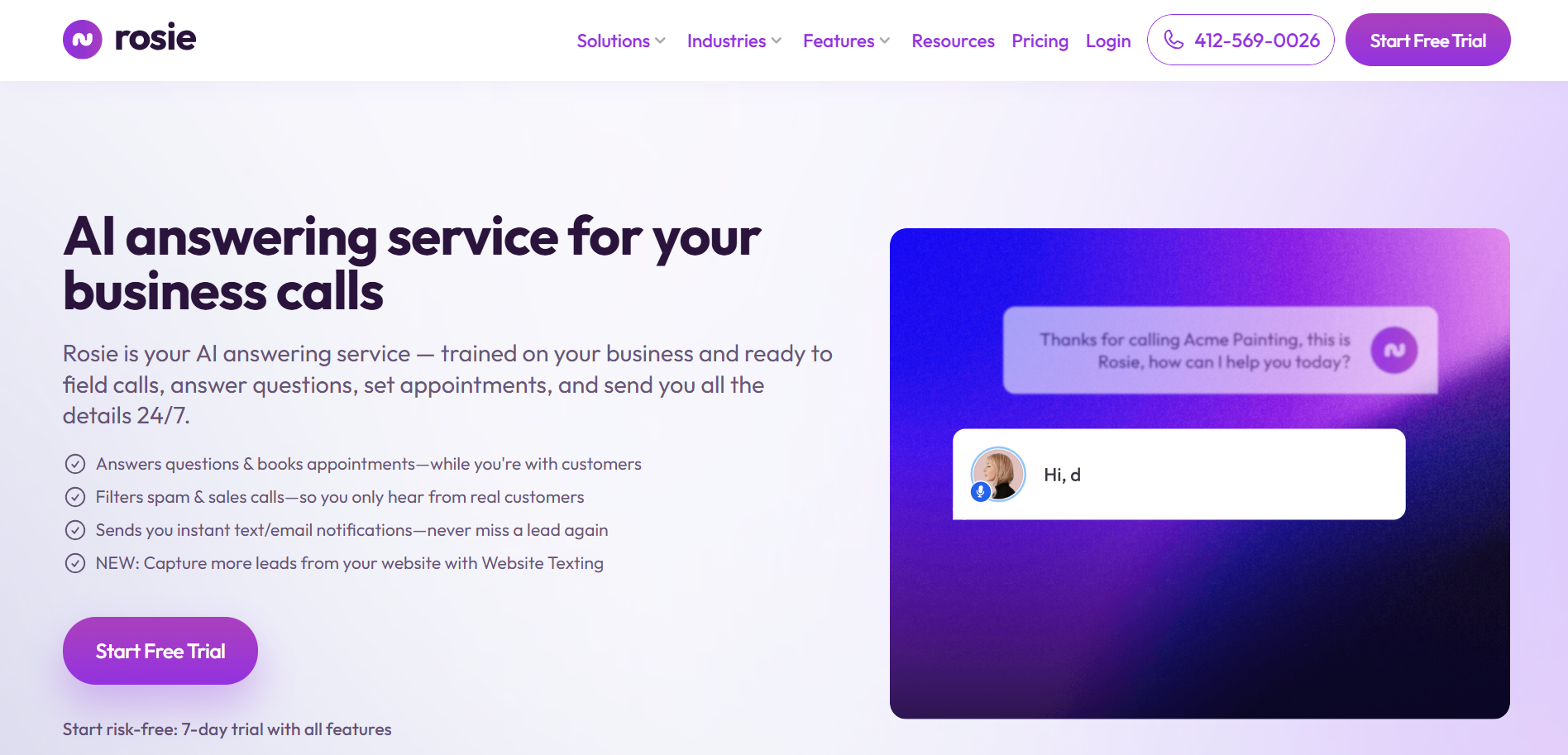
Rosie is an AI answering service built for small businesses that cannot always get to the phone. It trains itself automatically on your Google profile and website, then handles calls 24/7, answering questions, taking messages, booking appointments, and texting or emailing you the details afterward. It takes several calls at once, so callers never get a busy signal.
What it handles:
- 24/7 answering with custom FAQs, agent name, and greeting
- Appointment booking and message-taking, with warm, live, or waterfall transfers on higher plans
- Automatic spam and sales-call filtering
- English and Spanish on every call, plus 10-plus voices
- Call summaries, transcripts, recordings, and text/email notifications
- iOS and Android apps, and Zapier links to 1,000-plus tools
More than 1,900 small businesses use Rosie, which has answered over 3.1 million calls to date.
Pricing is flat and monthly: Professional at $49 (250 minutes), Scale at $149 (1,000 minutes, adding booking and transfers), and Growth at $299 (2,000 minutes, with custom training and onboarding). Annual billing gives two months free, with a 7-day free trial.
Where it fits less well: Plans are capped by minutes (250 to 2,000), and deeper features sit on higher tiers. High-volume or heavily customized businesses will outgrow it.
- RingCentral AI Receptionist
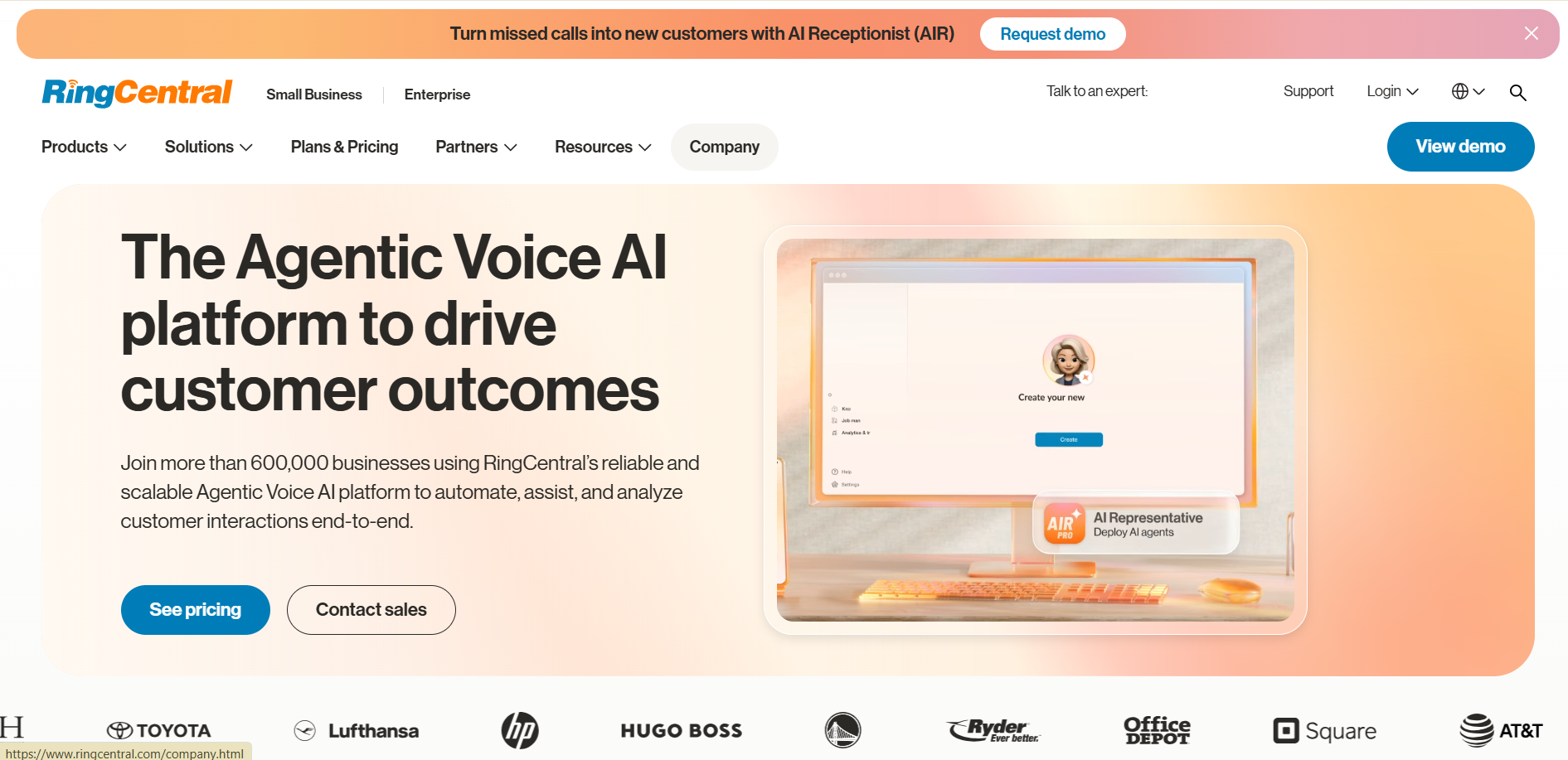
RingCentral AI Receptionist is the AI receptionist from RingCentral, whose platform also spans business phone, contact center, and video. It answers calls and texts, books appointments, and captures leads 24/7, and RingCentral says it works with any phone system, so you can add it to your existing setup.
Where RingCentral leans is routing. It routes each caller by name, location, or keyword to avoid wrong transfers, holds natural conversations in multiple languages without a phone-tree menu, switches languages mid-call, and hands complex issues to your team with a call summary.
What it handles:
- 24/7 answering of calls and texts, with FAQs, appointment booking, and lead capture
- Set up in minutes, no IT needed, trained on your website, FAQs, or documents
- Multiple simultaneous callers, adding more AI Receptionists as you grow or open locations
- Sync with your CRM, scheduling, and ecommerce tools
Pricing starts at $49 a month for the standalone version, or $39 a month if you're already a RingEX customer, each including 100 minutes, with additional minutes available if you go over.
Where it fits less well: AI Receptionist is one product inside RingCentral's larger platform, built by a phone-system provider, so it can trail tools built only for voice. Plans are metered from 100 minutes, so cost rises with volume.
- Nextiva XBert
XBert is Nextiva's AI receptionist, built to answer calls, texts, and chats 24/7 so customers reach you on whatever channel they use. It greets callers in a customizable voice, answers questions from your knowledge base, books appointments, and captures leads, then sends a transcript and call summary afterward. It comes from Nextiva, a communications company with 17 years in business, serving more than 100,000 businesses.
Most tools focus on the phone while XBert works across phone, text, and chat from one system, fitting businesses that want a single AI covering every inbound conversation.
What it handles:
- 24/7 answering across voice, SMS, web chat, and messaging apps
- Appointment scheduling with calendar sync, confirmation texts, reschedules, and reminders
- Call routing that captures details and transfers to the right person
- Lead qualification and follow-up, with CRM workflows, booking links, and feedback requests
- Transcripts, summaries, and performance reports
XBert AI pricing starts at $99 a month for 100 interactions, then $0.99 per additional interaction. It is also an add-on to Nextiva's business phone plans, which start at $15 per user a month, billed annually.
Where it fits less well: XBert sits within Nextiva's broader platform and attaches to a paid phone plan, built by a communications provider. It suits businesses that want Nextiva's full suite more than a standalone tool. Cost also layers in the phone plan plus the AI add-on, so it can run higher than a single-purpose product.
The 6 performance factors that decide a live call
These six decide whether an agent holds up on real calls or quietly loses customers:
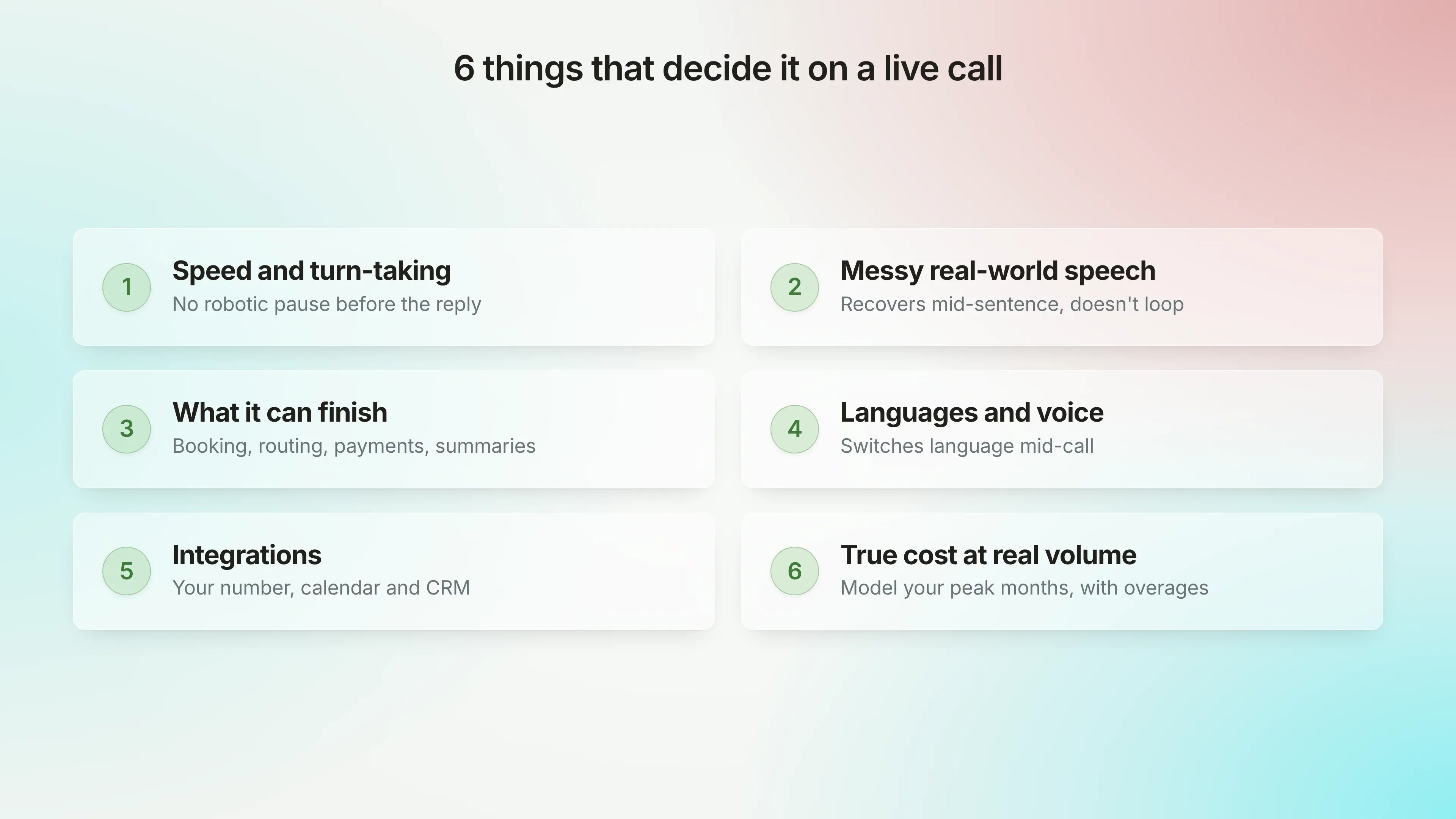
- Response latency and natural turn-taking
In conversation, people reply on average about 200 milliseconds after the other person stops talking. We pull that off even though producing the words takes 600 milliseconds or more, because we predict where a turn is heading and prepare the reply in advance. Callers expect that rhythm without thinking about it. Many voice systems, by contrast, wait 500 to 1,000 milliseconds of silence before responding.
.webp)
Judge an agent on how quickly and naturally it takes its turn, and whether it lets a caller pause mid-thought without cutting in.
- Interruptions, corrections, and messy real-world speech
Real callers do not follow a script. They talk over the agent, change their mind halfway through, trail off, and phone in from noisy cars and job sites. Handling a clean, linear request is the easy part. Off-script calls are a recognized failure point for conversational agents, where a caller asks for something the system was not built to handle, and a brittle one stalls or misfires instead of adapting.
Give it a messy call on purpose before you trust it. Interrupt, correct yourself, jump between topics.
- What it can actually accomplish
A capable agent completes the whole task on its own, booking the appointment, routing the call, taking a payment, updating the CRM, and sending a clean summary the moment the call ends. An agent that only takes a message leaves the real work for someone else. Look for one that closes the loop itself and drops the details where your team will see them, because a lost detail or a slow handoff costs you the lead no matter how well the call was answered.
- Languages and voice quality
If your callers are not all native English speakers, language coverage is not optional. More than 1 in 5 people in the US speak a language other than English at home, and Spanish accounts for about 61% of them, so English-only answering quietly turns away a real slice of callers.
Check which languages an agent truly supports and whether it can switch when a caller does mid-call. Voice quality carries similar weight: a natural voice, or one cloned to your brand or a team member, keeps a frustrated caller calm, whereas a stilted, synthetic one does the opposite.
- Integrations with your phone system and stack
An agent that cannot connect to what you already run just shifts the work somewhere else.
Two questions matter most:
- First, your phone setup: can the agent use your existing business number, or does it hand you a new one and expect you to forward calls?
- Second, your tools: does it write to the calendar, CRM, and scheduling apps your team already uses, or does someone re-key everything afterward? The closer it sits to what you run, the less cleanup it creates.
- True cost at your real call volume
The tools in this guide do not bill the same way, and the differences run deeper than the headline numbers. One charges by the minute. Another by the call, another by a unique caller. Some run on a flat monthly plan, and a few add AI onto a per-user phone bill. Until you run those models against your own monthly call volume, the plan prices are not really comparable.
Estimate your all-in monthly bill with overages and peak weeks included, and leave room for the calls that still reach a person.
How to test it before you trust it with real callers
A vendor demo only proves the agent can handle a script the vendor chose, not how it handles your callers. Before you point real customers at any agent, test it properly, and the method matters more than the brand.
Work through these five checks before you go live:
- Run it against your own past calls first. Take a set of real recordings and see how the agent would have handled them. With Phonely, if you have call recordings, you can drop them straight into the platform, build an agent in minutes with no code, and see how it handles those same calls before a single live customer is involved.
- Test it against difficult calls deliberately. Interrupt it, revise your request partway through, call from a noisy line, and switch languages mid-call if your callers do, then note whether it adapts or breaks down.
- Load-test it. Run several calls at once, a few long conversations, and quick back-to-back calls to confirm it stays stable under pressure.
- Watch the metrics that matter: how fast it responds, whether it completes the task, how often it escalates, and which calls run past your target handle time. After launch, Phonely's call history and monitoring keep full transcripts and recordings and filter straight to those problem calls.
- Pilot before full rollout. Put the agent in front of a small, representative group first, listen to the recordings, and gather the numbers and their feedback before switching it on for everyone.
Tested this way, you are not trusting a brochure or a demo. You are watching the agent handle the calls your business actually gets.
Frequently asked questions
- Is it better than a human receptionist?
It depends on the call. For routine, high-volume work, answering FAQs, booking appointments, capturing leads, and covering after hours, AI is usually the better choice: it never misses a call, handles many at once, works around the clock, and costs a fraction of a full-time receptionist.
A person is best suited for complex or sensitive conversations. Most businesses get the best results by letting AI handle the routine volume and routing the rest to a human.
- Can it transfer to a human when a call gets complex?
Yes. Almost every AI answering service can escalate to a live person when it hits something it should not handle alone.
What varies is the quality of that handoff. A warm transfer passes your team the caller's details and context so they do not start cold, a blind transfer just forwards the call. If smooth escalation matters to you, ask each vendor whether transfers are warm and what context the agent passes along.
- Is it secure and compliant for healthcare or legal calls?
It can be, but only with the right vendor. For healthcare, that means HIPAA compliance and a signed Business Associate Agreement, while for legal and financial calls, it means encryption and standards like SOC 2.
Reputable providers publish these: Phonely, for example, is SOC 2 and HIPAA compliant, and Synthflow offers HIPAA on its Enterprise plan. Whatever you choose, ask to see the BAA before any sensitive call runs through it, and treat a vendor that cannot produce one as a no.