Key takeaways
- AI-based IVR is a phone system that uses speech recognition, natural language understanding, and machine learning to handle calls through conversation instead of menu prompts. It identifies the caller's intent on the first turn and either resolves the request directly or routes it to a human with full context attached.
- Traditional IVR routes, while AI-based IVR resolves and routes. Legacy systems force callers down a fixed decision tree; AI-based IVR removes the tree entirely and lets callers describe what they need in their own words.
- Cost per call drops on two fronts. AI-based IVR resolves routine calls end-to-end at a fraction of agent cost, and it shortens handle time on the calls that still need a human.
- Industry-average first-call resolution sits around 70 percent. World-class centers hit 80 percent or higher. Better intent recognition and end-to-end resolution are the two mechanisms that move FCR up.
- The best fit is high call volume plus a high share of repeatable requests with structured data behind them. Contact centers, healthcare practices, insurance and financial services, and home services see the strongest unit economics from AI-based IVR deployments.
What is AI-based IVR?
AI-based IVR turns the menu tree into a conversation. The caller talks, the system understands what they need, and the call ends either in resolution or in a handoff the human picks up already briefed.
With legacy IVR, the caller has to map their problem onto the menu before anything happens, usually three or four layers deep, and often ends up in the wrong queue anyway.
AI-based IVR works differently. A caller can say, 'I need to reschedule my appointment for next Tuesday afternoon,' and the system parses the intent, checks availability, confirms the change, and sends a confirmation, all in one conversation.
The technology rests on four capabilities working together:
- Automatic speech recognition (ASR) converts spoken audio into text in real time, handling accents, background noise, and natural speech patterns.
- Natural language understanding (NLU) interprets meaning, identifies the caller's intent, and pulls out details like dates, account numbers, or product names.
- Dialogue management maintains context across the conversation, so callers don't have to repeat information they've already given.
- Integration with backend systems lets the IVR pull customer records, check inventory, book appointments, process payments, or trigger workflows in real time.
The numbers back it up. McKinsey estimates generative AI could reduce human-serviced contacts by up to 50 percent in industries like banking, telecommunications, and utilities, where call mix is heavy on repeatable transactional requests.
For the business, the outcome is fewer transfers, shorter calls, lower staffing needs at peak, and conversations that end in resolution instead of a callback.
AI-based IVR vs traditional IVR: What actually changed?
The two systems answer the same call but solve very different problems. Traditional IVR was built for routing efficiency in a world where labor was cheap, and customer patience was wider. AI-based IVR was built for resolution in a world where neither is true anymore.
Where traditional IVR breaks down
Legacy IVR was designed around a simple assumption: callers know what they want, know which menu option matches it, and will navigate the tree to get there. That assumption rarely holds.
In practice, four things go wrong:
- Callers can't find their problem in the menu. Menus are organized around the company's org chart, not the caller's intent. A billing dispute that's actually about a service outage ends up in the wrong queue.
- Wait times push customers off the line. The longer the menu navigation and queue time, the higher the share of callers who hang up before reaching anyone. Industry benchmarks consistently put healthy abandonment rates below 5 percent, with anything above 8 percent flagged as a problem worth fixing.
- Callers repeat themselves on transfer. Account numbers, order details, and the original reason for calling all reset when the call moves between queues. Context doesn't travel.
- Updates require re-recording. Adding a new menu option, changing business hours, or supporting a new language means new voice prompts, new IVR logic, and weeks of QA.
The cumulative effect is a system that processes calls but rarely resolves them. Customers learn to mash zero to skip the menu, which routes everyone to the same overloaded queue.
How intelligent call handling fixes it
AI-based IVR replaces the structural assumptions of legacy IVR rather than just adding features on top. Instead of a menu, the system listens. Callers describe what they need in their own words, and the IVR identifies intent on the first turn.
Instead of routing to a queue, the system carries the conversation forward, so any handoff to a human comes with the caller's identity and reason already attached. Instead of static prompts, the flows update through configuration. Adding a new use case takes hours, not weeks.
The performance gap shows up in real deployments. Deloitte Digital's 2026 survey of service leaders found that 64 percent report higher agent productivity and 39 percent report lower cost per contact as a result of AI. The same research showed a clear maturity gap: 48 percent of high-maturity service organizations are already running agentic AI, compared to 24 percent of low-maturity peers.
For an ops leader, the shift is less about replacing the phone system and more about recovering the calls a legacy IVR was quietly losing.
Side-by-side comparison
Here's how the two stack up on the dimensions that drive contact center economics:
How does AI-based IVR work?
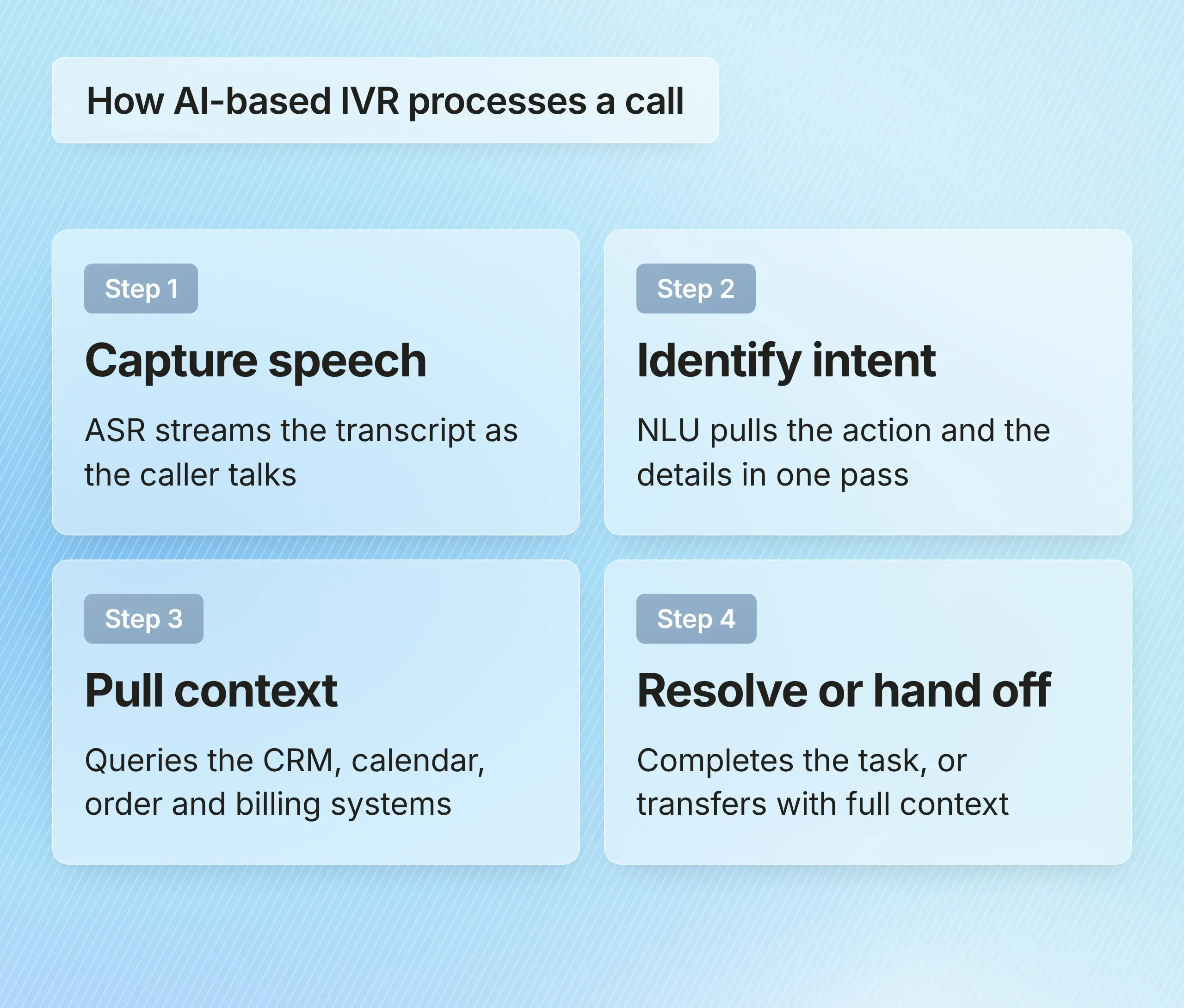
The shift from menus to conversation is built on a four-stage pipeline that runs every call.
Each stage adds milliseconds to the round trip, and the goal is to keep the total below the threshold where a caller starts to feel the lag.
Step 1: Capturing speech in real time
The first stage is automatic speech recognition. The system listens to the caller's audio, transcribes it into text as the words are being spoken, and detects when the caller has finished a turn so it knows when to respond.
Speed matters here more than people realize.
Research published in PNAS by Stivers and colleagues studied turn-taking across ten languages from five continents and found that the gap between one speaker finishing and the next beginning is consistently around 200 milliseconds, regardless of culture or language. The researchers also found that deviations from this rhythm carry communicative weight: listeners interpret longer pauses as signaling a problem with what was just said.
Across all ten languages, average turn transitions stayed within half a second.
That benchmark sets a hard ceiling for every part of the IVR pipeline. Production-grade systems stream the transcription as the caller talks, so by the time the caller stops, the text is already ready for the next stage.
Step 2: Understanding intent with NLU
Once the transcription is ready, natural language understanding takes over. The system reads the text and answers two questions: what is the caller trying to do, and what details did they give to do it with?
"Intent" is the action: reschedule appointment, check balance, report outage. "Entities" are the details: Tuesday afternoon, account ending 4-2-1-9, downtown branch. Modern NLU models handle both in a single pass, including when the caller says it in a roundabout way ("I won't be able to come in on Tuesday as we planned").
Where legacy IVR forces callers to express intent in one specific phrasing, AI-based IVR is designed for the way people actually talk. That flexibility is what makes natural conversation possible without scripting every possible utterance.
Step 3: Pulling context and deciding the next move
With intent and entities in hand, the IVR consults the systems that hold the answer. The CRM for customer records, the booking system for availability, the order management system for status, and the billing platform for account balance.
The same call that asks "where's my order" pulls the order record, the shipping status, and the estimated delivery date in one query.
This is where AI-based IVR splits from legacy. A traditional IVR's only decision is which queue to forward to.
An AI-based system can decide to resolve the request itself, route to a specific agent, schedule a callback, send an SMS confirmation, or some combination. The logic is encoded in the call flow but driven by real-time data, not a hardcoded tree.
Step 4: Resolving the call or handing off to a human
When the system can complete the task, it does. Appointment rescheduled, balance read out, return initiated. The caller hears a natural confirmation, and the call ends.
When the task needs a human, the handoff is what makes or breaks the experience.
AI-based IVR transfers the agent the full conversation summary, the caller's identity, and the reason for calling, before the agent picks up. The agent starts the call with context instead of with "Can you tell me what this is about?"
That context carry-forward is what makes hybrid AI-human models work. NBER research by Brynjolfsson, Li, and Raymond, studying 5,179 customer support agents, found that agents working with generative AI assistance resolved 14 percent more issues per hour, with the biggest gains, 34 percent, going to less experienced agents.
The same pattern shows up in voice: when an AI-based IVR hands an agent a full transcript and context summary, the agent has what they need to resolve faster.
What are the benefits of AI-based IVR?
The architectural shift from menu trees to conversation produces four operational gains that show up consistently across deployments: hold times collapse, cost-per-call drops, more issues resolved on the first try, and language coverage expands without proportional cost.
Each one has measurable upside, and together they shift the unit economics of a contact center.
- Near-zero hold times and unlimited concurrency
A traditional contact center scales by adding agents. When call volume spikes, hold times grow until enough agents come free.
AI-based IVR removes that bottleneck entirely. What limits concurrent calls is no longer how many people are on shift but how much telephony and API capacity is available, so a hundred callers and ten thousand callers get answered at the same time.
The practical effect is that hold time, a primary driver of abandonment, stops being a function of staffing. Routine requests get picked up instantly, even at peak. Complex requests still escalate to humans, but they reach the queue with full context attached, so the human agent starts faster too.
- Lower operational costs
The cost case for AI-based IVR rests on a simple number. According to ContactBabel, the average cost of an inbound call in the US is $7.20. Agent labor is the largest line in that figure.
When an AI-based IVR resolves a routine request end-to-end, the cost of that call falls to a fraction of that.
When the system handles intake and context-gathering before handing off, the agent spends less time per call, which drops cost per call even on the calls that still need a human. Both effects compound, and they hit the largest line in the contact center budget.
- Higher first-call resolution
First-call resolution (FCR) is one of the strongest predictors of customer satisfaction.
SQM Group's 25-year benchmarking puts the typical band between 70 and 79 percent, with the cutoff for world-class performance sitting at 80. The same research documents that every 1 percent improvement in FCR drives a 1 percent improvement in customer satisfaction.
AI-based IVR raises FCR through two mechanisms. First, accurate intent recognition routes the call to the right resource on the first attempt, eliminating the transfer chain that drives most second calls. Second, when the system resolves the request itself, there is no second call to make.
Both effects show up in the same place: fewer callbacks, higher satisfaction, lower cost.
- 24/7 multilingual coverage
Around-the-clock coverage used to require staggered shifts across time zones, with multilingual support layered in through bilingual hiring or interpreter services. Both are expensive and hard to scale.
AI-based IVR removes the scheduling and hiring constraints. The system is always on, and it speaks the caller's language.
For businesses serving global customers, this matters in two places. First, in coverage: a single deployment handles every time zone without rotating shifts. Second, in trust: callers who reach support in their own language are more likely to complete the transaction and return for the next one. Both used to require headcount investment that scaled linearly with reach. Neither does it anymore.
Where AI-based IVR delivers the most value
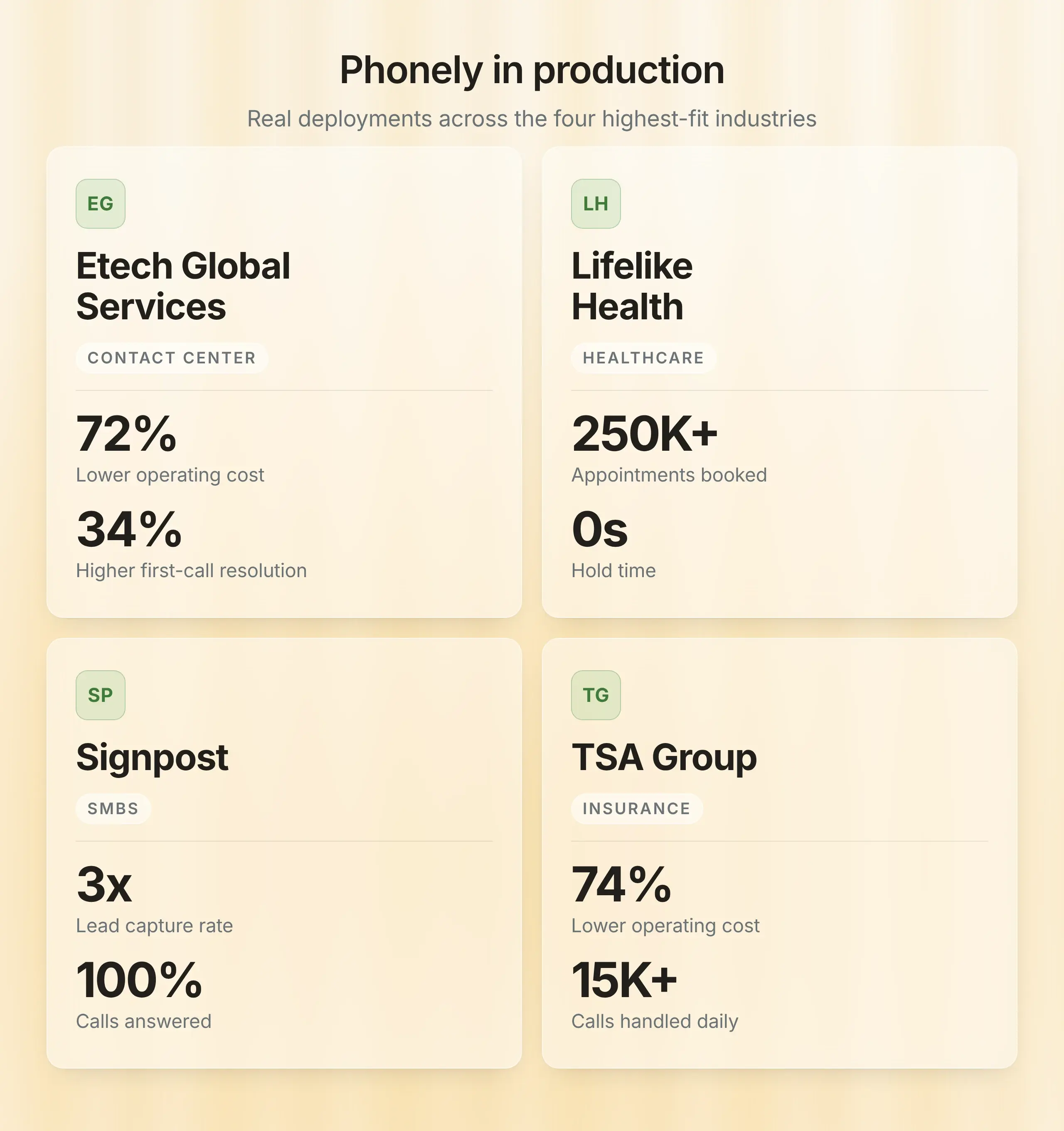
The clearest fit shows up where two conditions overlap: heavy inbound volume, and a call mix made up mostly of repeatable requests that map to data the system can already see. Where most calls follow predictable patterns and the answer lives in a system the AI can query, the unit economics work hardest.
Four industries fit this profile especially well:
The common thread across these industries is what makes the economics work: the highest-volume calls are also the most repeatable, and the repeatable calls are exactly the ones AI handles best. That leaves human agents free to spend their time on the calls that genuinely need them, which is also where their judgment is most valuable.
How to build your AI-based IVR with Phonely in 4 steps
Phonely's platform takes a business from no AI agent to a live one in four steps.
According to Phonely's own data, roughly 70 percent of businesses get started in under five minutes.
What follows is the build path: what you do, and what Phonely provides at each stage.
Step 1: Pick a voice or clone your own
The first decision is how the agent will sound.
Phonely's library includes 1,000+ natural voices spanning accents and languages, and any of them can serve as the starting point.
If none of the prebuilt voices fit, you can clone your own directly from the platform. That option matters for brands that want their AI agent to sound continuous with their existing recorded messaging or with a specific human voice their customers already recognize.
The voice you pick sets the conversational tone for every subsequent step.
Step 2: Train your agent on your business
A voice without context isn't an agent. Step 2 is where the agent learns what your business does, who your customers are, and what they typically call about.
Phonely supports two ways to do this: upload a knowledge base, or point Phonely at your website and let it learn from there. The platform also supports 100+ languages and tailors to regional accents, so an agent trained on English-speaking customers in the US can be extended to other markets without rebuilding from scratch.
This is also where the call flow gets shaped. Phonely's visual builder lets you design conversation flows, qualification questions, booking steps, and escalation paths without writing code.
Step 3: Connect your CRM and tools
An AI-based IVR earns its keep when it can actually do things, not just answer questions.
Step 3 is the integration step.
Phonely connects to CRMs, appointment scheduling software, and other backend systems so the agent can pull customer records, check availability, update accounts, and trigger workflows in real time. For software that doesn't expose a clean API, Phonely's prebuilt browser-based automations bridge the gap.
Once integrated, the agent can complete the call rather than just route it.
Step 4: Launch and improve from real calls
The agent goes live, and the learning loop starts.
Each call leaves behind a transcript, a short AI summary, and a sentiment read, all available in the dashboard or exportable to wherever your team already tracks operations.
That feedback is what makes the post-launch phase productive. Real calls expose intent gaps that the test cases didn't, and they show where the agent is succeeding and where it's escalating. Phonely's platform supports ongoing optimization so the flows evolve based on what the data actually shows.
For complex deployments, Phonely's team works alongside enterprise customers to configure, deploy, and tune the agent at scale.
Frequently asked questions
- How long does an AI-based IVR take to set up?
For most businesses, it takes under five minutes to get a working agent live. According to Phonely, roughly 70 percent of businesses reach that point quickly, starting from a voice selection, a knowledge base upload, and a basic call flow.
Enterprise deployments with deeper integrations and custom workflows take longer and typically involve a dedicated rollout team. The setup itself is fast. The customization for scale is where time goes.
- How do you measure AI-based IVR success?
Four metrics matter most: call containment, first-call resolution, average handle time, and customer satisfaction.
Containment is the share of calls fully resolved by the AI without escalation. First-call resolution (FCR) is the share resolved on the first contact, whether by AI or by an agent the AI routed to. For FCR specifically, SQM's benchmarking puts most contact centers in the 70 to 79 percent range, with 80 percent treated as the world-class threshold.
Average handle time (AHT) measures the duration of resolved calls. Shorter is better, but only when paired with strong FCR. CSAT, measured through post-call surveys, captures whether the caller actually felt their issue was handled well.
For an honest read on a deployment, all four metrics need to move in the right direction together. AHT dropping while CSAT also drops usually means the system is closing calls fast without resolving them.
- Is AI-based IVR secure and compliant?
Yes, when the platform is built for it. The compliance standards that apply most often are SOC 2 (security and confidentiality controls), HIPAA (protected health information), PCI DSS (payment card data), and CCPA (California consumer privacy).
Phonely supports all four. For regulated industries like healthcare, insurance, and financial services, compliance isn't optional. It's the precondition for the deployment to exist at all.