

Key takeaways
- The main benefits of voice AI in customer service are 24/7 availability with zero hold times, 75-80% lower cost per call compared to human agents, natural multilingual conversations at scale, and real-time task execution like booking appointments, updating CRM records, and retrieving tracking information. The top use cases span contact centers, healthcare, insurance, real estate, legal, home services, and small businesses.
- Gartner predicts agentic AI will autonomously resolve 80% of common customer service issues by 2029, and 91% of customer service leaders are now under executive pressure to implement AI (Gartner, 2026).
- Voice AI replaces rigid IVR menus with intelligent, context-aware conversations that resolve issues on the first call. Phonely customers like Etech have reported a 34% increase in first-call resolution after deployment.
- The best voice AI platforms combine sub-1s latency, deep software integrations, enterprise-grade compliance (SOC 2, HIPAA, GDPR), and no-code setup so your team can go live in minutes, not months.
Gartner predicts agentic AI will autonomously resolve 80% of common customer service issues by 2029, and 91% of customer service leaders now report executive pressure to implement AI. The economics have shifted, and customer service teams are moving fast to capture the savings.
Voice AI closes the gap between what customers expect and what human-agent operations can deliver. Instead of forcing callers through rigid phone menus or making them wait in a queue, it lets them speak naturally and get real answers in real time. Repetitive call volume drops, resolution times shrink, and operations scale without proportional hiring.
This guide covers what voice AI is, why it matters for customer service, where businesses are seeing the biggest returns, and how to evaluate whether it fits your operation.
What is voice AI for customer service?
Voice AI is software that listens to a caller, understands what they need, and responds with natural-sounding speech. Behind the scenes, it combines speech recognition, natural language processing (NLP), and integrations with your existing tools to perform actions like checking order statuses, booking appointments, updating CRM records, or routing calls to the right department without human intervention.
It operates on the phone channel, the one customers still reach for when something is urgent or complex. Legacy IVR menus force callers down preset paths, but a well-built voice AI agent handles open-ended questions, tracks context mid-conversation, and escalates to a human with the full call history attached. Across the 100,000+ calls Phonely handles every day, fewer than 10% of callers realize they're speaking with AI.
Callers get faster resolution, agents handle fewer repetitive inquiries, and operations scale without proportional hiring.
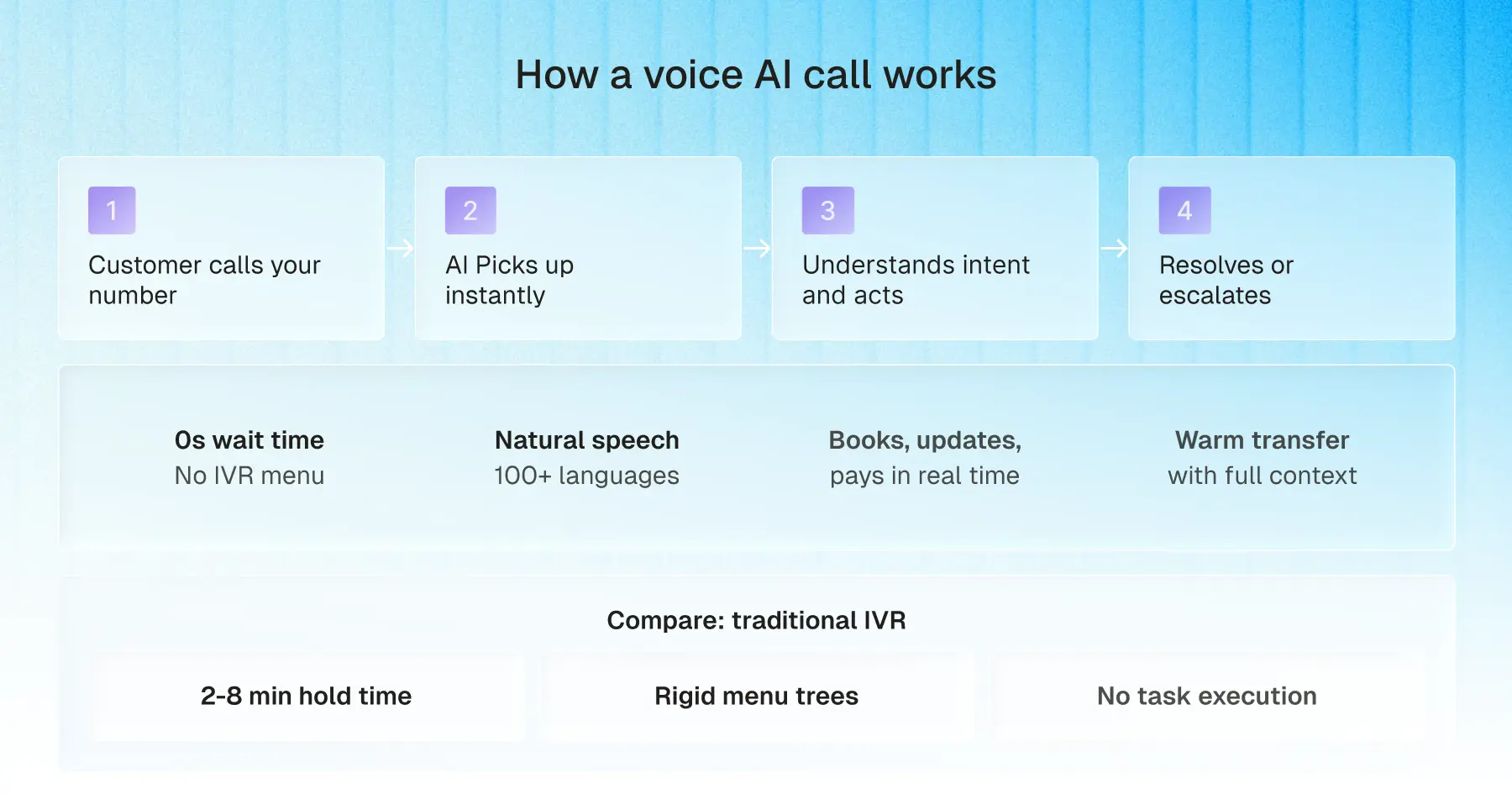
Why voice AI is replacing traditional IVR
Traditional IVR systems were designed to route calls, not resolve them. They rely on rigid menu trees and keyword matching. The moment a caller says something unexpected, the system breaks.
Voice AI flips that dynamic. Instead of forcing callers to adapt to the system, the system adapts to the caller.
Side by side:
IVR tells callers what they can do. Voice AI lets callers ask for what they need. That distinction is why Gartner projects conversational AI will eliminate $80 billion in contact center labor costs by 2026.
Benefits of voice AI for customer service
The benefits split into two categories: what your customers experience and what your business gains operationally.
Improved customer experience
Zero hold times, any hour of the day. Voice AI picks up on the first ring. No queue, no elevator music, no "your call is important to us" loop. Inbound calls are handled identically at any hour. 74% of consumers now expect 24/7 availability, which makes after-hours coverage a baseline requirement.
Conversations that feel natural. Modern voice AI pauses naturally, adapts to interruptions, and adjusts tone based on the caller's intent. Zendesk's 2026 report found that 83% of CX leaders believe voice AI can now significantly evolve the customer experience.
Personalized, context-aware responses. Connect voice AI to your CRM and it greets returning callers by name, references their last interaction, and skips straight to the relevant issue. That kind of continuity used to require a seasoned agent with great notes. Now it happens automatically on every call.
Support in any language. Voice AI supports 100+ languages and can detect and switch languages mid-conversation. No need to staff a specialized multilingual team to cover your global customer base.
Efficient business operations
Lower cost per call. A human-handled customer service call costs between $7 and $12. A voice AI interaction typically costs between $1 and $3, depending on call length and complexity. That's a 75-80% reduction per automated call. A Forrester Consulting study found that companies using voice AI reported a 3-year ROI between 331% and 391%.
Real-time integrations that close the loop. Voice AI connects to your scheduling tools, CRM, payment systems, and ticketing software to complete tasks during the call. Book an appointment, process a payment, update a record. No human touches the system. For a deeper look at how integrations work in practice, Phonely connects to Salesforce, HubSpot, Google Calendar, Calendly, Zapier, and dozens more.
Analytics you can act on. Every call generates structured data: transcripts, sentiment analysis, call duration, resolution status. Over thousands of calls, that data reveals which questions come up most, where callers get frustrated, and what drives escalations. These insights feed directly into better agent design and tighter workflows.
Effortless scaling during surges. Seasonal spikes, product launches, outage events. Voice AI handles 10 calls or 10,000 with the same speed and quality. No temp staffing. No degraded service when the phones light up.
Voice AI use cases across industries
Any company that relies on phone-based customer interactions can deploy voice AI. But certain industries are seeing outsized returns because of the volume and repetitiveness of their call traffic.
Contact centers and BPOs
91% of customer service leaders now report executive pressure to implement AI, up from 77% the year before (Gartner). The question is no longer "should we?" but "how fast can we deploy?"
Voice AI handles the calls that consume agent time: account lookups, balance checks, status updates, password resets. Offloading 50-70% of routine inbound volume frees your human agents for complex escalations. Phonely customers in this space have reported 50% reductions in operational costs while improving satisfaction scores.
.webp)
Phonely's blog on reducing call center frustration with AI goes deeper into the operational mechanics.
Healthcare and patient communication
Patients call to schedule appointments, confirm procedures, ask about test results, and request prescription refills. Most of these interactions follow predictable patterns, making them strong candidates for voice AI.
The added advantage in healthcare is consistency. A voice AI agent delivers the same compliant, accurate response every time. Phonely is fully HIPAA certified, meeting the data protection standards required to handle protected health information over the phone.
Insurance and claims processing
Policyholders call to check claim status, ask about coverage, update personal details, and file first notice of loss (FNOL). These calls are frequent, formulaic, and time-sensitive.
Voice AI authenticates the caller, pulls up their policy, and walks them through the claims process in a single interaction. Phonely published a detailed breakdown of AI in insurance claims processing covering real-world outcomes. Phonely customers in insurance have seen cost reductions of 74% alongside unlimited call concurrency.
Real estate, legal, and home services
These industries share a common problem: a missed call is a lost lead. When a potential client calls a law firm for intake, a real estate office about a listing, or a plumber for an emergency, and nobody picks up, that opportunity is gone.
Voice AI answers on the first ring, qualifies the caller, gathers intake information, and books the appointment. Your team captures leads at 9 PM on a Saturday instead of losing them to a competitor. It is like having an enterprise-grade front desk without the enterprise-grade payroll.
Small and mid-size businesses
SMBs cannot afford to miss calls, but they also cannot afford to staff a full-time receptionist. Voice AI gives you the same call coverage as a large support team at a fraction of the cost.
Small businesses using Phonely capture every inbound lead, even after hours, with AI agents that book appointments, answer common questions, and route urgent calls. Most businesses get up and running in under five minutes with no coding required.
What to look for in a voice AI platform
Not every voice AI platform performs the same in production. Here are the criteria that matter:
Start with your use case, then evaluate accordingly. A healthcare practice needs HIPAA compliance and appointment scheduling. A contact center needs unlimited concurrency and deep CRM integration. A law firm needs intelligent intake and attorney routing.
How Phonely powers voice AI for customer service
Phonely is a purpose-built voice AI platform for businesses that depend on phone calls. Not a chatbot bolted onto a phone line. Real conversations, real scale.
~Sub-1s latency. Phonely's AI agents respond fast enough that conversations feel natural. The platform runs custom open-source models on accelerated compute infrastructure (through partnerships with Groq and Maitai) to deliver inference speeds that closed-source models cannot match in production.
Connected to your stack. Phonely integrates with Salesforce, HubSpot, Pipedrive, Google Calendar, Calendly, Zapier, Slack, Gmail, and more. During a live call, the AI agent books appointments, updates CRM records, processes payments, sends SMS follow-ups, and escalates to a human without breaking the conversation.
Trained on your data. Upload your knowledge base, connect your website, or feed in existing call recordings. Phonely trains your AI agent to speak with your brand's voice and answer with your business's specific knowledge.
1M+ concurrent calls. Phonely handles over a million calls per month for 10,000+ businesses with the same low latency and accuracy whether you are handling 10 calls a day or 10,000.
Enterprise-grade security. SOC 2, HIPAA, GDPR, and PCI DSS compliant. Data is never used to train models. On-premise deployment available for full infrastructure control. The Enterprise plan includes dedicated infrastructure, white-glove onboarding, and custom AI development.
100+ languages and voice cloning. Choose from over 100 natural-sounding voices and accents, or clone your own from a 30-second sample. The AI detects and switches languages mid-conversation automatically.
Your first 100 minutes are free. Set up your first AI agent in under five minutes with Phonely's no-code dashboard. Start for free or explore pricing.
Getting started with voice AI
Rolling out voice AI does not require a six-month IT project. Here is a practical roadmap:
- Identify your highest-volume, most repetitive call types. Appointment scheduling, order status, FAQ responses, payment processing, basic account inquiries. These are where voice AI delivers the fastest ROI.
- Pick a platform that fits your workflow. Evaluate on latency, integrations, compliance, and setup speed. Run a pilot with real call traffic, not a demo script.
- Connect your tools. Plug voice AI into your CRM, scheduling system, and other software. The value multiplies when the AI can take action during a call, not just talk.
- Measure what matters. Track first-call resolution, average handle time, cost per interaction, and customer satisfaction. Compare against your baseline.
- Expand and optimize. Start with one call flow, nail it, then add more. Use analytics from every interaction to refine responses and workflows. Phonely's guide on conversational AI for customer support covers the design principles in detail.



.jpg)
.jpg)
.svg)