

Key takeaways
- AI contact centers win on cost savings, scalability, and 24/7 availability, while a hybrid AI + human model delivers the strongest customer experience for most businesses.
- Traditional contact centers run on labor-heavy infrastructure with 30–45% annual agent turnover, fueling burnout and inflating operational costs.
- AI voice agents use LLMs, NLP, and speech recognition to handle inquiries with near-zero hold time, instant scalability, and 24/7 coverage.
- Gartner predicts agentic AI will resolve 80% of common customer service issues without human intervention by 2029.
- AI call handling cuts operational costs 30%+, top deployments hit 70%+, while boosting ROI and personalized customer experiences.
- Platforms like Phonely.ai deploy in minutes and integrate directly with CRMs, schedulers, and telephony.
Most comparisons between contact center AI and traditional call handling assume that both solve the same problem. They don't, as both are built for very different jobs.
What is a traditional call handling system?
A traditional call center is the familiar combination of people and hardware that many businesses still rely on: agents handling calls through headsets, an automated phone menu directing inquiries, and a CRM system running in the background. This model was effective when phone support was the primary customer service channel and response times were less critical. Today, however, customer expectations and communication preferences have evolved, rendering those assumptions obsolete.
Core components of legacy call centers (PBX, IVR, ACD)
Three pieces define the legacy stack:
- A Private Branch Exchange (PBX) routes voice calls.
- An Interactive Voice Response (IVR) menu greets callers.
- An Automatic Call Distributor (ACD) drops the call into a queue. Reliable, but linear, hardware-bound, and impossible to scale on demand.
The cost structure of a traditional call center
The cost structure of traditional call centers relies heavily on agent salaries, training, overtime, and high turnover expenses. This makes labor the single biggest line item. Add to that: legacy phone systems, physical infrastructure, and maintenance costs, and operational spending climbs quickly with no easy way to scale. This is exactly why more businesses are shifting to AI-powered contact center solutions.
Why legacy call centers are falling behind AI-powered contact centers
The gap between AI-powered contact centers and legacy systems is widening fast. McKinsey's State of Customer Care survey shows 67% of leading organizations are already investing in foundational AI at scale, treating contact centers as growth engines rather than cost centers. Businesses stuck on traditional infrastructure lose efficiency and miss the shift in how customer care now drives revenue, loyalty, and competitive advantage.
Key limitations of traditional call handling
The pattern of failure is consistent when it comes to traditional call handling:
1. Long hold times during peak call volumes
2. Inflexible scripts that frustrate customers
3. High agent turnover and burnout that erode service quality
4. Limited visibility into what happens on calls
5. Slow scaling when demand spikes
The Stanford and MIT study published through NBER found that newer agents struggle to match senior staff performance, which is why service quality stays uneven in human call centers and why agent burnout accelerates when the same overworked staff absorbs every difficult call.
What is contact center AI?
Contact center AI uses large language models, speech recognition, and intelligent automation to handle phone, chat, and SMS conversations end-to-end. Instead of dropping every caller into a queue, AI voice agents pick up immediately, understand intent, pull customer data, complete the task, and escalate to a human only when needed.
How AI voice agents work (NLP, LLMs, and speech recognition)
A modern AI voice agent listens, transcribes speech in real time, runs the input through an LLM to figure out what the caller wants, looks up records via API, and responds in a natural human voice. The full loop closes in under a second on platforms built for low-latency voice AI. That latency budget separates a real conversation from a robotic one.
Key capabilities of modern AI contact centers
As per the Salesforce State of Service report, 79% of service leaders believe investing in AI agents is essential, and companies using them expect to cut service costs and case resolution times by 20% on average.
Here are some of the key features of modern AI contact centers that are driving organizations to invest in AI agents:
- Natural, bidirectional voice communication across more than 100 languages, allowing for fluid, human-like conversations rather than rigid, script-based exchanges.
- Real-time integration with business systems, including CRM data retrieval, appointment scheduling, and secure payment processing within the same interaction.
- Scalable call handling capacity, enabling the system to manage a virtually unlimited number of concurrent calls without performance degradation.
- Comprehensive real-time analytics, such as sentiment analysis, full-call transcription, and automated AI-generated summaries, are available immediately after each interaction.
- Dynamic workflow orchestration, with intelligent branching logic that adapts to user input and escalates to human agents only when complexity or sensitivity requires it.
Contact center AI vs. traditional call handling: a comparison
Moving from traditional call handling to an AI contact center changes how your team handles customer interactions day-to-day. Here's how the two stack up across the things operations and CX leaders actually care about:
Manual workflows vs. intelligent automation
Legacy call centers rely on humans pushing tickets through every step. AI voice agents execute the full workflow to automate CRM updates, follow-up SMS, and payment confirmations with zero manual intervention.
Wait times, call abandonment, and first-call resolution
Microsoft-commissioned research found average call wait times now stretch 10 to 14 minutes, spiking call abandonment rates since most frustrated callers never dial back. AI voice agents answer on the first ring, killing the biggest source of customer frustration.
Scalability during peak call volumes
Traditional call centers rely on weeks-ahead forecasts and overstaffing to absorb demand surges. AI-driven systems scale on demand, expanding capacity through compute, not recruitment and training cycles.
24/7 availability and multichannel support
Salesforce's State of Service research shows 86% of agents say customers now expect faster service year over year. AI-powered agents meet that demand with consistent, high-quality support around the clock, holding daytime standards through off-hours.
Personalization and customer context
AI voice agents pull customer data on every call and tailor the conversation in real time. They know the caller's last order, open ticket, and preferred contact method before the second sentence. That’s personalization no new human agent can match without months of ramp-up.
Real-time analytics vs. retrospective reporting
Legacy QA teams sample a fraction of calls and review weeks later on stale data. AI platforms transcribe, analyze, and summarize every call in real time, and the sentiment shifts, compliance issues, and coaching moments surface the same day.
Cost comparison: AI voice agents vs. traditional call center
The cost gap between a traditional call center and an AI voice agent is hard to ignore. The table below illustrates where the money really goes on both sides.
Hidden costs of traditional call handling (turnover, absenteeism, lost calls)
Agent turnover is the line item nobody puts in the budget, but it drains millions. Metrigy's 2024 contact center research pegs annual agent turnover at 31.2%, while industry benchmarks from SQM Group place the broader range at 30–45% a year. And the replacement cost? McKinsey research pins it at $10,000 to $20,000 per departing agent once you factor in recruiting, onboarding, and the 90-day ramp to full productivity. For a 100-agent operation, that quietly balloons into $1M+ in annual turnover costs. Layer on the missed calls that pile up during understaffed shifts and ramp periods, and most operations end up paying for both inefficiencies while budgeting for neither.
Predictable pricing of AI contact center software
AI platforms charge per minute or per seat, giving finance teams a clean cost efficiency model they can forecast against. No overtime, no benefits, no last-minute hiring sprint before a holiday rush. Phonely.ai publishes its pricing openly so teams can model spend before committing.
Security, compliance, and data privacy considerations
HIPAA, GDPR, and SOC 2 in AI-powered call handling
Any platform handling customer conversations must meet the security bar of the industries it serves: SOC 2 controls, GDPR for EU customers, HIPAA for healthcare, and PCI DSS for payments. Compliance is the foundation that a regulated business cannot operate without.
How Phonely.ai protects customer conversations
Phonely.ai is SOC 2, GDPR, CCPA, HIPAA, and PCI compliant, with encryption, access controls, and a dedicated trust center for enterprise reviews. The platform is in production with Fortune 500 companies in heavily regulated industries.
Industry use cases: who benefits most from contact center AI?
AI excels at high-volume, structured tasks such as appointment booking, order tracking, FAQ resolution, lead qualification, payment processing, and call routing. McKinsey's State of AI 2025 reports 88% of organizations use AI in at least one business function, with customer service among the fastest-growing. Complex complaints, grief-related calls, sensitive financial decisions, and high-stakes negotiations still belong with humans, which is why a recent Gartner survey found 95% of customer service leaders plan to keep human agents in the loop rather than chase full automation. AI voice agents deliver high-volume, predictable workflows in the following industries.
- Healthcare: reducing no-shows and patient call volume
AI voice agents handle appointment confirmations, refill requests, and insurance questions without putting patients on hold, freeing staff to focus on in-person care.
- Insurance: renewals, claims, and policy inquiries
Renewal calls, FNOL intake, and policy lookups are predictable and high-volume. Carriers see immediate gains in containment and renewal rates.
- E-commerce and retail: 24/7 order support
Order tracking, returns, and product questions never go to sleep. AI handles seasonal spikes without panic-hiring temps.
- Real estate and home services: capturing every lead
For local service businesses, every missed call is a lost job. AI voice agents triple lead capture rates by answering 100 percent of inbound calls, including the ones at 2 a.m.
- Financial services: compliant, high-volume call handling
For banks and lenders, AI handles balance inquiries, fraud verification, and routine servicing inside regulatory guardrails. Every call is logged, transcribed, and auditable.
How to migrate from traditional call handling to contact center AI
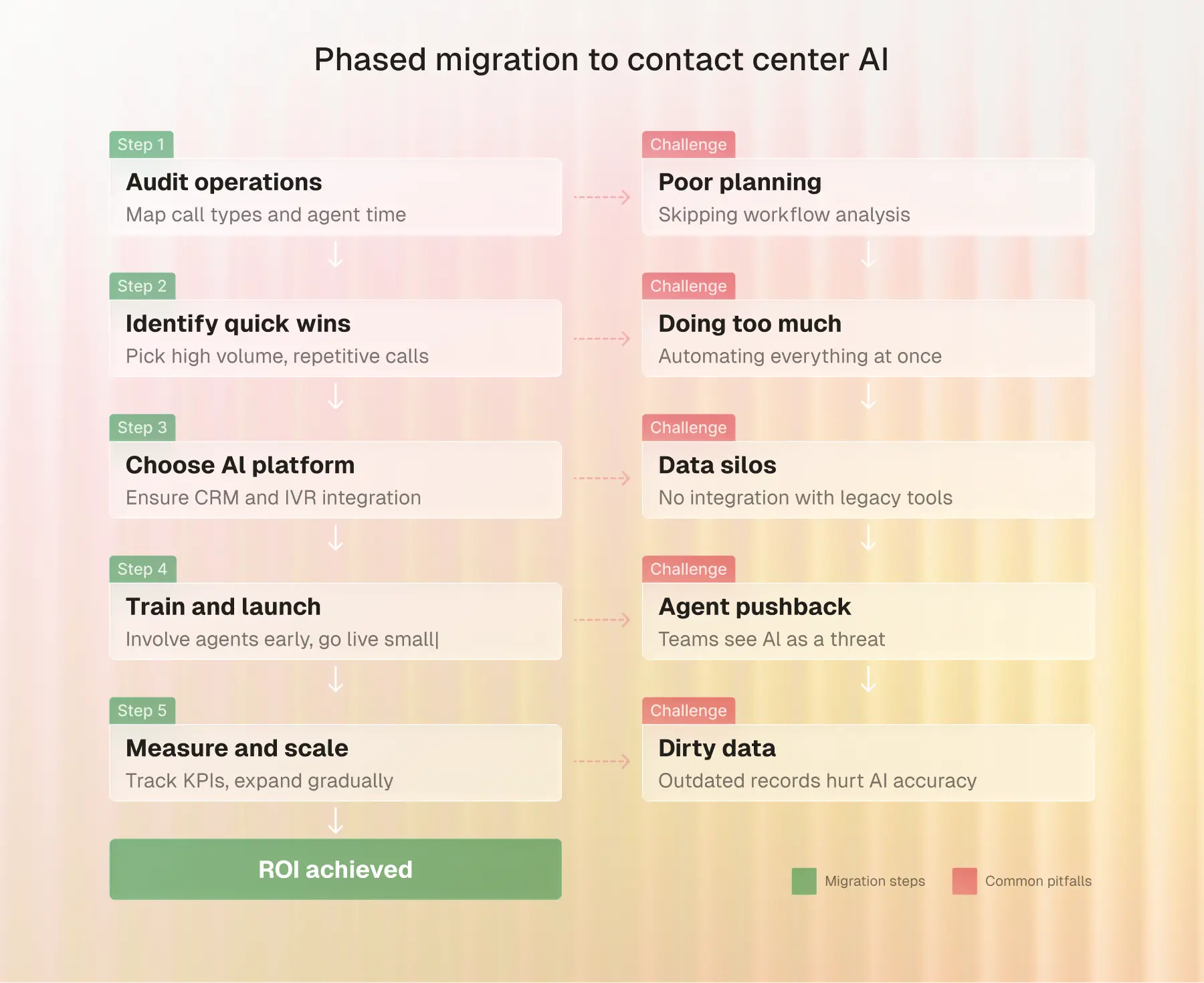
Businesses that follow this phased approach to contact center automation see faster adoption, fewer disruptions, and stronger ROI within months:
- Step 1: Audit operations: Map call types and agent time to find where volume lives. Skipping this is why rushed rollouts stall.
- Step 2: Identify quick wins: Start with high-volume, repetitive interactions like appointment scheduling, order status checks, and FAQs. IBM's research on contact center automation shows top performers prioritize human-machine collaboration: AI on routine tasks, agents on complex problems.
- Step 3: Choose the right AI phone answering solution: Pick one that integrates with your CRM, helpdesk, and IVR. Data silos quietly kill ROI.
- Step 4: Train and launch: Involve agents early and start small. Teams that feel equipped adapt; teams that feel replaced push back.
- Step 5: Measure and scale: Track KPIs against existing benchmarks, clean dirty data (it tanks AI accuracy), and expand only where numbers justify it.
Integrating AI voice agents with your existing CRM and telephony
Look for a platform with native integrations for Salesforce, HubSpot, Twilio, Zapier, calendar tools, and existing phone numbers. A good AI layer sits on top of what you have, not on a rip-and-replace.
Why Phonely.ai is the smarter alternative to traditional call handling
Human-like voice quality and natural conversations
Phonely offers 1,000+ voices, voice cloning, and natural turn-taking, which customers described as indistinguishable from a real agent. The public templates showcase live examples for receptionist, scheduling, and intake use cases. Hear the quality before committing.
Integrations and workflow automation
Plug in your CRM, scheduler, or payment system, and Phonely handles it in real time, requiring no coding or engineers for changes.
Transparent pricing and rapid deployment
The first 100 minutes are free, plans are usage-based, with no long lock-ins. For teams scaling past 1 million calls, the enterprise plan adds custom routing, dedicated support, and advanced compliance. See Phonely's roundup of the best conversational AI platforms for contact centers in 2026 to dive deeper.
Frequently asked questions (FAQs)
What's the difference between contact center AI and a traditional call center?
Traditional call centers route calls to human agents who handle every interaction manually. Contact center AI uses voice agents to handle conversations end-to-end, escalating only what needs a human with full context attached.
Will AI voice agents replace human call center agents?
No. AI handles repetitive, high-volume calls so humans can focus on complex, emotional, or high-value conversations. The best setups are hybrid AI + human models.
How much can businesses save by switching to AI call handling?
Deloitte's Future of Service report found 43% of organizations expect AI to cut contact center costs by 30%+ within three years. Phonely customers report 70–74% reductions in operational costs.
How long does it take to deploy Phonely.ai?
Most SMBs go live in under 5 minutes. Enterprise rollouts take a few days with white-glove support.
Is contact center AI secure and compliant?
Yes, on the right platform. Phonely.ai is SOC 2, HIPAA, GDPR, CCPA, and PCI compliant, with built-in encryption and access controls.
Ready to see how AI voice agents perform on your real calls? Start a free trial with Phonely or talk to sales to map an enterprise rollout.



.jpg)
.jpg)
.svg)